Christians are often pushed into a false choice when they think about the natural world. One side treats creation as raw material to be consumed. The other treats nature as most pure when man withdraws and leaves it alone. Genesis allows neither option. From the beginning, mankind is given a real task within a good world. That task helps explain why creation is called good, why Eden matters, and why both abuse and abdication fall short of the biblical vision.
CREATION WAS MADE GOOD FOR A PURPOSE
Genesis says Yahweh made the world good, and finally very good. The Hebrew word tov does not mean creation was a static endpoint with no further vocation built into it. It means creation was exactly what Yahweh intended it to be – ordered, fitting, fruitful, and worthy of His approval. The world was not made defective, but neither was it presented as the end of the story. It was intentionally made good as the proper setting for mankind’s mission as God’s imagers.
That point matters because many readers smuggle the word perfect into Genesis in a way the text itself does not emphasize. The creation account does not present mankind as dropped into a world with nothing left to do. Instead, as soon as humanity is created in God’s image, mankind is given a commission to be fruitful, multiply, fill the earth, subdue it, and exercise dominion. In other words, creation is called good not because it has reached its final developed form, but because it is exactly the kind of world Yahweh made for His imagers to inhabit and steward under His rule.
EDEN SHOWS THE PATTERN
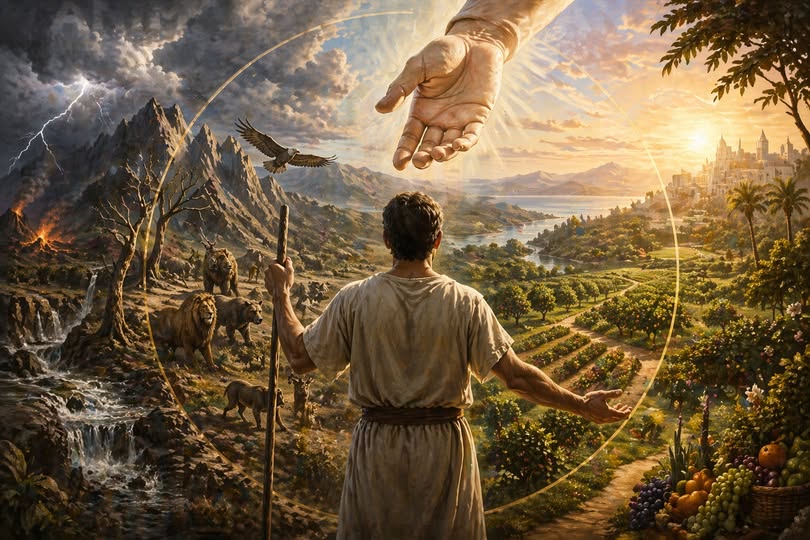
The Garden of Eden sharpens that point. Yahweh creates the wider world and then plants a garden, placing man within it. Eden is not a rejection of nature, but nature specially ordered for sacred purpose. Adam is told to work it and guard it. Even before sin enters the story, man’s life includes labor, responsibility, and care.
This is why Eden should be understood as a model. Humanity begins in a place where creation is brought into concentrated order under Yahweh’s presence, and from there mankind is told to fill the earth. The implication is clear. The order of Eden was meant to move outward through faithful human rule. The mission was never to sit forever in one enclosed holy place, but to extend ordered, fruitful, God-honoring life into the wider world.
NAMING IS PART OF STEWARDSHIP
Genesis 2 adds an important detail. Yahweh brings the animals to Adam to see what he will call them. In the biblical world, naming is not a trivial act. It is bound up with discernment, classification, and delegated rule. Adam is not just looking at animals. He is exercising a form of cognitive dominion.
That matters because stewardship is not merely physical labor. It is also intellectual labor. Man studies the world so he can understand it, describe it, and act wisely within it. In that sense, science at its best fits the creation mandate. To identify patterns, distinguish kinds, and understand the laws of creation is part of mankind’s calling as Yahweh’s imager. We do not study the world because it is meaningless matter. We study it because it belongs to God and has been entrusted to us.
DOMINION IS STEWARDSHIP, NOT DESTRUCTION
This guards us from one major error. Dominion is not despoiling. To subdue the earth does not mean to abuse it. The same man who is told to exercise dominion is also told to work and guard the garden. Human rule in creation is supposed to reflect Yahweh’s own character. It should be wise, measured, life-giving, and accountable.
A faithful imager does not treat the world as disposable. He does not poison, waste, or destroy simply because he has the power to do so. That is not dominion. It is rebellion. Christians should therefore reject the idea that biblical dominion can be used to excuse reckless exploitation. Creation belongs to Yahweh, and man handles it as a steward, not as an owner without limits.
THE FALL MADE THE TASK HARDER
Genesis 3 explains why stewardship is now so difficult. After the fall, the ground is cursed and begins to yield thorns and thistles. The task remains, but it becomes uphill. Creation is still good, yet it is now burdened by man’s rebellion. Romans 8 says creation groans. That helps explain why human rule so often turns harsh, frustrated, and distorted. Sinful man responds to a resistant world not with faithful stewardship, but often with domination, greed, and short-sighted overreaction.
That does not excuse exploitation, but it does explain why stewardship now requires sacrifice, patience, and restraint. Caring for the world after Eden is not effortless. It is labor in a fallen world. The answer to that difficulty is not to abandon the mission, but to carry it out humbly under God’s authority.
STEWARDSHIP ALSO REQUIRES LIMITS
The Bible also makes clear that dominion is not endless extraction. The creation pattern ends with Sabbath, and Israel’s law later includes Sabbath for the land. The land was to rest every seventh year. That principle matters because it shows that biblical stewardship includes limits, rhythms, and restraint. Yahweh did not give man the world to consume without pause. He taught His people that rest is part of order too.
This protects us from treating productivity as the highest good. Faithful rule knows when to cultivate and when to refrain. It knows that creation is not merely a machine for output. The Sabbath principle reminds us that dominion under God includes trust, patience, and reverence.
THE WILD STILL BELONGS TO GOD
At the same time, not everything in creation exists for immediate human use. In Job, Yahweh points to wild creatures and untamed places that display His wisdom and delight apart from man’s convenience. That is an important balance. Man has a unique mission in creation, but he is not the measure of all value. Some things matter simply because Yahweh made them and delights in them.
That should produce humility. Christians do not care only about what is profitable, useful, or easily controlled. The wild has value because it belongs to God. Stewardship includes protecting what we may never fully use, simply because the Creator loves what He has made.
BABEL SHOWS THE DANGER OF FALSE ORDER
None of this means every human effort to shape the world is good. Babel proves the opposite. Human beings can build and order in rebellion against Yahweh just as surely as they can cultivate in obedience to Him. That means the real issue is not whether man shapes the world, but whether he does so faithfully. Human intelligence is not enough by itself. Human power is not enough by itself. The question is whether man acts as an imager or as a rival.
This is why Genesis gives us both Eden and Babel. Eden shows ordered creation under Yahweh’s rule. Babel shows man creating a false order against Yahweh. The lesson is clear. The problem is not that man orders the world. The problem is when man orders it in pride, autonomy, and contempt for the Creator.
CONCLUSION
Genesis gives us a richer vision than the modern choice between exploitation and retreat. Creation is good because Yahweh made it. Mankind is placed within that good creation as His imager, called to study, name, work, guard, cultivate, and extend ordered fruitfulness under divine authority. The fall made that task harder, Sabbath teaches its limits, and even the wild reminds us that the world belongs first to God. The calling of man is neither to despoil the world nor to abandon it, but to steward it in loyalty to the Creator. That is not a rejection of nature. It is the mission Yahweh gave from the beginning.
DISCUSSION QUESTIONS
- Genesis calls creation good, not something to be escaped or abandoned. How does that challenge both the idea of exploiting nature and the idea of leaving it completely untouched?
- Eden is presented as an ordered garden that mankind is meant to work and guard. In what ways does that shape how we should think about our role in the world today?
- Adam naming the animals shows that stewardship includes intellectual work, not just physical labor. How does that change the way we view science, study, and understanding creation?
- The fall introduced “thorns and thistles,” making stewardship more difficult. How have you seen frustration or difficulty lead people toward either exploitation or withdrawal instead of faithful stewardship?
- The Sabbath principle shows that even the land was meant to rest. What might it look like to practice restraint and limits in how we use and manage resources in our own lives?
WANT TO KNOW MORE
- The Lost World of Genesis One – John H. Walton
Walton argues that Genesis 1 is about God ordering creation for function and purpose rather than describing material origins in modern scientific terms. This helps clarify what “good” means in the text and supports the idea that creation is structured with intention and vocation built into it. - The Lost World of Adam and Eve – John H. Walton
This companion volume explores the role of humanity in Genesis, emphasizing Adam and Eve’s function as God’s representatives. It provides helpful context for understanding the dominion mandate and humanity’s role as imagers within sacred space. - A New Testament Biblical Theology – G. K. Beale
Beale traces the theme of the temple from Eden to the New Jerusalem, showing how the garden functions as the first sacred space meant to expand across the earth. This directly supports the idea that Eden is a model to be extended, not a static retreat. - Dominion and Dynasty: A Biblical Theology of the Hebrew Bible – Stephen G. Dempster
Dempster highlights the kingdom theme of Scripture, including mankind’s role as vice-regents under God. His work helps frame dominion not as exploitation, but as ordered rule under divine authority. - Creation Regained: Biblical Basics for a Reformational Worldview – Albert M. Wolters
Wolters presents a clear framework of creation, fall, and redemption, emphasizing that the cultural mandate remains in effect even after the fall. This is especially helpful for understanding how stewardship continues in a fallen world without abandoning the original mission.
About the Author