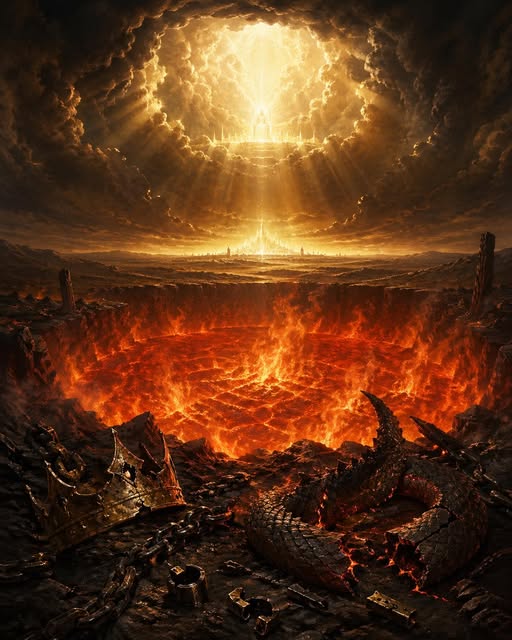
When Christians hear the phrase Lake of Fire, many immediately treat it as a simple synonym for hell. Revelation is doing more than that. The image certainly includes final judgment, but it is not presented as a bare label for where wicked people go. In Revelation, the Lake of Fire is the final end of the whole rebel order. The beast is thrown there. The false prophet is thrown there. Satan is thrown there. Death and Hades are thrown there. Then those not found in the book of life are thrown there as well. That means the image is larger than a reduced popular idea of postmortem punishment. The Lake of Fire is Revelation’s picture of the final removal of everything that stands against the reign of God.
This is why Revelation identifies it as the second death. The first death belongs to the present fallen order, where mankind dies and the grave still claims the body. The second death comes after resurrection and judgment. It is not merely another stage in the same process. It is final. It is irreversible. Revelation 21:8 makes that connection explicit when it says that the lake burning with fire and sulfur is the second death. The Lake of Fire therefore belongs to the climax of redemptive history. It is part of the last victory scene of Scripture, where evil is not merely restrained but finally dealt with.
It may also help to think of the Lake of Fire as the final outside, the cosmic Gehenna, the divine landfill of the old creation. In the ancient world, what was unclean, defiled, ruined, or irredeemable was taken outside. It was removed from the ordered life of the city so the holy center could remain undefiled. Revelation takes that logic to its ultimate scale. The Lake of Fire is where the refuse of the rebel order is sent so the New Jerusalem remains holy. This is not less than punishment, but it is more than punishment. It is cosmic sanitation. It is the final removal of the leprosy of sin, death, and rebellion from the fabric of creation.
The Valley of Hinnom helps deepen that image. It was associated with child sacrifice and later became the kind of place that symbolized uncleanness, burning refuse, and final disgrace. Jesus drew on that same imagery when He warned of Gehenna. Revelation universalizes it. What Gehenna represented outside Jerusalem, the Lake of Fire represents at the end of history: the final cosmic refuse heap so the holy city remains undefiled.
Why the ANE Background Matters
The Lake of Fire did not begin with John, and John did not invent it. He was recording revealed truth in imagery already rooted in the Old Testament and in the wider symbolic world in which God had long been revealing Himself. The Ancient Near Eastern background matters because it helps us see how ancient readers would have recognized themes like divine fire, royal judgment, cursed ruin, the defeat of chaos, and the overthrow of underworld powers. But that background is only context. It is not the source of the doctrine. The source is God’s revelation.
That point must remain clear. Revelation is not creatively blending pagan myths into Christian theology. It is unveiling the true end toward which the biblical story had always been moving. The surrounding nations preserved distorted stories and rival claims about the gods, the sea, chaos, death, and divine judgment, but Scripture repeatedly answers those claims by locating all true sovereignty in Yahweh alone. John is not making something up from the religious atmosphere around him. He is being shown the final form of truths that had already been revealed in seed form throughout the rest of Scripture.
One helpful way to frame this is prophetic reclamation. The ancient world preserved distorted echoes of real judgment. Pagan cultures carried broken memories, rival symbols, and false accounts of cosmic conflict and divine sentencing. John is not borrowing those things as though paganism held the key. God is reclaiming the vocabulary and showing John the reality that the nations only dimly and wrongly echoed. The nations had the sketch. John is shown the reality.
Even the specific image of a lake of fire seems to have echoes in the ancient world. Egyptian funerary texts speak of a fiery lake in the underworld associated with judgment and destruction. Revelation does not adopt Egyptian mythology as authority. It places even that familiar image under Yahweh’s throne and turns it into something final and absolute. What the nations dimly and falsely echoed, God reveals in truth.
Fire as the Presence of Divine Judgment
Throughout the Bible, fire is repeatedly associated with the active presence of God in judgment and kingship. Yahweh appears in fire, speaks from fire, leads by fire, and consumes His enemies in fire. The burning bush, Sinai, the pillar of fire, the consuming fire language in Deuteronomy, Elijah’s confrontation on Carmel, and the fiery throne imagery in Daniel all reinforce the same pattern. Fire is not merely an impressive visual. It signals the holy presence of God as judge.
The Lake of Fire stands at the far end of that pattern. It is the final judicial fire of God’s kingdom, where all rebellion is brought to its appointed end. In the ancient world, fire often carried associations of divine action, destruction, purification, and judgment. Ancient readers would have understood that symbolism immediately. Revelation uses that symbolic world, but it places it firmly under Yahweh’s authority. The point is not that fire is mystical or magical. The point is that rebellion cannot survive the unveiled holiness of the true King.
This is also where the Old Testament roots become especially important. Isaiah 30:33 speaks of Tophet prepared long ago, made ready for the king, with fire and wood in abundance, and the breath of Yahweh like a stream of sulfur kindling it. Daniel 7:10 describes a river of fire flowing out from before God’s throne in the context of royal judgment. Isaiah 66:24 closes the book with the image of the rebellious lying outside the restored order under unquenched fire and undying corruption. Those passages matter because they show that fiery judgment is not some late, disconnected image. It is already bound up with the holiness, kingship, and judicial authority of God. The Lake of Fire is the final form of that revealed reality. It is not that God invents fire as a cruel device. It is that His holy presence is death to all that has made itself permanently hostile to Him.
The Defeat of Chaos Powers
One of the clearest ANE points of contact is the ancient theme of divine conflict with chaos. Across the ANE, the nations preserved stories about gods battling sea monsters, serpents, dragons, and forces of disorder. Scripture answers those rival claims by assigning true sovereignty to Yahweh alone. He rules the sea. He crushes Leviathan. He breaks the dragon. He subdues the deep. In the biblical story, the chaos powers are never genuine rivals who threaten God’s throne. They are created beings, hostile powers, and symbols of rebellion that will ultimately answer to Him.
Revelation brings that theme to its climax. The dragon, the beast from the sea, and the false prophet form a counterfeit kingdom that imitates divine rule while opposing God and persecuting His people. They are not random villains. They are the concentrated expression of the rebel order. The Lake of Fire is where that order ends. It is the final answer to every pretended claim of autonomy, every counterfeit throne, and every power that exalts itself against God. The dragon is not a dark mirror of God, and he is not a near equal. He is a condemned rebel awaiting sentence. The Lake of Fire is the final disposal of the chaos powers and their kingdom.
The image of the lake becomes even sharper when read against the sea. In the ANE imagination, the sea was the realm of chaos, the deep, the untamed threat. In Israel’s temple world, the Bronze Sea was a contained basin, a sign that chaos was under God’s rule and had been rendered fit for holy use. By the end of Revelation, the sea is no more. That does not mean John suddenly dislikes bodies of water. It means the old realm of chaos has no place in the new creation. The Lake of Fire is the final inversion of the sea. Chaos is no longer loose in the world. It is contained, sentenced, and locked away forever. The sea of rebellion becomes the lake of judgment.
Fire, Sulfur, and the Memory of Cursed Land
Revelation describes the lake as burning with fire and sulfur. That language naturally recalls biblical judgments such as Sodom and Gomorrah, but it also fits the wider ancient pattern of lands marked out by divine curse. In Scripture, when God judges a place, it can become desolate, burned, ruined, and unfit for life. The land itself becomes a witness to judgment. It stands as a testimony that rebellion brings devastation and exclusion from blessing.
That imagery may have been even more vivid in light of the sulfurous, smoking wasteland associated with the Dead Sea region, a visible reminder that divine curse can leave behind a scar in the land itself. The Lake of Fire intensifies that imagery beyond any one city, nation, or historical event. It is not simply another ruined place within the old world. It is the final realm of judgment itself. What earlier acts of judgment foreshadowed in localized form now appears in Revelation in ultimate form. The enemies of God do not merely lose within history. They are assigned their final portion in the place of irreversible judgment. This is part of why the image is so severe. Revelation is not describing a temporary setback for evil. It is showing the last word spoken over rebellion.
The End of Death and the Grave
One of the most important details in Revelation is that Death and Hades are thrown into the Lake of Fire. That immediately tells us the Lake of Fire cannot simply be collapsed into every other biblical image of the underworld. Hades gives up the dead and is then itself judged. Death is judged as well. Neither is ultimate. Both belong to the fallen order, and both are brought to an end under the authority of God.
This gives the Lake of Fire a significance that goes beyond punishment. It is also a victory image. It is the place where death itself is finally abolished. In the ancient world, death and the grave were often treated like unavoidable tyrants, powers that swallowed all men alike and could not be resisted. Revelation shows that they too must stand before the throne. They are not eternal facts of reality. They are enemies marked for destruction. The Lake of Fire is therefore not only the doom of the wicked. It is also the final cleansing of creation from every hostile power, including the last enemy.
The phrase second death also carries the weight of finality. In the ancient world, fire was the great separator. It revealed what was precious and what was only dross. But the second death means history has reached its fixed verdict. There is no more refining left to do. There is no more probation, no more softening, no more possibility of change within the old order. What could be purified has been gathered to life. What has become permanently hardened in rebellion is only consumed or excluded. The second death marks the transition from history, where repentance and change are still possible, to eternity, where the verdict stands.
A Judicial Image, Not Random Violence
The Lake of Fire also makes sense in light of royal and courtroom imagery. Ancient kings ruled from thrones, rendered verdicts, and passed sentence against rebels. Scripture uses that same judicial logic in divine council scenes and throne visions. Revelation 20 places the final judgment before the great white throne, and that setting matters. The fire is not random destruction. It is sentence. It is verdict. It is the righteous judgment of the supreme King against all who have persisted in rebellion.
This fits especially well within a Divine Council reading of Scripture. Revelation is not only dealing with human sin in the abstract. It is bringing the whole rebel hierarchy into judgment. The dragon, the beast, the false prophet, Death, and Hades all fall under the decree of the throne. Human beings who give their allegiance to that rebellion share in its end. The Lake of Fire is therefore judicial in the fullest sense. It is the place where the divine courtroom hands down the final sentence against every rebel power and every human being aligned with it.
The Final Outside
The ancient world thought in terms of sacred geography, and Scripture does as well. Heaven, earth, sea, wilderness, mountain, temple, abyss, and grave all carry theological weight. Revelation uses those realms deliberately. The beast rises from the sea. Demonic powers emerge from the abyss. The dead are held in Death and Hades. Then, at the end, everything belonging to the rebel side of the cosmic conflict is removed to the Lake of Fire.
That is why the Lake of Fire can be understood as the final outside, the final anti-creation zone. It is where all that opposes the new creation is removed forever. Nothing unclean remains inside God’s restored order. Nothing rebellious survives as a tolerated pocket of resistance. Nothing allied to death is allowed to linger within the renewed cosmos. The Lake of Fire marks the complete separation between God’s restored creation and the doomed order of rebellion. It is the final exclusion of all that cannot dwell in the presence of the Holy One.
Why This Matters
The Lake of Fire is not revealed to satisfy curiosity about the afterlife. It is revealed to make a theological point about the finality of God’s victory. Evil will not be tolerated forever. Death will not remain a permanent feature of reality. Satan and his kingdom will not survive in some rival domain as though God’s triumph were partial. The whole rebel order will be judged, exposed, and removed. Revelation uses severe imagery because it is announcing an absolute end to rebellion.
Read against the Old Testament and the ANE world, the Lake of Fire gathers together themes that God had already woven throughout His revelation: divine fire, royal judgment, the defeat of chaos powers, the curse on rebellion, the overthrow of death, the containment of chaos, and the final cleansing of creation. Revelation is not recycling myth. It is revealing the true end toward which the biblical story was always moving. The King who judges from the throne is the same God who revealed Himself in fire, subdued the sea, defeated the dragon, and promised to abolish death. The Lake of Fire is the final declaration that no rebel power, no rival kingdom, and no uncleanness will outlast His reign.
Conclusion
The Lake of Fire in Revelation is the final expression of God’s judgment against the whole rebel order. It is where Satan, the beast, the false prophet, Death, Hades, and all who remain aligned with rebellion meet their appointed end. Seen in light of the Old Testament and the ANE world, the image gathers up the Bible’s long-standing themes of divine fire, judicial authority, cursed ruin, cosmic conflict, Gehenna-like exclusion, the containment of chaos, and the destruction of death itself. John is not inventing this imagery, and Revelation is not borrowing its authority from the nations. God is bringing His own prior revelation to its final and terrible conclusion. The true King will not negotiate with evil forever. He will judge it, remove it, and cleanse creation completely. That is why the Lake of Fire matters. It is the final declaration that rebellion will not outlast the reign of God.
One thing I would still consider on the next pass is whether you want the Egyptian paragraph kept as a brief illustrative note, as it is here, or cut entirely to keep the lesson more tightly rooted in Old Testament development.
Discussion Questions
- Why is it important that Revelation presents the Lake of Fire as the end of the whole rebel order and not merely as a simple label for hell?
- What does the phrase second death add to our understanding of the Lake of Fire, and how does it shape the way we think about final judgment?
- How does the lesson’s description of the Lake of Fire as the final outside or cosmic Gehenna help clarify its role in relation to the New Jerusalem and the new creation?
- Why does the ANE background matter for understanding the imagery of the Lake of Fire, and why is it equally important to say that John is not inventing or borrowing the doctrine from pagan sources?
- How does the connection between the sea, chaos, the dragon, and the Lake of Fire deepen the meaning of Revelation’s claim that the sea is no more?
WANT TO KNOW MORE?
- The Book of Revelation by G. K. Beale – This is one of the strongest major commentaries for tracing Revelation’s Old Testament background and symbolic world. It is especially useful for a lesson like this because Beale constantly shows how John’s imagery grows out of prior revelation rather than being invented on the spot.
- Revelation and the End of All Things by Craig R. Koester – This is a very readable guide that helps connect Revelation’s imagery to its larger message about God’s final victory. It is a strong pick if you want something more accessible that still takes the book seriously and helps readers think clearly about judgment, new creation, and the defeat of evil.
- The Theology of the Book of Revelation by Richard Bauckham – This is excellent for seeing Revelation as a theological whole rather than a collection of disconnected end-times symbols. Bauckham is especially helpful for showing how the book’s imagery serves its vision of God’s kingship, judgment, worship, and the final defeat of all rival powers.
- Revelation Through Old Testament Eyes by Tremper Longman III – This is a very good fit for this lesson because it keeps pushing readers back into the Old Testament world that shapes Revelation’s images. It is especially helpful if you want to follow how themes like fire, judgment, chaos, and final restoration are already present earlier in Scripture.
- Triumph of the Lamb by Dennis E. Johnson – This is a useful pastoral commentary that keeps Christ’s victory at the center of Revelation. It is especially good for readers who want to understand the book not merely as a puzzle about the end, but as an unveiling of the Lamb’s conquest over Satan, death, and the whole rebel order.
About the Author