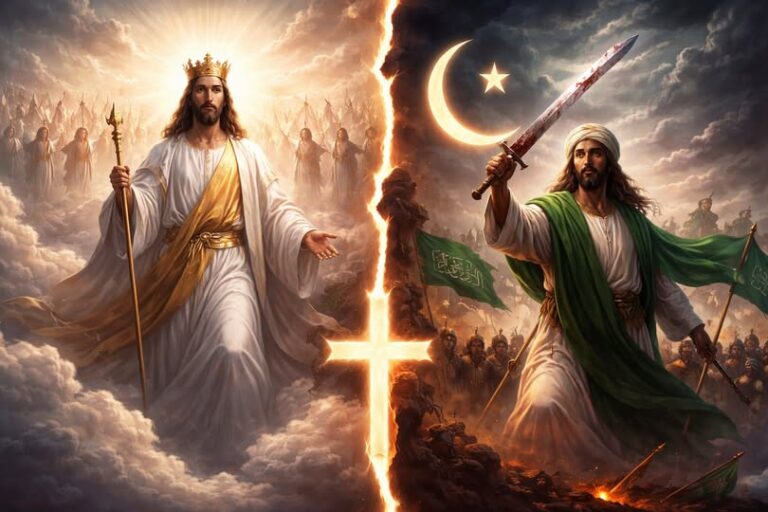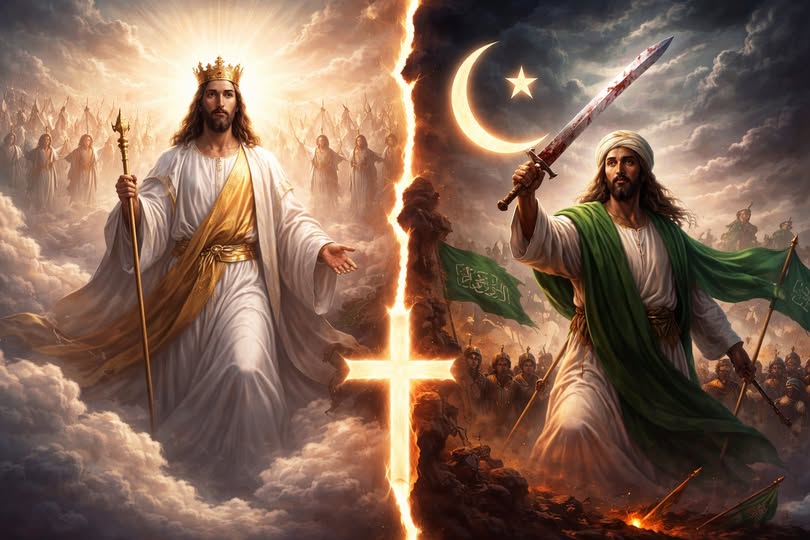
It is common to hear that Islam honors Jesus and even affirms His second coming. That statement is used to imply theological alignment, as though Christianity and Islam are simply different expressions of the same revelation. The inclusion of Jesus in Islamic theology, however, does not preserve the biblical Christ. It redefines Him. The name is retained. The identity and mission are altered.
Christianity is built upon specific historical and theological claims about Jesus. He is the Son of God. He was crucified. He rose bodily from the dead. He reigns with all authority in heaven and on earth. He will return in glory to judge the nations. When those pillars are removed or rewritten, the figure that remains is not the same Christ.
DENIAL OF THE SON
Islam explicitly rejects the identity of Jesus as the Son of God. It teaches that God does not beget and has no son. The confession that stands at the center of Christianity is denied. Scripture is unambiguous on this point. Whoever denies the Son does not have the Father. The relationship between Father and Son is not a minor theological detail. It is foundational.
This denial is not peripheral within Islamic history. The Dome of the Rock, built on the Temple Mount in Jerusalem, contains inscriptions rejecting the Sonship of Christ and the Trinity. On the very site associated with the Temple, where Yahweh caused His name to dwell, there now stands a monument publicly declaring that God has no Son. That is not theological overlap. It is theological contradiction carved in stone.
DENIAL OF THE CROSS AND RESURRECTION
Islam also denies the crucifixion as Christianity proclaims it. The dominant interpretation within Islamic tradition is that Jesus was not actually crucified, but that it only appeared so, while he was taken up instead. If Christ was not crucified, then He did not bear sin. If He did not bear sin, then there is no atonement. If there is no atonement, there is no Gospel.
Christianity does not treat the cross as symbolic tragedy. It is the decisive act in which sin is judged and death is defeated. The resurrection is not metaphorical. It is the vindication of the Son and the public defeat of the grave. Remove the cross and resurrection, and the Christian proclamation collapses. What remains is a prophet preserved from execution, not the Lamb who takes away the sin of the world.
REDUCTION OF CHRIST’S STATUS
Islam does not merely deny Christ’s divine identity and saving work. It lowers His standing even within its own prophetic hierarchy. In the account of Muhammad’s night journey and ascent through the seven heavens, the order of encounters is structured to communicate rank.
On the first level Muhammad meets Adam. On the second level he meets Jesus and John the Baptist together. On the third level he encounters Joseph. On the fourth is Enoch. On the fifth is Aaron. On the sixth is Moses. On the seventh is Abraham, positioned nearest before Muhammad approaches the divine presence.
This progression is intentional. As the ascent rises, proximity and significance increase. Jesus is placed on the second level, below Joseph, below Enoch, below Aaron, below Moses, and below Abraham. He is not the summit of revelation. He is encountered early and then surpassed.
In the New Testament, John the Baptist openly declares that he is unworthy even to untie the sandals of the Messiah. He decreases so that Christ may increase. In the Islamic narrative, Jesus and John stand together on the same level. Christ is positioned beneath multiple other prophets in the heavenly hierarchy. The biblical Christ is the one through whom all things were made and to whom all authority in heaven and on earth has been given. The Isa of Islamic tradition is a prophet on the second level of heaven, ranked below Moses and Abraham. That placement communicates that Jesus is neither supreme nor final.
THE END TIMES ROLE OF ISA
Islamic eschatology presents a final global conflict in which the Mahdi unites the world under Islam through warfare. Jesus descends during this period. He does not return as independent sovereign King establishing His own covenantal kingdom. He descends into an already Islamic order and functions within it.
The hadith literature describes Isa breaking the cross, killing the swine, and abolishing the jizya. The abolishing of jizya is decisive.
Historically, jizya allowed Jews and Christians to live under Islamic rule as protected but subordinate communities. When jizya is abolished, that protected category ends. The classical framework leaves no parallel existence for Christianity or Judaism. The remaining option is submission to Islam.
The traditions also describe Isa killing the Dajjal and participating in the final Islamic military victory. In some narrations, Jews are hunted and killed in the final conflict, with even trees and stones exposing those in hiding. Christianity is not corrected. It is dismantled. Its central symbol is destroyed. Its legal protection is removed. Its continued existence as a tolerated confession ends.
In this portrayal, Isa does not vindicate the Gospel. He does not gather the Church. He does not judge the nations as the enthroned Son of God. He joins the Islamic military campaign and enforces its supremacy. That is not a minor theological variation. It is a complete reversal of the New Testament expectation.
CONCLUSION
Islam includes Jesus in its theology, but inclusion is not affirmation. The Son is denied. The crucifixion is denied. The resurrection is denied. His status is lowered within the prophetic hierarchy. In the end times narrative, He does not return to establish His kingdom but to validate and enforce another religious system, abolishing the protected status of Christians and Jews and participating in the final triumph of Islam.
The Christ of the New Testament is eternal Son, crucified Savior, risen Lord, and returning King with all authority in heaven and on earth. The Isa of Islamic tradition is a prophet who denies the Sonship, denies the cross, stands on the second level of heaven beneath other prophets, and ultimately leads the enforcement of Islamic supremacy. These are not two perspectives on the same figure. They are two fundamentally different portrayals sharing a name. Clarity about that distinction is not hostility. It is theological honesty.
Discussion Questions
- If Islam affirms that Jesus was a prophet and will return, but denies His Sonship, crucifixion, and resurrection, at what point does inclusion of His name cease to be meaningful continuity with the biblical Christ?
- In the ascension narrative where Jesus is placed on the second level of heaven beneath Moses and Abraham, what theological message is being communicated about authority and final revelation? How does that hierarchy directly contrast with New Testament claims about Christ’s supremacy?
- Why is the crucifixion non-negotiable within Christianity? What collapses doctrinally if Christ was not actually crucified and resurrected?
- In Islamic eschatology, Isa breaks the cross, abolishes the jizya, and participates in the final Islamic military victory. What does that imply about the future of Christianity and Judaism within that framework? How does that differ from the New Testament picture of Christ’s return?
- Why is clarity about the identity of Jesus essential in interfaith conversations? How can Christians speak honestly about theological differences while still engaging Muslim individuals with personal compassion and respect?
WANT TO KNOW MORE?
- The Islamic Jesus: How the King of the Jews Became a Prophet of the Muslims – Mustafa Akyol
Written by a Muslim author, this book explains how Islam reinterprets Jesus within its own theological system. It clearly outlines the denial of Sonship, the rejection of the crucifixion, and the prophetic framing of Isa. - The Muslim Jesus: Sayings and Stories in Islamic Literature – Tarif Khalidi
Khalidi compiles Qur’anic and early Islamic traditions about Jesus. This collection demonstrates how Isa is presented as a moral prophet and ascetic teacher rather than the incarnate Son and risen Lord of the New Testament. - Crucifixion in the Qur’an and the Hadith: A Historical-Theological Study – Todd Lawson
Lawson provides a detailed academic analysis of Qur’an 4:157 and the Islamic denial of the crucifixion. The book traces how Muslim exegetes developed the substitution theory and shows how central the rejection of the cross is within Islamic theology. - The Islamic Antichrist: The Shocking Truth About the Real Nature of the Beast – Joel Richardson
Richardson examines Islamic eschatology, including the roles of the Mahdi, Isa, and the Dajjal. He documents how Islamic end times traditions portray Jesus breaking the cross, abolishing the jizya, and participating in the final Islamic military victory. - The Cross and the Crescent: Responding to the Challenge of Islam – Colin Chapman
Chapman addresses the core theological differences between Christianity and Islam, focusing on the person of Christ, the meaning of the cross, and the incompatibility between the two systems.
About the Author