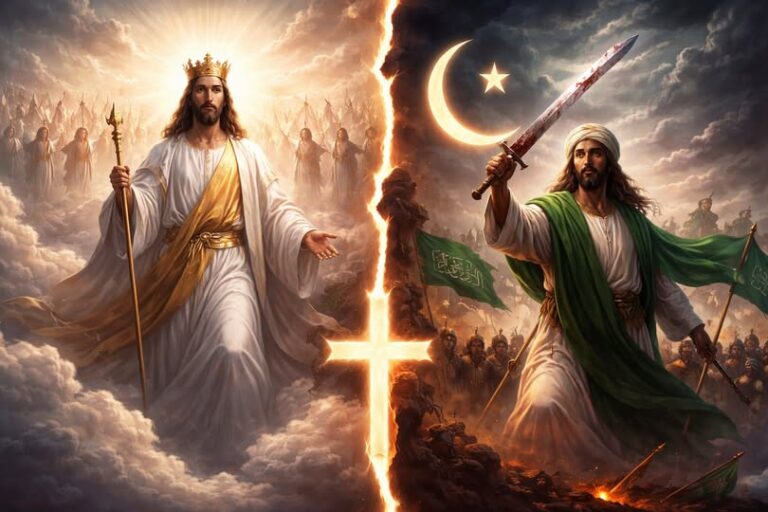
A helpful point raised by Joel Richardson is that Matthew 25 has to be read in its Old Testament and prophetic setting. Once that setting is restored, the passage no longer reads like a church audit about “real” and “fake” Christians. It reads like what it is: the Son of Man judging the nations in line with the prophets. That matters because this passage is often polished into something far softer than Jesus intended. It gets turned into a vague lesson about being nice, or into a warning aimed at professing Christians who may not really be saved. But the atmosphere of the passage is much heavier than that. Jesus is not giving a stained-glass devotional reflection. He is speaking as a King, briefing His inner circle about the reckoning that will come when the nations stand before Him.
The geographic setting matters far more than most readers realize. Jesus is speaking on the Mount of Olives. Behind Him lies the wilderness, and before Him stands Jerusalem and the Temple. That is not an incidental backdrop. It is part of the message. Zechariah 14 says that the Lord’s feet will stand on that very mountain when He comes to fight against the nations that attacked Jerusalem. That means Jesus is not merely discussing future judgment from a random location. He is standing on the very ground associated with the day when the Lord will confront the nations over their assault on His city and His people. If that location is ignored, the whole scene is quietly detached from its prophetic anchor, and the passage becomes softer and more generic than it was ever meant to be.
The Courtroom Has Three Parties, Not Two
One of the biggest mistakes in reading Matthew 25 is assuming that the scene contains only two groups, the sheep and the goats. That assumption drives the common misreading. In reality, the courtroom contains three distinct parties, and the third party is what makes the whole passage snap into focus. The Judge is the Son of Man, seated in glory as the King. The defendants are “all the nations,” which means the Gentile nations gathered before Him for judgment. Then there is the third group, “my brothers,” the King’s own kin, the people whose treatment becomes the evidence in the case.
That point changes everything. If “my brothers” are the standard by which the sheep and goats are evaluated, then they cannot be the same group as the sheep and goats. They are not the ones being judged. They are the ones whose treatment determines the verdict. That observation alone does enormous damage to the usual “real Christian versus fake Christian” reading. Jesus is not sorting church members according to whether their profession was genuine. He is judging the nations according to how they treated a third party that He openly identifies as His own. Once the legal parties are kept distinct, the passage stops looking like a lesson about religious authenticity and starts looking like the courtroom scene it actually is.
This Is the Final Enforcement of Genesis 12:3
Jesus is not inventing a new standard in Matthew 25. He is enforcing a covenantal principle that had already governed the relationship between God, Israel, and the nations for centuries. In Genesis 12:3, God tells Abraham, “I will bless those who bless you, and him who dishonors you I will curse.” That is not a sentimental promise and it is not a minor detail buried in the patriarchal narratives. It is one of the foundational legal realities of redemptive history. From that moment forward, the nations are never neutral in relation to Abraham’s line. Their treatment of his offspring carries consequences because God has bound His own name and purposes to that people.
Matthew 25 is the final execution of that covenantal reality. Jesus is not standing up a new moral standard based on generic humanitarian concern. He is applying the ancient terms of blessing and curse as the Messianic King. What began as a covenant promise to Abraham reaches its final judicial expression when the Son of Man sits on His throne and summons the nations before Him. This is why the passage feels so much more serious when read in its Old Testament context. The issue is not whether the nations met a broad standard of niceness. The issue is whether they aligned themselves with the people to whom God bound His covenant promises. The sheep are blessed because they blessed the King’s kin. The goats are cursed because they treated them with contempt or indifference. Genesis 12:3 is not background decoration here. It is the legal framework under the whole scene.
Joel 3 Already Gave the Template
This is also why Joel 3 matters so much for understanding Matthew 25. In Joel 3, God declares that He will gather all the nations into judgment because they scattered His people, divided His land, and mistreated Judah and Jerusalem. That is not loosely parallel to Matthew 25. It is the template. In both passages the nations are gathered, judgment is rendered, and the central issue is how those nations treated the Lord’s people. Jesus is not reaching for a vague stock image of judgment. He is speaking in a well-established prophetic pattern that His hearers should have recognized.
That Old Testament pattern is strengthened even further by passages like Zechariah 2, where the Lord says that whoever touches His people touches the apple of His eye. That is covenant identification in its strongest form. To act against His people is to act against Him. That is exactly the logic Jesus uses in Matthew 25 when He says, “as you did it to one of the least of these my brothers, you did it to me.” He is not introducing a sentimental spiritual metaphor. He is declaring covenant solidarity between Himself and those He calls His brothers. The prophets had already laid that foundation. Jesus is bringing it to its full clarity by placing Himself at the center of the reckoning.
“My Brothers” Cannot Be a Vague Category
This is why the phrase “my brothers” carries so much interpretive weight. The popular reading has to blur that phrase in order to preserve itself. It has to turn “my brothers” into humanity in general, or needy people in the broadest sense, or even professing Christians whose authenticity is supposedly being tested. But the context does not permit that kind of vagueness. Jesus is judging the nations, not humanity in the abstract. He is speaking in a prophetic framework where the nations are held accountable for how they treated God’s covenant people. In that setting, “my brothers” cannot simply mean whoever happens to be suffering. The phrase has to refer to a defined group whose relationship to the King is central to the charge.
That is why this passage makes the most sense when “my brothers” is understood as the King’s own Jewish brethren, the remnant with whom Israel’s Messiah identifies. This is not forced into the text. It arises from the text’s own logic. The Judge is the Jewish Messiah. The defendants are the Gentile nations. The evidence is how they treated the King’s kin. Once that structure is seen, the popular reading begins to look less like interpretation and more like an attempt to domesticate a passage that is far more covenantal and politically charged than many modern readers are comfortable admitting.
In This Setting, Mercy Is Defiance
Another major weakness in the standard reading is that it treats the actions in the passage as ordinary acts of charity. Feeding the hungry, giving drink to the thirsty, welcoming the stranger, clothing the naked, and visiting the imprisoned are all reduced to a general humanitarian ethic. Scripture certainly affirms compassion, but that is not the main point here. In the setting Jesus describes, these actions are taking place in the middle of a world hostile to the King’s brothers. That changes their meaning.
If the nations are being judged for how they treated the King’s kin, then we are not dealing with a neutral social setting where simple kindness costs little. We are dealing with a time when standing with them would be dangerous. In that context, to feed one of the King’s brothers is not merely to be generous. It is to defy the spirit of the age. It is to risk association with those the world has marked out as disposable or dangerous. The sheep, then, are not simply “nice people.” They are those who, despite the pressure of the world system, aligned themselves with the King by protecting His family. The goats are those who went along with the hostility of the age and treated the King’s brothers as unworthy of costly solidarity. What many readers call “charity” is actually allegiance under pressure.
The Surprise Reveals Instinctive Alignment
The surprise of both groups is one of the strongest features in the entire scene. Neither the sheep nor the goats knew they were interacting with the King Himself. That matters because it shows that the judgment is not based on calculated religious performance. If this were a test designed for professing Christians, they would have been consciously looking for Jesus, trying to prove their sincerity, or attempting to secure a favorable outcome. But that is not what happens. Both groups are caught off guard because their actions were not transactional. They were revelatory.
What the judgment exposes is instinctive alignment. The sheep recognized a moral and covenantal obligation to the King’s brothers and acted accordingly, even though they did not realize the King was personally identifying with them. The goats, on the other hand, revealed that they shared the cold logic of the age. They did not need to consciously reject Jesus face-to-face. Their disregard for those He calls His own was enough to show where they stood. The surprise, then, does not weaken the passage. It sharpens it. It shows that the issue is not outward religious awareness but inward alignment revealed through concrete action.
This Must Be Heard as Prophetic Oracle
A great deal of confusion comes from reading Matthew 25 as if it were simply another chapter in a book meant for calm devotional reflection. But that is the wrong genre instinct. This part of the Olivet Discourse is not functioning like a quiet pastoral meditation. It is a prophetic oracle. It is a royal declaration of coming judgment. It is closer to a war briefing from a King than to a sentimental sermon illustration. Once that change in tone is allowed to register, many of the weaker interpretations begin to collapse under their own weight.
The language is too public, too severe, and too covenantally charged to support soft readings. The Son of Man comes in glory. He sits on His throne. All the nations are gathered before Him. He divides them according to how they treated those He calls His brothers. Nothing in that scene suggests that Jesus is mainly concerned with helping later readers discern whether they are genuine believers rather than nominal ones. That may be an important question elsewhere, but it is not the controlling issue here. The controlling issue is the geopolitical and covenantal reckoning of the nations before the King of Israel.
Conclusion
Matthew 25 is not a church audit. It is not a generic lesson about kindness. It is not a hidden test for spotting fake Christians. It is the Son of Man, the King of Israel, sitting in judgment over the Gentile nations according to a covenantal standard established long before in the Law and the Prophets. The issue is how those nations treated the King’s brothers, and that makes the passage both sharper and more dangerous than popular readings usually allow.
Read in that light, the sheep and goats judgment becomes unmistakable. The Judge is the King. The defendants are the nations. The evidence is the treatment of His kin. The verdict is the final enforcement of the blessing and curse announced to Abraham and echoed throughout the prophets. That is why the scene is so severe, and that is why attempts to reduce it to a lesson about being a nice person completely miss the point. Jesus is not giving the church a mirror for self-analysis. He is giving His disciples a prophetic warning about the day when the nations will answer to Him for how they treated His people.
Discussion Questions
- Why does the phrase “all the nations” in Matthew 25 rule out the idea that Jesus is primarily evaluating professing Christians?
- How does understanding the Mount of Olives setting and its connection to Zechariah 14 change the way we read the sheep and goats judgment?
- Why is it important to recognize “my brothers” as a separate group from the sheep and goats, and how does that reshape the entire passage?
- In what way does Genesis 12:3 function as the legal foundation for the judgment described in Matthew 25?
- How does viewing the acts of feeding, clothing, and visiting as acts of defiance in a hostile world make the passage more serious than a simple lesson on kindness?
Want to Know More
- Joel Richardson, The Sheep and Goats Judgment: Not What Most Christians Think? (Video Teaching)
This teaching is what helped spark the direction of this lesson, highlighting that Matthew 25 must be read in its Old Testament and prophetic context rather than as a generic moral or church-focused passage. Richardson emphasizes the judgment of the nations framework and the covenantal implications behind how “my brothers” are treated, which aligns with the broader biblical pattern seen in Genesis and the prophets. - R. T. France, The Gospel of Matthew
A highly respected commentary that carefully traces Matthew’s structure and Old Testament background. France is especially helpful for seeing how Matthew presents Jesus as the climactic fulfillment of Israel’s story and how passages like Matthew 25 fit within that larger framework. - Craig L. Blomberg, Matthew (New American Commentary)
A solid evangelical commentary that interacts with major interpretations while staying grounded in the text. Blomberg provides helpful discussion on the sheep and goats passage and engages the question of who “the least of these” refers to. - John Nolland, The Gospel of Matthew (New International Greek Testament Commentary)
A detailed, technical commentary that digs into the language and intertextual connections. Nolland is particularly useful for seeing how Matthew 25 connects to Old Testament judgment themes and prophetic expectations. - Michael J. Wilkins, Matthew (NIV Application Commentary)
A balanced resource that bridges scholarship and application. Wilkins helps readers understand the flow of the Olivet Discourse and how Matthew presents Jesus as the authoritative Judge of the nations. - Darrell L. Bock and Mitch Glaser (eds.), Israel, the Church, and the Middle East
A collection of essays from evangelical and Messianic scholars that explores the relationship between Israel and the nations in God’s plan. This volume is especially helpful for understanding the ongoing significance of Israel in passages like Matthew 25.
About the Author