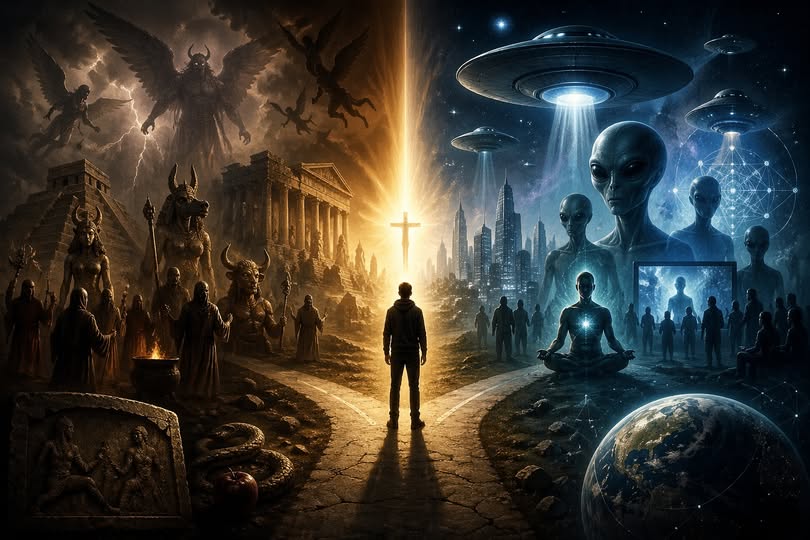
The modern world claims to have moved beyond belief in gods and spirits, yet it continues to embrace them under new names. What ancient cultures called gods, watchers, or heavenly beings are now often described as extraterrestrials, interdimensional intelligences, or advanced cosmic entities. The terminology has changed, but the underlying spiritual framework has not. The clearest pattern is not the sightings themselves, but the theology that follows them.
These encounters and movements almost never produce anything resembling biblical Christianity. They do not call people to repentance, submission to Yahweh, or allegiance to Jesus Christ as Lord. Instead, they promote ideas that mirror ancient paganism and later Gnostic thought. Man is divine, salvation comes through hidden knowledge, Scripture is treated as flawed or incomplete, and Jesus is reduced to one figure among many. The same structure appears repeatedly, even when the language is updated.
The Old Gods in New Clothing
UFO religions often present themselves as scientific or forward-looking, but their ideas are deeply rooted in older religious systems. They frequently teach that superior beings from the heavens created or guided humanity, shared advanced knowledge, and are preparing mankind for a higher state of existence. Popularized by writers such as Erich von Däniken, ancient astronaut theory helped make this framework familiar by reframing ancient gods as extraterrestrial visitors rather than spiritual beings.
Scripture already provides categories for these kinds of claims. Genesis 6, Deuteronomy 32, Psalm 82, and 1 Corinthians 10 describe a world in which spiritual beings rebelled, influenced nations, and accepted worship that belonged to Yahweh alone. Second Temple texts such as 1 Enoch and Jubilees expand on this by describing the transmission of forbidden knowledge and its corrupting effects. When modern narratives speak of higher beings imparting secret knowledge to elevate humanity, the resemblance to these earlier patterns is difficult to ignore.
UFO Religion as a Bridge for Atheists and New Agers
UFO religion often functions as a transitional system for people who have rejected traditional religion but remain open to spiritual ideas. It allows atheists to adopt belief in higher intelligences, purpose, and revelation without using explicitly religious language. It allows New Age thinkers to retain concepts such as spirit guides, reincarnation, and hidden knowledge while reframing them in technological or cosmic terms.
This overlap raises the question of how these systems relate to the biblical categories of demons and rebel elohim. Scripture presents a populated spiritual reality in which not all beings are aligned with God. Some seek influence, deception, and even worship. Within that framework, the consistent themes found in UFO religion, particularly the emphasis on secret knowledge and human elevation, can be compared to earlier patterns associated with rebellious spiritual influence.
It is also important to note that not every reported encounter should be taken at face value. Some claims may be psychological, fabricated, or culturally influenced. Even so, when messages are reported, they tend to follow a similar theological direction. Many reported encounters also include phenomena such as paralysis, telepathic communication, and a sense of overwhelming spiritual presence, which parallel ancient descriptions of demonic or angelic visitation more than ordinary scientific contact. The point is not to accept every story, but to test the spiritual fruit of the message being delivered.
The Consistent Approach to Christianity
A recurring feature across UFO religions is their treatment of Jesus. Rather than rejecting Him outright, these systems tend to reinterpret Him. He is described as an enlightened teacher, an advanced being, or one figure among many within a larger spiritual framework.
This approach is consistent with earlier Gnostic and occult traditions. By placing Jesus within a broader hierarchy, these systems avoid direct confrontation while removing His unique authority. The result is a version of Jesus that does not challenge the system or require submission in the biblical sense. Scripture calls believers to “test the spirits” precisely because not every spiritual messenger is from God, and the central test is what they do with Christ.
Case Studies: When “Aliens” Start Preaching Theology
This pattern can be observed in several modern movements and texts.
- Raëlism teaches that humanity was created by extraterrestrial scientists called the Elohim. Biblical language is used, but its meaning is redefined. God becomes a created being, and Jesus is presented as one messenger among many rather than the unique Son of God.
- Heaven’s Gate combined Christian terminology with extraterrestrial belief, teaching that salvation required leaving the body to ascend to a higher existence. Jesus was reinterpreted as an earlier representative of these higher beings, and the group’s beliefs ultimately led to mass suicide in 1997.
- Scientology, founded by L. Ron Hubbard, includes a cosmology involving Xenu, a galactic ruler who brought billions of beings to Earth, where they were killed near volcanoes. Their disembodied spirits, known as thetans, are said to attach to human beings. Within this framework, the human problem is not sin but spiritual burden, and the solution is progression through levels of knowledge and practice. Scientology materials attributed to Hubbard also present a reinterpretation of Jesus. In disputed early OT VIII material, Jesus is described in explicitly negative and immoral terms, including claims about sexual behavior, and is framed within a broader narrative that conflicts with traditional Christian doctrine. While the authenticity of specific documents is debated, the overall direction of the system does not affirm the biblical understanding of Christ.
- The Urantia Book presents itself as revelation from celestial beings and outlines an extensive cosmic hierarchy. It includes a portrayal of Jesus, but places Him among many advanced beings and treats the Bible as incomplete.
- The Aetherius Society teaches that cosmic masters communicate spiritual knowledge involving karma, reincarnation, and human development. Jesus is included in this system but is presented as one figure among many within a broader structure.
- Research by John E. Mack documented reports of encounters that included messages about human transformation, ecological responsibility, and spiritual awareness. These accounts typically emphasize growth through knowledge and alignment rather than repentance or submission to Christ.
Why Paganism Fits So Easily
Pagan systems already assume a layered spiritual reality with multiple beings and pathways to advancement. This structure aligns easily with UFO religion, which often describes a hierarchy of advanced entities and stages of development. The language differs, but the framework remains similar.
Biblical Christianity presents a different structure. It affirms one Creator, distinguishes clearly between Creator and creation, and places all spiritual beings under God’s authority. It does not provide multiple paths to divinity or a hierarchy in which human beings ascend to godhood. Because of this, it does not integrate easily into systems built on those assumptions.
The Serpent’s Promise Revisited
One of the earliest biblical themes is the idea of humanity seeking to become like God apart from Him. This concept appears in various forms throughout history. In many UFO-related systems, similar ideas are expressed through the language of evolution, awakening, or transformation.
These systems often describe humanity as having latent potential that can be unlocked through knowledge or contact with higher beings. While the terminology is modern, the underlying concept parallels earlier ideas about hidden knowledge and human elevation.
Conclusion
Across a wide range of UFO religions and encounter narratives, similar theological patterns appear. These include the elevation of hidden knowledge, the redefinition of Jesus, and the presentation of humanity as capable of transformation through means other than the framework described in Scripture.
This does not require Christians to panic over every strange report or treat every unexplained event as demonic. It does require discernment. When a message from “higher beings” diminishes Christ, bypasses the cross, rejects repentance, and promises enlightenment through hidden knowledge, it is not spiritually neutral. It belongs to a much older pattern of rebellion against Yahweh, even when it arrives dressed in the language of science, space, or human evolution.
Discussion Questions
- What theological patterns show up repeatedly across UFO religions, and how do those patterns compare to the biblical description of truth, sin, and salvation?
- Why do you think so many alien or “higher being” encounters redefine Jesus instead of rejecting Him outright, and what does that suggest about their underlying message?
- In what ways does UFO spirituality appeal differently to atheists and New Age thinkers, and why is it able to function as a bridge between those two worldviews?
- How does the concept of rebel elohim and demons in Scripture help provide a framework for understanding the messages reported in alien encounters?
- What does it mean in practical terms to “test the spirits” when evaluating modern claims of contact with higher beings, and what criteria should be used based on Scripture?
Want To Know More?
- UFO Religions by Christopher Partridge
A focused academic study of UFO-based religious movements and how they turn alleged extraterrestrial contact into full spiritual systems. - American Cosmic: UFOs, Religion, Technology by Diana Walsh Pasulka
A modern study of how UFO belief functions religiously, especially through technology, testimony, sacred experience, and communities of believers. - Messengers of Deception: UFO Contacts and Cults by Jacques Vallée
An important investigation into UFO contact claims, cult formation, manipulation, and the darker spiritual and social patterns behind some UFO movements. - The Re-Enchantment of the West, Vol. 2: Alternative Spiritualities, Sacralization, Popular Culture and Occulture by Christopher Partridge
Helpful for understanding how occult and pagan ideas re-enter modern culture through entertainment, spirituality, UFO belief, and “alternative” religion. - The Unseen Realm: Recovering the Supernatural Worldview of the Bible by Michael S. Heiser
Useful for the biblical framework behind the lesson, especially the divine council, rebel elohim, the nations, and the spiritual powers behind false worship.
About the Author