The Spear of Destiny, also called the Holy Lance and later the Lance of Longinus, is one of the most famous relic traditions in Christian history. Its reputation rests on a single moment in the crucifixion account when a Roman soldier pierced the side of Jesus. From that brief scene grew centuries of legend, devotion, political symbolism, and modern myth. The spear came to be treated not simply as an object connected to the Passion, but as a sign of divine favor, a token of imperial authority, and eventually a centerpiece in stories about destiny and power. What began as a confirmation of Christ’s death became, over time, something far removed from its biblical purpose.
To understand the spear properly, the lesson has to move in a straight line from Scripture to tradition to empire to modern myth without losing coherence. Each layer builds on the last, not because the object itself changes, but because people continually project meaning onto it. That process reaches its most intense and revealing form in the twentieth century, when the Vienna Lance and the rest of the Imperial Regalia were pulled into the ideological world of the Third Reich and then recovered through one of the more fascinating intelligence efforts of World War II.
What Scripture Actually Emphasizes
The Gospel of John records that a Roman soldier pierced Christ’s side and that blood and water flowed out. The purpose is direct and grounded. It confirms that Jesus truly died and fulfills prophetic expectations. John emphasizes eyewitness testimony because the reality of the crucifixion matters. The death was physical, final, and verifiable.
What stands out is how little attention is given to the spear itself. The soldier is unnamed. The weapon is not preserved. There is no instruction to venerate the object or assign power to it. The spear serves the moment and disappears from the narrative. The focus remains entirely on Christ and His work. That silence is critical because everything that follows in history moves beyond what Scripture actually says.
From Tradition to Relic Culture
The name Longinus, now commonly attached to the soldier, comes from later tradition rather than the New Testament. As the church moved further from the first century, there was a growing tendency to fill in narrative gaps. People wanted names, stories, and continuity. That instinct expanded dramatically once Christianity moved from persecution into imperial favor.
By the fourth century, relic culture had begun to flourish. Pilgrimages increased, sacred sites were identified, and objects connected to Christ’s life and death were sought out and preserved. The spear fits into that broader development. It was not preserved by the apostles or passed down through the early church. It emerged as part of a later desire to physically connect with sacred history. That shift marks the moment when memory began to take material form in objects that could be claimed, displayed, and eventually politicized.
The Spear as a Tool of Empire
Once relics entered the world of empires, their meaning changed again. In Constantinople and later in the Holy Roman Empire, sacred objects were not just devotional. They were political. Possessing a relic associated with Christ suggested divine approval and reinforced the idea that a ruler governed under heaven’s authority.
The spear became especially useful in that role because it was both tied to the crucifixion and shaped like a weapon. It could be presented as a symbol of divine justice, victory, and authority. Emperors and kings associated with the imperial regalia treated the lance as a visible sign of legitimacy. Over time, the belief took hold that possession of the spear was tied to rightful rule. Whether historically accurate or not mattered less than the fact that people acted as if it were true.
The Problem of Multiple “True” Lances
As the tradition spread, multiple relics were identified as the Holy Lance. Jerusalem, Constantinople, France, and the Holy Roman Empire all had competing claims. The sack of Constantinople in 1204 only intensified the confusion, scattering relics across Europe and multiplying traditions.
This is one of the clearest signs that the story had moved away from verifiable history. These objects cannot all be the original spear. Their significance did not depend on proof, but on symbolism. Once a relic becomes a symbol of authority and devotion, its meaning can survive even when its authenticity becomes uncertain. That is exactly what happened with the spear. It continued to be revered because of what it represented, not because of what could be proven.
The Vienna Lance and the Nazi Worldview
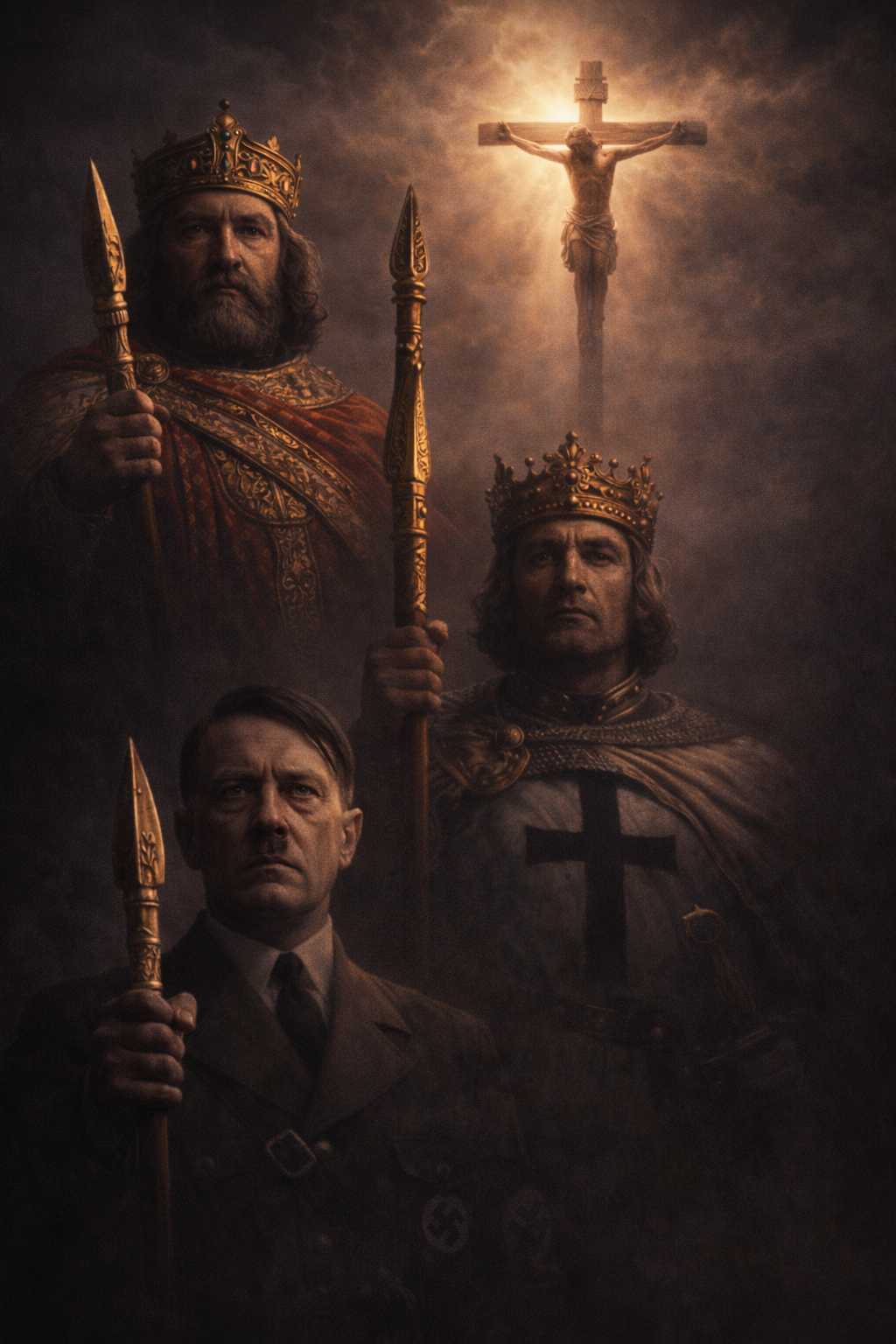
The version of the spear most closely tied to modern legend is the Vienna Lance, preserved as part of the Imperial Regalia of the Holy Roman Empire. By the twentieth century, it had already accumulated centuries of symbolic weight tied to kingship and empire. When Adolf Hitler rose to power, that symbolism did not go unnoticed.
After the annexation of Austria in 1938, the imperial regalia were taken from Vienna and transferred to Nuremberg. This was not a casual decision. Nuremberg was one of the symbolic centers of the regime, a place where the Nazis staged their identity and projected their vision of history. Moving the regalia there was part of a deliberate effort to present the Third Reich as the heir to a grand, continuous, and almost sacred imperial tradition.
The Occult Atmosphere and the Power of Symbols
What makes this period different from earlier uses of the spear is the ideological environment surrounding it. Elements within the Nazi leadership, especially under Heinrich Himmler, cultivated a pseudo-sacred atmosphere built on mythic ancestry, ritual, and a fabricated sense of destiny. The SS was shaped to reflect that vision, blending racial ideology with symbolic and quasi-religious elements that gave the regime an air of inevitability and historical purpose.
Not every Nazi leader approached these ideas the same way, and exaggerated claims about Hitler’s personal obsession with occult objects often go beyond what can be supported. Even so, the broader pattern is clear. The regime placed enormous importance on symbols that could reinforce its narrative. The Imperial Regalia, including the spear, fit perfectly into that framework.
In that environment, the spear was no longer just a relic from Christian tradition. It became part of a symbolic system meant to suggest continuity with empire, conquest, and destiny. It was useful because it made power appear rooted in something ancient and inevitable. The object itself did not carry power, but the belief that it represented power made it valuable to the regime.
The Hidden Vault and the Intelligence Hunt
As the war turned against Germany, the regalia were hidden in underground vaults and tunnels beneath Nuremberg. This was a deliberate act, designed to keep them from falling into Allied hands. Their concealment reflected their perceived importance. These were not just valuable artifacts. They were symbols the regime wanted to preserve even as everything else collapsed.
What followed was not a lucky discovery, but a methodical investigation. Walter Horn, a German-born art historian working with Allied forces, was tasked with locating the missing regalia. His background gave him an advantage. He understood the historical and symbolic significance of what he was looking for, and he had a strong sense of how such objects would be hidden.
The recovery effort relied heavily on interrogation. Captured German officials, local authorities, and those connected to the concealment were questioned. Each provided fragments of information. Horn had to piece those fragments together, following a chain of knowledge that eventually led to the hidden vaults beneath the city.
This is one of the most compelling parts of the story because it shows how much work went into recovering objects that many might assume were simply stumbled upon. The spear, along with the rest of the regalia, was found because of careful intelligence work and persistence.
Patton’s Connection and the Weight of the Discovery
The role of General George S. Patton enters the story through later accounts that tie Horn’s findings to higher-level awareness within the Allied command. Horn had previously served within Patton’s orbit, and some retellings describe intelligence about the regalia being reported in a way that brought it to Patton’s attention. In those versions, Patton is portrayed as recognizing the significance of the artifacts and ensuring that their recovery was treated as important.
The strongest historical summaries focus on Horn’s assignment and investigative work, but the Patton connection reflects a broader truth. Senior commanders were aware that the Nazis had looted and hidden culturally significant objects, and recovering them mattered. The regalia were not treated as curiosities. They were treated as important pieces of history that needed to be secured.
The Recovery and the Collapse of the Myth
One of the most persistent claims in popular retellings is that the spear was recovered on the same day Hitler died. That version creates a powerful sense of symmetry, as if the object itself marked the rise and fall of power.
The stronger historical evidence points to a different timeline, with the recovery taking place after the collapse of the regime through a process of interrogation and investigation. The real story is not about a mystical transfer of power on a single day. It is about the deliberate recovery of historically and symbolically important artifacts from a defeated regime.
What makes the moment powerful is not the myth, but the reality behind it. The same regime that tried to wrap itself in the symbolism of empire and destiny ultimately lost both, and the objects it tried to use as symbols of permanence were reduced to recovered artifacts in a vault.
Returning to the Biblical Focus
With all of that history in view, the correction becomes clear. The spear matters because of what it confirms about Christ’s death, not because of any power it possesses. The Gospel of John includes the detail to emphasize the reality of the crucifixion and the fulfillment of prophecy. That is where its significance lies.
Everything else reflects the human tendency to attach meaning to objects and then use those objects to tell stories about authority, destiny, and legitimacy. The further the story moves from the biblical text, the more it becomes a reflection of human concerns rather than divine revelation.
Conclusion
The Spear of Destiny began as a weapon in the hands of a Roman soldier at the foot of the cross. In Scripture, it serves a clear purpose. It confirms that Christ truly died. Over time, that simple detail was expanded into a symbol claimed by emperors, carried into battle, seized by the Nazis, hidden beneath Nuremberg, and recovered through a chain of interrogations and investigations led by Walter Horn.
The Nazi attempt to surround such objects with mythic meaning only reinforces the lesson. The spear did not grant power. It did not shape destiny. It was used by those who wanted to make their power appear inevitable. In the end, it became just another artifact recovered from a fallen regime.
The true significance of the account remains where it began. The focus is not on the lance, but on the One who was pierced. The power is not in the object, but in Christ and what He accomplished through His death and resurrection.
Discussion Questions
- Why does the Gospel of John include the detail of the spear piercing Christ’s side, and what theological point is it actually making?
- How did the shift from a persecuted church to an imperial church contribute to the rise of relic culture and the desire for physical connections to sacred history?
- In what ways did empires use objects like the Spear of Destiny to legitimize authority, and how does that differ from what Scripture emphasizes?
- How did the Nazi regime’s use of symbolism, myth, and pseudo-sacred imagery shape the way artifacts like the spear were viewed and treated?
- What does the long history of the Spear of Destiny reveal about the human tendency to assign power to objects, and how should that shape the way believers think about relics and symbols today?
Want to Know More
- Sidney D. Kirkpatrick, Hitler’s Holy Relics: A True Story of Nazi Plunder and the Race to Recover the Crown Jewels of the Holy Roman Empire
This is the most directly relevant book for the World War II side of the lesson. It focuses on the Nazi seizure of the Imperial Regalia, the hunt for the hidden treasure, and the recovery effort tied to Walter Horn. It is the best resource for digging deeper into the spear’s modern legend, the Nuremberg concealment, and the postwar search. - Patrick J. Geary, Furta Sacra: Thefts of Relics in the Central Middle Ages
This is an excellent book for understanding the broader relic culture behind stories like the Holy Lance. Geary explores how relics were stolen, transferred, and reinterpreted in the medieval world, which helps explain why multiple objects could all be treated as sacred and politically powerful at the same time. - Alexandra Walsham, ed., Relics and Remains
This is a strong scholarly resource for understanding relics as religious and cultural phenomena across different periods. It is especially useful for explaining why physical objects connected to the sacred became so important and how relics could become focal points for devotion, controversy, and power. - Nicholas Goodrick-Clarke, The Occult Roots of Nazism: Secret Aryan Cults and Their Influence on Nazi Ideology
This is one of the key books for the ideological background behind the Nazi fascination with myth, ancestry, and pseudo-sacred symbolism. It helps ground the discussion of the occult atmosphere around Nazism without drifting into exaggeration. - Eric Kurlander, Hitler’s Monsters: A Supernatural History of the Third Reich
This book explores the broader supernatural and pseudo-scientific worldview surrounding the Third Reich. It is especially valuable for showing that the regime’s attraction to mythic and occult ideas was not just fringe decoration, but part of a wider effort to give their ideology a sense of destiny and inevitability.
About the Author