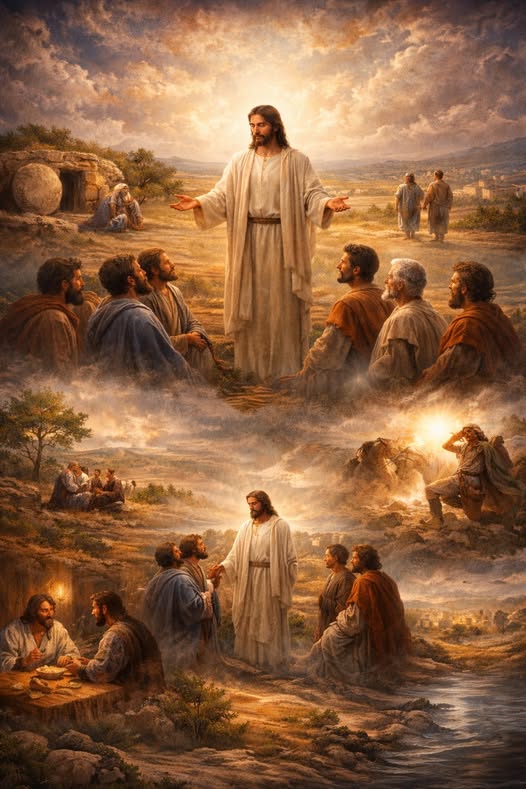
The resurrection of Jesus is not presented in Scripture as a vague religious sentiment, a private mystical vision, or a symbolic way of saying that His teachings lived on. The New Testament presents it as a series of real encounters with the risen Christ, spread across different places, different settings, and different kinds of people. Some of those people were grieving. Some were afraid. Some were confused. Some were skeptical. One was even an active enemy.
That breadth is part of the point. The risen Jesus did not appear only once, to one person, in one setting that could be dismissed or explained away. He appeared again and again, in ways that turned sorrow into proclamation, fear into courage, and doubt into worship. These appearances are not a side note to the Christian faith. They are one of the central reasons the earliest believers became so certain that Jesus had truly conquered death.
What makes these appearances especially important is the way they build on one another. Each encounter reveals something about the resurrection itself, but each one also reveals something about the character and mission of Christ. He does not merely prove that He is alive. He teaches, restores, commissions, and prepares His followers for what comes next. The resurrection, then, is not simply an event to be acknowledged. It is the beginning of the Church’s witness to a living King.
Mary Magdalene and the First Named Witness
One of the most moving appearances is Jesus’ encounter with Mary Magdalene at the tomb. She is not standing there in triumph, expecting resurrection. She is broken by grief and assumes that His body has been taken. Her first instinct is not faith, but loss. Then Jesus speaks her name, and everything changes. In that moment, her sorrow is pierced by recognition. The one she thought was gone is alive and standing before her.
That appearance matters for more than its emotional power. Mary is not only comforted. She is sent. Jesus turns her from mourner to messenger, making her the first named individual in John’s account to bear news of the risen Christ to the disciples. This is a detail that cuts strongly in favor of the Gospel accounts. In the first-century world, women did not carry the same public weight as legal witnesses. If the story were being invented for maximum persuasive power, this is not how it would begin. Yet the Gospels consistently place women at the front of the resurrection testimony because that is where they actually were.
The Women at the Tomb and the Public Nature of the Message
Matthew also records that other women encountered Jesus after leaving the tomb. Like Mary Magdalene, they are met by the risen Lord, they fall before Him in worship, and they are told to go and tell the disciples. This is an important pattern. The resurrection is never treated like secret knowledge for a spiritual elite. From the beginning, it is something meant to be proclaimed. Those who see the risen Christ are entrusted with the responsibility to bear witness.
That pattern also reminds us that the Kingdom does not operate by worldly status. The first witnesses are not political rulers, religious elites, or socially powerful men. They are faithful followers who came in love and grief, and Christ honors them by making them heralds of the greatest news in history. The Gospel does not spread because the right people in the eyes of the world approve it. It spreads because the risen Christ appoints witnesses.
Emmaus and the Opening of the Scriptures
The road to Emmaus gives us one of the richest resurrection appearances because it shows that the problem facing the disciples was not merely emotional devastation. It was also interpretive confusion. These followers knew Jesus had been crucified. They had heard reports that the tomb was empty. But they still did not understand how those facts fit into the story God had been telling all along. Their hopes had been shattered because they expected one kind of Messiah and could not yet comprehend why the Christ had to suffer before entering His glory.
Jesus meets them in that confusion, but He does not immediately reveal Himself. Instead, He walks with them and opens the Scriptures. He shows them that Moses and the Prophets had already pointed to a suffering and victorious Messiah. Only later, in the breaking of bread, do they recognize Him. That sequence matters. Their eyes are opened through both divine revelation and biblical interpretation. The resurrection is not disconnected from the Old Testament. It is the fulfillment of it. What seemed like the collapse of hope was actually the moment toward which the biblical story had always been moving.
The Disciples in Fear and the Reality of the Risen Body
When Jesus appears to the disciples in the locked room, the setting is defined by fear. These are not men confidently awaiting a triumph they predicted in advance. They are hiding. They know what happened to their Master, and they fear they may be next. Into that fear, Jesus comes speaking peace. But He does more than calm them with words. He shows them His hands and His side. In Luke’s account, He even eats in their presence. This is not a phantom, a dream, or a symbolic experience. The crucified Jesus is bodily alive.
That detail is essential because Christianity does not rest on the survival of an idea or the inspiration of a memory. It rests on the claim that Jesus truly rose from the dead. The scars remain, identifying Him as the same Jesus who was crucified, but the body standing before them is gloriously alive. The resurrection is therefore both continuity and transformation. He is the same Lord they followed before the cross, yet He now stands on the other side of death itself.
Thomas and the Confrontation of Doubt
Thomas is often remembered only for his doubt, but his role in the resurrection accounts is deeply important. He refuses to accept the testimony of the others without seeing Jesus for himself. That response is not flattering to the apostles, and it is not flattering to Thomas either, which is another mark of authenticity in the account. Scripture does not polish these men into cartoon heroes. It shows them as they were, struggling to believe something so world-altering that it shattered their categories.
When Jesus appears again, He does not cast Thomas aside. He invites him to see and to believe. The result is one of the clearest confessions in the New Testament when Thomas calls Him, “My Lord and my God.” That declaration matters because it comes in direct response to the risen Christ standing before him. Thomas does not arrive at that confession through blind emotionalism. He arrives there because his doubt is confronted by reality. The account shows that Christianity is not asking people to believe in spite of evidence. It shows Christ providing what His disciple needs so that doubt gives way to worship.
The Sea of Galilee and the Restoration of Peter
John 21 carries a very different tone from the locked room in Jerusalem. The disciples are back at the Sea of Galilee, and in some ways the scene feels almost ordinary. They are fishing, perhaps uncertain how to move forward. Then Jesus meets them there with another miraculous catch of fish, echoing the earlier moment when He first called them. The message is unmistakable. Their calling has not ended. The risen Lord still rules their mission, still provides, and still directs them.
This setting also becomes the place where Peter is restored. After denying Jesus three times, Peter could easily have assumed that his failure had disqualified him permanently. Instead, Jesus publicly recommissions him. The one who fell is called again to feed Christ’s sheep. That is a powerful reminder that the resurrection is not only proof that Jesus is alive. It is also the setting in which broken disciples are restored for service. Christ does not erase Peter’s failure by pretending it never happened. He overcomes it by reestablishing Peter in love and responsibility.
The Appearance to the Five Hundred
Paul’s reference in 1 Corinthians 15 to Jesus appearing to more than five hundred brothers at one time is one of the most significant statements about the public nature of the resurrection. This was not an isolated encounter that could be dismissed as individual grief, hallucination, or misunderstanding. It was a large-scale appearance to a crowd, and Paul adds that many of those witnesses were still alive when he wrote. In other words, this was not merely a cherished tradition. It was a claim open to challenge within living memory.
That detail is easy to miss, but it matters enormously. Paul is effectively appealing to the availability of witnesses. He is not presenting the resurrection as something buried in inaccessible antiquity. He is pointing to a body of testimony that could still be examined. Christianity did not begin as a myth developing in the dark over centuries. It began with people insisting that the risen Jesus had been seen by many.
James and the Power of the Resurrection to Create Belief
The appearance to James is brief in the text, but the implications are large. During Jesus’ earthly ministry, His brothers are not portrayed as believers in Him. Yet after the resurrection, James becomes a major leader in the Jerusalem church. Something happened to produce that change, and Paul identifies one key piece of that answer when he states that Jesus appeared to James.
This matters because it shows again that the resurrection did not merely reinforce the convictions of those already predisposed to believe. It generated belief in those who had not followed Him in faith before. James was not simply swept up in communal enthusiasm. His transformation points to an encounter weighty enough to reorder his life. That pattern strengthens the case for the resurrection because it shows the risen Christ turning skepticism into leadership.
The Great Commission and the Universal Mission
Matthew’s account of Jesus meeting His disciples in Galilee reaches beyond proof and into purpose. The risen Christ declares that all authority in heaven and on earth has been given to Him, and on that basis, He commands His followers to make disciples of all nations. This is the proper setting for the Church’s mission. The disciples are not being sent out with noble ideals and fond memories. They are being sent by the resurrected and enthroned Lord.
That means the resurrection is tied directly to the global scope of the Gospel. Because Jesus is alive and has all authority, no nation stands outside His claim. The mission is not local, tribal, or temporary. It is universal. The resurrection is therefore not merely the vindication of Jesus after His suffering. It is the public declaration that the crucified Christ now reigns and will gather a people from every corner of the earth.
The Ascension and the Shift to Spirit-Empowered Witness
The ascension is sometimes treated as the quiet conclusion to the resurrection narratives, but it is better understood as a transition in redemptive history. Jesus is taken up before His disciples, not because He is withdrawing in defeat or absence, but because He is entering His exalted reign. At the same time, He promises the coming of the Holy Spirit, who will empower His people to be His witnesses. The visible appearances of the risen Christ are giving way to the Spirit-empowered mission of the Church.
This helps explain how the resurrection testimony moved from a frightened cluster of disciples in Jerusalem to a movement that spread across the Roman world. The same Jesus who appeared to them is the one who now reigns from heaven and works through His people by the Spirit. The ascension, then, is not the end of Christ’s activity. It is the enthronement of the risen Lord and the beginning of the Church’s outward advance.
Paul and the Reach of the Risen Christ
The appearance to Saul on the road to Damascus shows that the risen Christ is not limited to comforting loyal followers. He also confronts enemies. Saul is not seeking truth in a posture of openness. He is actively persecuting the Church. Yet the risen Jesus appears to him and utterly overturns the direction of his life. That transformation becomes one of the most powerful testimonies to the continuing reign and activity of Christ.
Paul’s conversion matters for several reasons. It shows that the resurrection appearances are not confined to one emotional setting among sympathetic disciples. It also shows that Jesus continues to identify Himself with His people, asking Saul why he is persecuting Him when Saul is persecuting the Church. Most importantly, it demonstrates that the risen Christ is still acting in history, still calling servants, and still turning opponents into witnesses. The message of the resurrection is not sustained by sentiment. It is sustained by the living Lord who continues to intervene.
Conclusion
When the post-resurrection appearances are taken together, they form a unified and powerful testimony. Jesus appears to the grieving, the fearful, the doubting, the failing, the skeptical, and the hostile. He appears to women at the tomb, to disciples behind locked doors, to travelers on a road, to fishermen by the sea, to a large crowd, to His own brother, and to a persecutor on the road to Damascus. That range matters because it makes the resurrection harder to dismiss and easier to see for what Scripture presents it to be: a real event with world-changing consequences.
These appearances do more than prove that Jesus rose. They show what His resurrection means. He is alive, still teaching, still restoring, still commissioning, and still reigning. The Church did not emerge from wishful thinking or pious memory. It emerged because the crucified Christ stood alive before His followers and turned them into witnesses. That is why the resurrection remains central to the Christian faith. It is not merely the happy ending to the story of Jesus. It is the declaration that the story is still going because the risen Lord is still alive.
Discussion Questions
- Why do you think Jesus chose to appear to such a wide range of people, including skeptics, doubters, and even enemies, instead of only appearing to His closest followers?
- How do the physical details of the resurrection appearances, like eating, speaking, and being touched, challenge common modern ideas that reduce the resurrection to something symbolic or spiritual?
- What does the transformation of figures like Thomas, Peter, and James tell us about the kind of evidence and encounters that produce real, lasting belief?
- In what ways does the resurrection shift the disciples from fear to mission, and how should that same shift shape how believers think about their own role today?
- Why is it important that the resurrection was witnessed by groups, including the five hundred mentioned by Paul, rather than only private, individual experiences?
Want to Know More
- N. T. Wright, The Resurrection of the Son of God
This is one of the strongest large-scale studies on the resurrection in modern scholarship. Wright works through the Jewish background, the Greco-Roman world, the Gospel accounts, and the explosive rise of resurrection-centered Christian belief. It is especially helpful for showing why the post-resurrection appearances were central to the earliest Christian proclamation. - Gary R. Habermas and Michael R. Licona, The Case for the Resurrection of Jesus
This is a more accessible entry point that still engages the historical evidence. Habermas and Licona focus on key facts surrounding the resurrection and interact with common objections, making this a strong follow-up for readers who want to move from the biblical text into apologetics. - Michael R. Licona, The Resurrection of Jesus: A New Historiographical Approach
This is a more technical and academic treatment that applies historical method to the resurrection accounts. Licona carefully evaluates sources, methodology, and competing explanations, making it especially useful for understanding how historians approach the appearance narratives. - Craig L. Blomberg, The Historical Reliability of the Gospels
Blomberg’s work helps establish confidence in the Gospel accounts themselves. Since the resurrection appearances are drawn from these texts, this resource is valuable for showing why the Gospels should be taken seriously as historically grounded documents. - Richard Bauckham, Jesus and the Eyewitnesses: The Gospels as Eyewitness Testimony, 2nd ed.
Bauckham focuses on the role of named witnesses and the transmission of testimony in the Gospels. This directly supports a lesson on the post-resurrection appearances by reinforcing that these accounts are rooted in eyewitness memory rather than later invention.
About the Author