At the center of the Christian message stands the crucifixion of Jesus Christ, not merely as an example of suffering or sacrifice, but as the decisive turning point in the conflict between God’s kingdom and the rebellious powers. The cross is where sin is dealt with, where death is confronted, and where the corrupt rulers of the nations are fatally overplayed. The New Testament does not present the crucifixion as an unfortunate interruption in Jesus’s mission. It presents it as the very means by which God accomplished His purpose, though in a way so unexpected that the powers moving against Him failed to understand what they were doing. That failure matters, because it helps explain why the enemies of God would press toward Christ’s death while not grasping that they were securing their own downfall.
To understand that more fully, the cross has to be read within the worldview of Scripture and the wider Ancient Near Eastern context in which Scripture was given. Modern readers often think of death primarily in biological terms, as the ending of bodily life. In the ancient world, however, death was not usually conceived as erasure or total disappearance. It was understood as a transition into a lesser condition, a changed status in which the dead still existed, but in a diminished way. That concept sheds important light on why the powers may have expected Christ’s death to neutralize Him, and why the resurrection was not just surprising, but a complete overturning of their assumptions.
Death in the Ancient Near East Was Not Erasure
In the Ancient Near Eastern world, death was commonly understood as a descent into weakness, silence, and loss of status. The dead were not thought of as simply vanishing into nothing. They continued to exist, but in a reduced and shadow-like condition. The Hebrew Bible reflects this outlook in its descriptions of Sheol. The dead are still present there, but they are cut off from the fullness of life in the land of the living. They no longer participate in ordinary human activity, they no longer exercise the same kind of influence, and they are consistently portrayed as being in a state of deprivation when compared to embodied life before God.
This is an important distinction. Death was real, fearful, and tragic, not because it meant nonexistence, but because it meant loss. To die was to be lowered. It was to pass from strength into weakness, from activity into stillness, from social and covenantal participation into a diminished form of existence. That is why death in the Old Testament is so often associated with the grave, silence, and the inability to praise God as one does among the living. The issue is not that the person has ceased to be, but that the person has become less than what he was. In that sense, death was a reduction of status.
The Nephilim Tradition and the Logic of Reduction
Second Temple literature develops this same pattern further, especially in relation to the Nephilim and their aftermath. In texts like 1 Enoch, the giants do not simply disappear after death. Their postmortem state is one of continuation under diminished conditions. They become disembodied spirits, restless and corrupt, still active in a limited sense, but deprived of the embodied might and stature that once defined them. Whatever one wants to say about the canonical status of those texts, they are valuable for showing how many Jews in the Second Temple period thought about death, spiritual beings, and the fate of rebel powers.
That matters because it reveals a consistent pattern in the worldview of the time. Death did not elevate. Death reduced. Even mighty beings who once exerted enormous power were not thought to become greater through death. They became lesser. They persisted, but in altered and damaged form. If that was the operating logic of the unseen realm, then the death of Jesus could have looked to the rebellious powers like the elimination of a threat. If He could be killed, then He could be reduced. If He could be reduced, then His mission could be brought to an end, or at least His authority could be contained.
The Rulers of This Age Knew More Than They Understood
It is important to state carefully that the spiritual powers were not utterly ignorant of who Jesus was. The Gospels show the demonic realm recognizing Him with startling clarity. The demons identify Him, name Him as the Son of God, and respond to Him as one who possesses immediate authority over them. That means the issue was not total ignorance of His identity. They knew they were dealing with someone far greater than an ordinary man, and they understood enough to fear Him, resist Him, and seek His destruction.
What they did not understand was the wisdom of God in the cross. Their knowledge of His identity did not translate into understanding the divine plan. They recognized the threat, but they misread the strategy. They knew who He was, but they did not grasp what His death would accomplish. That is where Paul’s statement in 1 Corinthians 2:8 becomes so important. When he says that the rulers of this age would not have crucified the Lord of glory if they had understood, he is not saying they had never perceived anything about Him. He is saying they failed to comprehend the hidden wisdom of God, the mystery by which Christ’s death would become the instrument of their defeat.
The Rulers of This Age Did Not Understand
This is where Paul’s statement in 1 Corinthians 2 becomes especially important. He says that the rulers of this age did not understand God’s wisdom, for if they had, they would not have crucified the Lord of glory. That statement makes little sense if the crucifixion was simply a straightforward triumph of evil over good. Paul is saying something much deeper. The rulers acted in ignorance. They were not ignorant of Christ’s significance in every sense, but they were ignorant of what His death would actually accomplish. They did not grasp the mystery God had ordained from before the ages, and because they did not grasp it, they walked directly into the trap divine wisdom had set.
Within a biblical supernatural worldview, there is good reason to see these rulers as more than merely human authorities. Human rulers were certainly involved. Pilate, the chief priests, the Sanhedrin, and the machinery of Roman execution all played their roles. But Scripture repeatedly presents earthly rebellion as intertwined with spiritual rebellion. The powers behind the nations, the corrupt elohim associated with the administration of the nations after Babel, and the unseen rulers opposed to God’s kingdom are all part of the larger picture. Paul’s language fits that larger framework. The crucifixion was not merely a miscarriage of justice at the human level. It was a cosmic confrontation in which the powers were maneuvered into bringing about the very event that would strip them of their claim to rule.
Why the Cross Looked Like Victory to the Powers
From the perspective of the rebellious powers, the death of Jesus likely appeared to be exactly the right move. He was the one announcing the kingdom of God, casting out demons, healing the oppressed, confronting corrupt authority, and reclaiming ground that had long been under dark influence. He was not merely teaching morality. He was invading enemy territory. His ministry was a direct assault on the dominion of the powers, and His presence was exposing their illegitimate rule. Since they recognized His authority, they also recognized the danger He posed to them. That helps explain why opposition to Him escalated so fiercely.
At the same time, their recognition of His authority did not save them from their own bad assumptions. If they could bring Him to death, then by the logic of the ancient world, they could bring Him down into the same diminished realm that swallowed every other human being. That expectation would have made perfect sense in terms of ANE assumptions about death. Death was the great reducer. It took kings and turned them into shades. It took warriors and silenced them. It took the mighty and rendered them weak. It turned embodied strength into frailty and public authority into reduced existence in the underworld. If even the Nephilim tradition reflected the idea that mighty beings could continue after death only in degraded form, then the powers had every reason to assume that Christ’s death would neutralize Him. Their fatal mistake was that Jesus was not merely another figure moving within the ordinary boundaries of death. He was the Lord of glory, and death could not hold Him.
The Hidden Wisdom of God
Paul’s point is not simply that the powers lacked information. It is that God’s wisdom was hidden in such a way that the enemies of God could not see the true shape of the plan unfolding before them. This does not mean the Old Testament gave no hints. It did. The suffering righteous one, the pierced one, the rejected stone becoming the cornerstone, the Servant who bears sin, and the Son of Man who receives dominion all pointed in that direction. But the full convergence of suffering, death, descent, resurrection, exaltation, and the stripping of hostile powers was not something the rulers of this age put together.
The same pattern is visible even among Jesus’s own disciples, who repeatedly struggled to understand His predictions of death and resurrection. They heard Him speak of these things, but they did not yet grasp what He meant because they were still expecting triumph in more obvious political or visible terms. If His own followers had trouble understanding the shape of the victory, it is no surprise that the rebellious powers misread it as well. God’s plan was not hidden because it was irrational. It was hidden because divine wisdom was unfolding along lines the powers did not expect. They knew who Christ was in some real sense. What they did not understand was what would happen when the author of life entered death and broke it from the inside.
The Resurrection Reversed the Expected Outcome
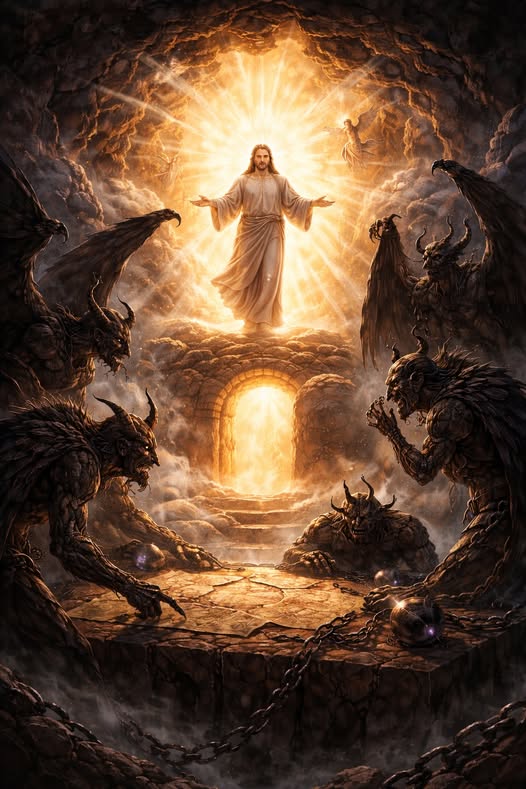
The resurrection of Jesus was not simply a miracle tacked onto the end of the crucifixion story. It was the public overturning of everything the powers had assumed. Instead of being diminished, Christ was vindicated. Instead of being reduced, He was exalted. Instead of being trapped in the realm of death as one more weakened shade, He rose in glory and emerged as the one to whom all authority in heaven and on earth had been given. The very event the powers expected to end His threat became the event through which His kingship was openly established.
This is why the resurrection cannot be reduced to a nice ending or a symbolic statement about hope. In biblical theology, it is the decisive declaration that the powers were wrong. Death did not erase Christ, and it did not reduce Him to impotence. It became the place where His obedience was displayed, His righteousness was vindicated, and His authority was manifested in a new stage of redemptive history. The one they tried to lower was enthroned. The one they expected to silence now speaks as risen Lord. The one they assumed could be contained now stands as ruler over heaven and earth.
The Powers Were Disarmed at the Cross
Paul makes this explicit in Colossians 2:15, where he says that God disarmed the rulers and authorities and put them to open shame, triumphing over them in Christ. That language is not decorative. It is warfare language. It describes defeat, exposure, and public humiliation. The powers were not merely inconvenienced by the cross. They were stripped. Their authority was unmasked as corrupt and temporary. Their hold over the nations and over humanity was broken by the obedience, death, and resurrection of Christ.
This also explains why the cross is not only about individual forgiveness, though it certainly includes that. It is also about cosmic reclamation. Humanity’s bondage to sin, death, and the hostile rulers behind the nations is confronted at the cross. Christ does not simply offer private spiritual comfort. He reclaims the world. He begins the overthrow of the rebel administration that had held the nations in darkness. The gospel is therefore not merely a message about going to heaven when you die. It is the announcement that the crucified and risen Jesus now reigns, and that the powers who once held sway are living on borrowed time.
Humanity’s Restoration Under the Risen Christ
This larger picture also helps explain why the New Testament so often links Christ’s exaltation to the restoration of humanity’s place under God. Human beings were created to image God and to rule under Him, but that vocation became entangled with rebellion, idolatry, and subjection to corrupt spiritual powers. The nations were handed over, lesser rulers became corrupt, and the human story became one of exile, bondage, and death. Christ enters that story not merely to forgive isolated acts of sin, but to restore the human calling itself. He succeeds where Adam failed, where Israel failed, and where every earthly ruler failed.
Because Christ did not remain in a diminished state, those united to Him will not remain under death either. His resurrection becomes the guarantee of theirs. His exaltation becomes the pattern of their future vindication. In Him, death is still an enemy, but it is no longer the final reducer. The ancient expectation that death always lowers and never restores has been shattered by the resurrection of Jesus. That does not mean believers avoid death in the present age, but it does mean death no longer has the last word. The powers can still wound, accuse, and persecute, but they cannot secure ultimate victory over those who belong to the risen King.
Conclusion
When the crucifixion is read within the worldview of the Ancient Near East and the Second Temple period, the event comes into sharper focus. The powers did not simply lash out in blind rage, nor were they completely ignorant of who Jesus was. The demonic realm recognized Him, feared Him, and knew they were dealing with one who possessed divine authority. Their error was not in failing to recognize Him at all. Their error was in failing to understand the wisdom of God in the cross.
They acted according to a logic they thought they understood. Death, in their frame of reference, was not erasure, but it was reduction. It brought the mighty low, changed status, and confined beings to a lesser condition. That expectation likely shaped the way they viewed Christ’s execution. If He could be killed, then He could be diminished. If He could be diminished, then He could be neutralized. But the cross did not produce the outcome they expected. Christ entered death without being mastered by it.
He passed through the realm that reduces all others and emerged exalted, vindicated, and enthroned. What the rulers of this age mistook for victory became the moment of their undoing. The wisdom of God was greater than their strategy, the obedience of Christ was stronger than their violence, and the resurrection revealed that the Lord of glory cannot be reduced to a lesser state like every other son of Adam. In the crucifixion and resurrection, the powers were exposed, death was broken, and the authority of the risen Christ was established over heaven and earth. That is why the cross stands at the center of Christian theology, not as a symbol of loss alone, but as the turning point where God’s hidden wisdom overturned the rulers of this age and began the restoration of all things.
Discussion Questions
- How does the Ancient Near Eastern view of death as a diminished state, rather than nonexistence, change the way we understand what the powers expected to happen at the crucifixion?
- The Gospels show that demons recognized Jesus’s identity, yet Paul says the rulers did not understand God’s wisdom. What is the difference between recognizing who Jesus is and understanding what He came to accomplish?
- In what ways does the resurrection of Jesus completely overturn the ancient assumption that death always reduces and never restores?
- How does viewing the crucifixion as a cosmic confrontation with spiritual powers deepen our understanding of passages like 1 Corinthians 2:8 and Colossians 2:15?
- If the cross represents not only forgiveness of sin but also the defeat of corrupt spiritual rulers, how should that shape the way believers think about authority, mission, and the Great Commission today?
Want to Know More
- Michael S. Heiser, Reversing Hermon: Enoch, the Watchers, and the Forgotten Mission of Jesus Christ. This is one of the most useful books for the specific angle of your lesson because Heiser directly connects the Watchers tradition, Second Temple expectations, and the mission of Jesus. For a lesson dealing with the powers, the Nephilim tradition, and the way Christ’s work overturns supernatural rebellion, this is one of the most on-point resources available.
- Michael S. Heiser, Demons: What the Bible Really Says About the Powers of Darkness. This works well as a companion volume because it focuses more broadly on evil spiritual powers, supernatural rebellion, and how the biblical writers actually frame these beings. It is especially helpful for readers who want to move beyond popular assumptions and engage the biblical worldview more carefully.
- John H. Walton, Ancient Near Eastern Thought and the Old Testament: Introducing the Conceptual World of the Hebrew Bible. This is an essential resource for understanding the ANE background behind your lesson. Walton explains how the ancient world understood reality, order, death, and the divine realm, which directly supports the idea that death was viewed as a reduction or change of status rather than erasure.
- N. T. Wright, The Resurrection of the Son of God. This is one of the strongest scholarly works on resurrection in its historical context. Wright explores ancient Jewish and pagan beliefs about death and afterlife, making it clear how radically different the resurrection of Jesus is from normal expectations, which ties directly into your argument about the reversal of death.
- Larry W. Hurtado, Destroyer of the Gods: Early Christian Distinctiveness in the Roman World. This book helps place the victory of Christ in the broader religious landscape of the ancient world. It shows how early Christianity confronted competing divine claims and spiritual powers, reinforcing the cosmic dimension of the cross and resurrection in your lesson.
About the Author