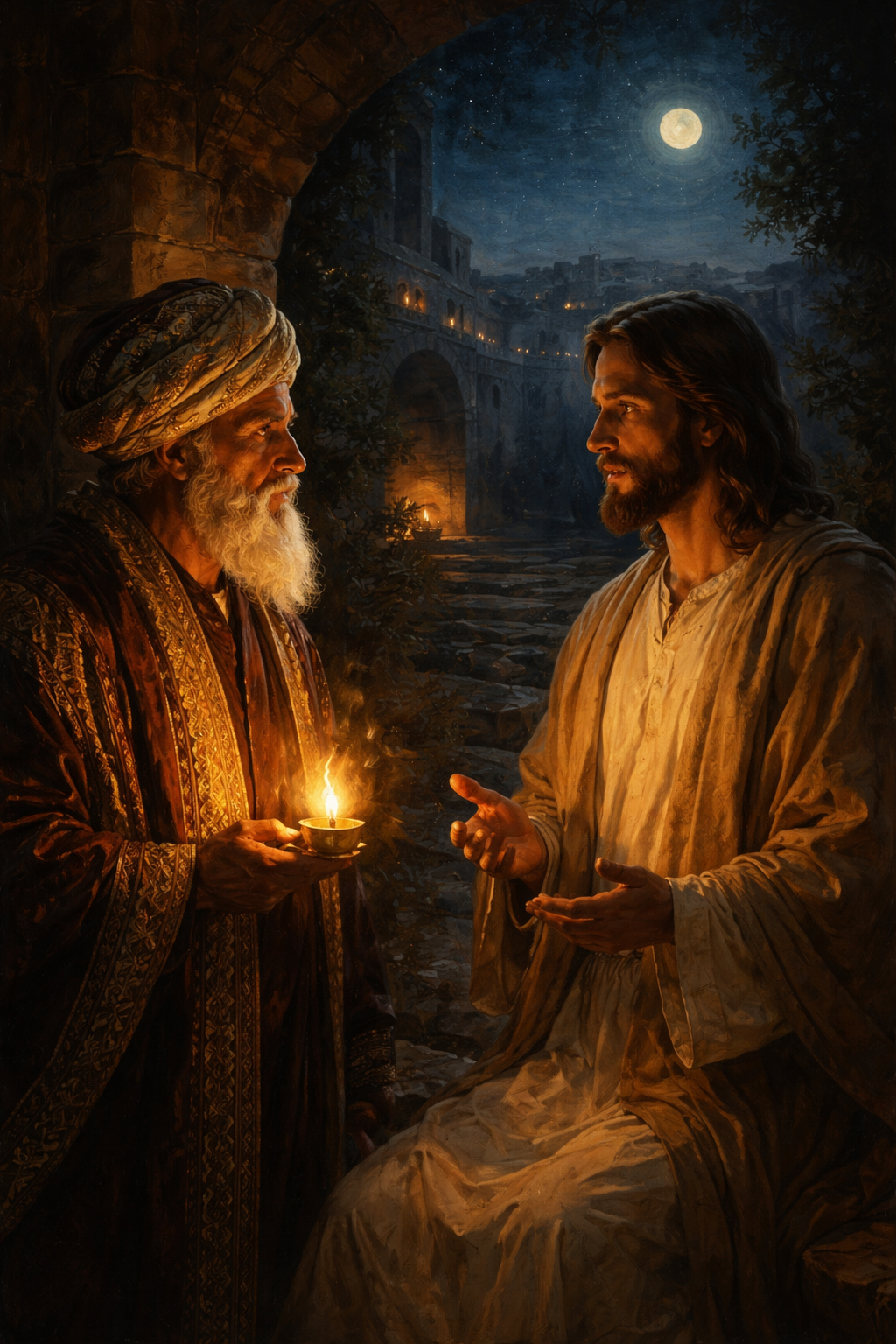
Nicodemus is central to correcting a widespread but textually unsupported claim often repeated in Christian teaching: that Jesus Christ held a general disdain for the Pharisees as a group. This claim is usually inferred from Jesus’ sharp rebukes of hypocrisy, but it ignores how the Gospels themselves differentiate between resistance to truth and sincere engagement with it. Nicodemus appears in the Gospel of John precisely to demonstrate that distinction.
Rather than functioning as a narrative antagonist, Nicodemus is presented as a serious religious authority whose encounter with Jesus unfolds gradually. His presence disrupts any attempt to turn “Pharisee” into a moral category rather than a descriptive one. The text treats him not as a symbol of failure, but as an individual navigating the cost of truth within a powerful religious system.
A Pharisee Jesus Engaged, Not Dismissed
Nicodemus is identified as both a Pharisee and a ruler of the Jews, placing him within the Sanhedrin and among the most educated interpreters of Israel’s Law. He is not portrayed as ignorant or malicious. He approaches Jesus because the signs force a theological question that cannot be ignored. His opening words acknowledge divine authorization without yet understanding its implications.
The nighttime setting of their meeting is often moralized, but the text itself does not do this. It reflects the political reality of the moment, not duplicity. Jesus does not rebuke Nicodemus for caution, nor does He accuse him of impure motives. Instead, Jesus immediately moves the conversation into deep theological territory, speaking of rebirth from above, the work of the Spirit, and the nature of the kingdom of God. This is not how Jesus speaks to someone He has written off.
Correction Without Condemnation
Jesus challenges Nicodemus directly by appealing to his role as “the teacher of Israel.” This is not contempt. It is expectation. Jesus assumes that Nicodemus should recognize the trajectory of Israel’s Scriptures and confronts him with the gap between knowledge and understanding. The rebuke is precise and proportional, aimed at illumination rather than humiliation.
This distinction matters. Jesus’ harshest words in the Gospels are reserved for leaders who actively resist truth while exploiting their authority. Nicodemus does neither. He questions, listens, and allows himself to be unsettled. Jesus responds to him as someone capable of growth, not as an enemy to be exposed.
Pharisees Were Not the Problem by Definition
Modern preaching often treats “Pharisee” as shorthand for spiritual blindness. Historically and textually, this is inaccurate. The Pharisees emphasized Scripture, prayer, ethical obedience, and belief in resurrection, all themes Jesus regularly affirms. His disputes with them center on misuse of authority, distortion of intent, and performative righteousness, not on their existence as a group.
Nicodemus embodies this distinction. He does not weaponize the Law to protect his status. He allows it to interrogate his assumptions. Jesus’ interaction with him shows that Pharisaic identity itself was not the issue. Resistance to truth was.
Faith That Develops Under Pressure
Nicodemus’s later appearance before the Sanhedrin shows measurable progression. He does not declare allegiance publicly, but he appeals to the Law’s demand for justice and due process when others seek summary condemnation. This is not neutrality. It is restrained courage shaped by increasing conviction.
The Gospel presents this moment without critique. Faith here is not instantaneous or dramatic. It develops within constraint, where risk is real and consequences are unavoidable. The text treats this growth as genuine rather than deficient.
Public Action Without Commentary
After the crucifixion, Nicodemus appears again, this time without ambiguity. He participates openly in Jesus’ burial and brings an extravagant amount of burial spices. This is a public act that identifies him with a condemned man at the point when association offers no benefit and only danger.
John does not editorialize this moment. There is no praise or explanation attached to it. The narrative allows the action to stand on its own, consistent with the trajectory already established. Nicodemus’s faith is demonstrated through costly obedience rather than verbal affirmation.
Conclusion
Nicodemus forces a more careful reading of Jesus’ conflicts with the Pharisees. The Gospels do not present Jesus as opposing religious groups wholesale, but as confronting individuals according to their response to truth. Titles and affiliations do not determine Jesus’ posture. Engagement does.
By taking Nicodemus seriously, Jesus demonstrates that sincere pursuit is met with challenge rather than dismissal, even when it comes from within flawed systems of authority. Nicodemus’s story shows that Jesus’ rebukes are targeted, not indiscriminate, and that the dividing line in the Gospels is not between Jesus and the Pharisees, but between truth received and truth resisted.
Discussion Questions
- How does Nicodemus’s role as a Pharisee and member of the Sanhedrin shape the way Jesus speaks to him in John 3, and what does that suggest about accountability in spiritual leadership?
- In what ways does Nicodemus’s nighttime visit reflect political and social realities rather than moral failure, and how does that affect common interpretations of secrecy and faith in the Gospels?
- How does the distinction between hypocrisy and sincere inquiry help explain why Jesus rebukes some Pharisees harshly while engaging others patiently?
- What does Nicodemus’s gradual movement from private questioning to public action reveal about how faith can develop under pressure rather than ideal conditions?
- How might flattening the Pharisees into a single moral category distort both the historical context of the Gospels and modern applications of Jesus’ teachings on authority and truth?
Want to Know More
- D. A. Carson, The Gospel According to John
A widely respected evangelical commentary that treats Nicodemus within John’s theological and literary framework, emphasizing Jesus’ engagement with Jewish leaders as individuals rather than as stereotypes. - Craig S. Keener, The Gospel of John: A Commentary (2 vols.)
A comprehensive scholarly work providing extensive Second Temple Jewish background, including detailed discussion of Pharisees, the Sanhedrin, and the social risks faced by figures like Nicodemus. - N. T. Wright, Jesus and the Victory of God
Places Jesus’ confrontations with religious authorities in their first-century Jewish context, showing that His critiques function as prophetic challenges rather than blanket condemnations of groups. - Joachim Jeremias, Jerusalem in the Time of Jesus
A classic historical study of Jewish religious leadership, social structures, and institutions, helpful for understanding the status and responsibilities of a Sanhedrin member like Nicodemus. - E. P. Sanders, Judaism: Practice and Belief, 63 BCE–66 CE
Provides essential background on Pharisaic belief and practice, correcting common caricatures and helping readers distinguish between later polemics and historical reality.
About the Author