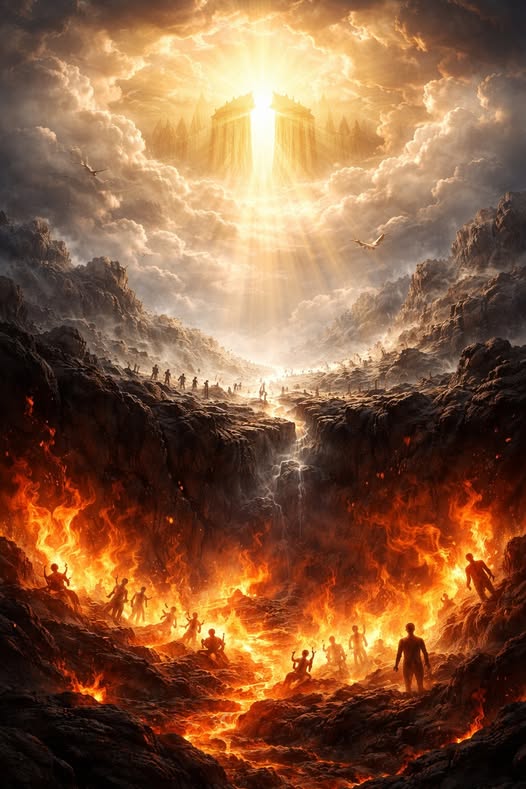
Annihilationism is often defended as the most decisive and morally satisfying form of judgment. Extinction, it is argued, permanently ends rebellion, suffering, and moral tension. If the wicked no longer exist, judgment feels complete, justice appears settled, and the emotional weight of eternal punishment seems resolved in a way that avoids ongoing discomfort.
The difficulty is that Scripture does not define finality as nonexistence. Biblically, final judgment is framed in terms of permanence, fixity, and the end of all future possibility rather than the erasure of being. When modern intuitions about what feels “final” are imported into the text, they quietly override the internal logic Scripture uses to describe resurrection, judgment, and the fate of the wicked.
Because annihilationism presents itself as a biblical alternative rather than a philosophical preference, it must be tested against the structure of Scripture itself. That requires following the sequence Scripture establishes from resurrection to judgment to final state. Only by tracing that sequence carefully can extinction be evaluated on biblical terms instead of assumed as the default meaning of final judgment.
What Annihilationism Claims
Annihilationism affirms final judgment and rejects universalism. It teaches that the wicked are raised, judged, and then destroyed so that they no longer exist. Some versions allow for a limited period of suffering prior to extinction, while others envision immediate annihilation following judgment.
The position usually rests on three interconnected claims. First, immortality is a gift granted only to the redeemed and is not intrinsic to human nature. Second, biblical language of death, destruction, and perishing should be understood as literal cessation of existence. Third, extinction is assumed to be the most final and proportionate response to rebellion against God.
These claims appear coherent when treated independently, but their coherence depends on whether resurrection, death, and judgment can be separated conceptually. If Scripture binds them together as stages of a single irreversible movement toward final states, then extinction must be justified within that movement rather than assumed as its endpoint. This makes resurrection the first pressure point that must be examined.
Resurrection as the Irreversible Turning Point
Scripture consistently teaches a resurrection of both the righteous and the wicked. Daniel speaks of some raised to everlasting life and others to everlasting contempt. Jesus speaks of a resurrection to life and a resurrection to judgment. Resurrection is universal, while outcomes diverge.
Resurrection is never portrayed as provisional or temporary. It marks entry into the age to come rather than a restoration within the present order. Judgment follows resurrection because accountability must be rendered upon the same embodied agents who acted in history, preserving continuity of identity and moral responsibility.
This means resurrection cannot be treated as a disposable mechanism God uses prior to erasing existence. It establishes the subject in a final mode of existence appropriate for judgment or life. Any attempt to make resurrection temporary introduces instability into the biblical framework and forces later doctrines to compensate for a move Scripture itself never makes.
Are the Damned Raised into Perishable Flesh
Some annihilationist models attempt to preserve extinction by proposing that the wicked are raised into perishable, non-glorified flesh and then destroyed. This proposal is often supported by appeal to Lazarus, whose body had already begun to decay before being raised.
Lazarus, however, was restored to mortal life within the present age. His raising was reversible and he died again. Scripture never presents Lazarus as a model for final resurrection, nor does it treat resurrection unto judgment as a return to biological vulnerability.
The difference is not the condition of the corpse but the purpose of the act. Final resurrection ends death’s authority over the person rather than reestablishing it. A return to perishability after resurrection would require death to resume its role, a move Scripture never describes and later explicitly forbids.
Judgment and the Destruction of Death
Paul identifies death as the last enemy to be destroyed. Revelation depicts death and Hades being thrown into the Lake of Fire. In Scripture, death is not merely the event of dying but a dominion that enslaves, confines, and governs the dead.
Judgment occurs before death itself is judged. Death releases the dead for resurrection, judgment is rendered, final states are assigned, and only then is death destroyed. This ordering is deliberate and establishes the point at which death ceases to function.
Because death is destroyed after judgment, it cannot continue operating as a mechanism of extinction. Any model that places annihilation after judgment necessarily reintroduces death after Scripture declares its defeat. This ordering alone severely constrains what final judgment can mean.
Psalm 82 and Dying Like Men
Psalm 82 depicts rebellious elohim being judged and told they will die like men. This passage is often cited as evidence that even immortal beings can be destroyed or extinguished.
The scene, however, is judicial rather than ontological. To die like men is to lose authority, immunity, and delegated rule. The elohim are condemned and demoted, not erased from existence, and they continue to appear in later biblical texts as hostile powers awaiting further judgment.
This use of death language forces an important clarification. In Psalm 82, death does not mean the cessation of existence but the loss of status, protection, and delegated authority. The elohim are judged downward into a condition that mirrors human vulnerability rather than erased from reality altogether. This demonstrates that Scripture can speak of death in judicial and relational terms without implying annihilation. If death language does not automatically mean extinction for divine beings, it cannot be assumed to mean extinction for resurrected humans.
Sheol and Divine Death
In the biblical and ancient Near Eastern worldview, when gods die they descend to Sheol. Sheol is not annihilation but confinement, humiliation, and diminished existence under judgment. Both humans and divine beings can be described as dead while remaining conscious and accountable.
This category demonstrates that Scripture already distinguishes between life and existence. Death often names a relational condition of exclusion rather than the cessation of being itself. As long as death reigns, Sheol functions as a holding realm within that system.
Sheol therefore serves as a critical conceptual bridge in the biblical worldview. It shows that beings can be described as dead while still existing as moral subjects under judgment. This breaks the assumed equation between death and nonexistence that annihilationism relies upon. It also prepares the reader for a later biblical move in which death itself is abolished and replaced by a final state that no longer functions as a realm of transition.
The Lake of Fire as a Post-Death State
The Lake of Fire is not Sheol, not Hades, and not a temporary holding realm. It appears after resurrection and judgment. Death and Hades are thrown into it, indicating that no one enters it by dying and no one leaves it by dying.
If the Lake of Fire functioned as annihilation, death would still be operating after its destruction. Scripture explicitly rejects this possibility. The Lake of Fire is not the mechanism of death but the condition that replaces death once death has been judged.
Because this state exists beyond death’s authority, it must be understood in terms of permanence rather than process. This explains why the language surrounding the Lake of Fire emphasizes endurance, exclusion, and fixity rather than disappearance or cessation.
The Second Death as Verdict
After judgment, the wicked are said to be in the second death. This does not describe a second instance of dying but a final condition defined by exclusion from the life of God.
Death as a ruling power is destroyed, but death as a verdict remains. The second death names a settled relational state rather than an ontological process. Scripture consistently distinguishes between existence and participation in life.
Understanding the second death as a verdict rather than an event resolves several persistent tensions. It allows death to be truly defeated while still functioning as a descriptive category for final exclusion. It also explains why Scripture continues to use death language in the age to come without implying decay, extinction, or further dying.
Why Extinction Is Not Biblically Final
Extinction feels final because it ends experience. Biblically, finality is defined by the end of all future possibility, appeal, or change. Final judgment fixes orientation, destiny, and relationship forever.
Annihilation ends the subject, while biblical judgment ends the future. Extinction would allow death to deliver the final word, but Scripture removes that role from death and assigns finality to God’s verdict alone. Judgment is accomplished by containment rather than erasure.
This distinction explains why Scripture consistently frames final judgment as enduring rather than terminal. Finality is achieved through permanence, not disappearance.
The Pastoral Objection
A common emotional objection asks how the redeemed could be joyful knowing loved ones are under eternal judgment. Scripture does not answer this by erasing memory, love, or awareness.
Eternal joy is grounded in alignment with truth rather than denial of reality. The redeemed do not rejoice in suffering but in the end of rebellion and the restoration of moral order. Love no longer contests God’s verdicts or clings to false hope because judgment has completed its work.
Scripture places the burden of urgency, warning, and mercy on the present age, reserving comfort for the age in which justice is complete and uncontested.
Final Judgment, Experience, and the End of Process
One overlooked possibility in discussions of final judgment concerns the relationship between permanence and experience. Scripture is highly descriptive when judgment is approaching, awareness is forming, and verdict is being recognized. Before the Lake of Fire, we see fear, recognition, regret, and speech. These descriptions occur in Sheol, at resurrection, and at the moment judgment is rendered. Once the Lake of Fire appears and death itself is judged, however, Scripture’s language shifts. The emphasis moves away from interior experience and toward fixity, exclusion, and irreversibility.
This shift allows for a coherent category in which judgment is eternal without requiring ongoing experiential torment. Eternity in Scripture does not function as infinite duration experienced moment by moment, but as a settled state in which change, decay, and process have ceased. If a being is fixed permanently under judgment, that state does not require continuous conscious awareness in order to be real or just. The verdict remains, exclusion remains, and restoration is no longer possible, even if experiential sensation is no longer operative.
An analogy may help clarify the category. A being frozen in a single moment for eternity would not experience the passage of time, even though the condition itself is permanent. From the outside, the state is eternal. From the inside, there is no ongoing experience because process has ended. In the same way, final judgment may result in a permanent condition of exclusion without requiring endless subjective suffering to make that judgment meaningful.
This proposal does not collapse into annihilationism. The subject still exists under verdict, and death does not undo being after resurrection. What ends is not existence, but becoming. Judgment is satisfied, mercy is not negated, and death does not regain jurisdiction after it has been destroyed. Scripture requires eternal exclusion and finality; it does not require us to speculate beyond that about the mechanics of experience once all process has come to an end.
Conclusion
Annihilationism depends on reintroducing death after death has been abolished. Scripture does not permit this move. Resurrection is irreversible, judgment is final, and death is destroyed.
When the full sequence of resurrection, judgment, and the destruction of death is held together, annihilationism fails structurally rather than emotionally. It requires death to continue operating after Scripture declares its defeat, and it requires resurrection to function as a temporary mechanism rather than a final transition. The biblical witness instead presents final judgment as a state of permanent fixity under God’s verdict. Life continues for the redeemed in glorified communion, while the wicked remain in death as exclusion from that life. Scripture resolves rebellion not by erasure, but by ensuring rebellion has no future.
Discussion Questions
- How does the biblical sequence of resurrection, judgment, and the destruction of death challenge the assumption that extinction is the most final form of judgment? Which step in that sequence creates the greatest difficulty for annihilationism, and why?
- The lesson argues that resurrection is an irreversible transition into the age to come rather than a temporary mechanism. How does this understanding of resurrection affect proposals that the wicked are raised only to be destroyed afterward?
- Psalm 82 describes rebellious elohim as “dying like men” without implying nonexistence. How does this use of death language reshape the way we should interpret biblical terms like death, destruction, and perishing in discussions of final judgment?
- The lesson distinguishes between death as a ruling power and death as a verdict. How does this distinction help explain the meaning of the “second death” after death itself has been destroyed?
- Many people find annihilationism emotionally appealing because it seems to resolve the tension between divine justice and eternal punishment. According to the lesson, how does Scripture address that tension without resorting to extinction, and what implications does this have for how believers think about justice, mercy, and finality?
Want to Know More
- Edward William Fudge, The Fire That Consumes: A Biblical and Historical Study of Final Punishment
A comprehensive defense of conditional immortality and annihilationism that surveys biblical texts, Second Temple literature, and early church sources. This work represents the strongest scholarly case for annihilationism from within evangelical theology. - Robert A. Peterson, Hell on Trial: The Case for Eternal Punishment
A sustained biblical and theological defense of eternal conscious punishment. Peterson engages annihilationist arguments directly and emphasizes resurrection, judgment, and the permanence of final states. - Preston Sprinkle (ed.), Four Views on Hell: Second Edition
A multi-view volume presenting and critiquing four positions: eternal conscious punishment, annihilationism, universal reconciliation, and purgatory. Valuable for seeing how annihilationism is articulated and challenged in contemporary evangelical scholarship. - N. T. Wright, Surprised by Hope
Explores resurrection, new creation, and final judgment with an emphasis on bodily resurrection and eschatological continuity. While not a focused work on hell, Wright’s treatment of resurrection and finality is essential for evaluating annihilationist proposals. - Richard Bauckham, The Theology of the Book of Revelation
A focused theological study of Revelation that examines judgment, the Lake of Fire, the defeat of death, and final states. Particularly helpful for understanding the narrative sequencing that constrains annihilationist interpretations.
About the Author