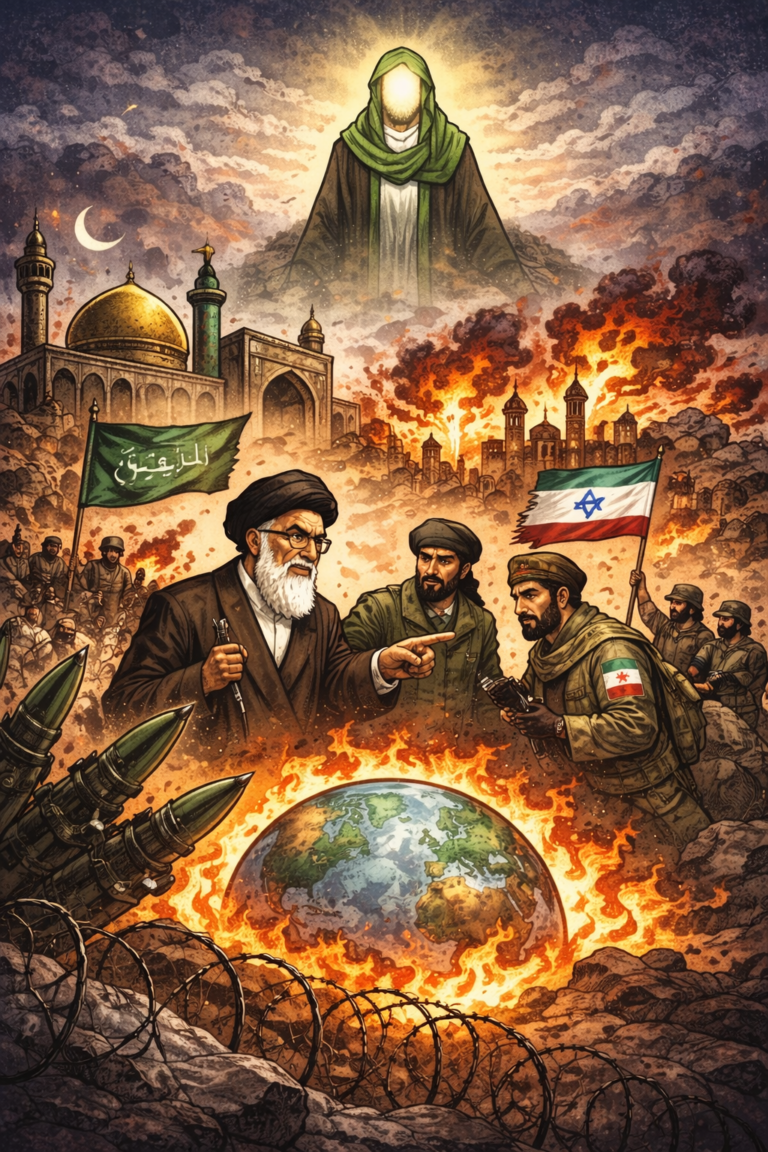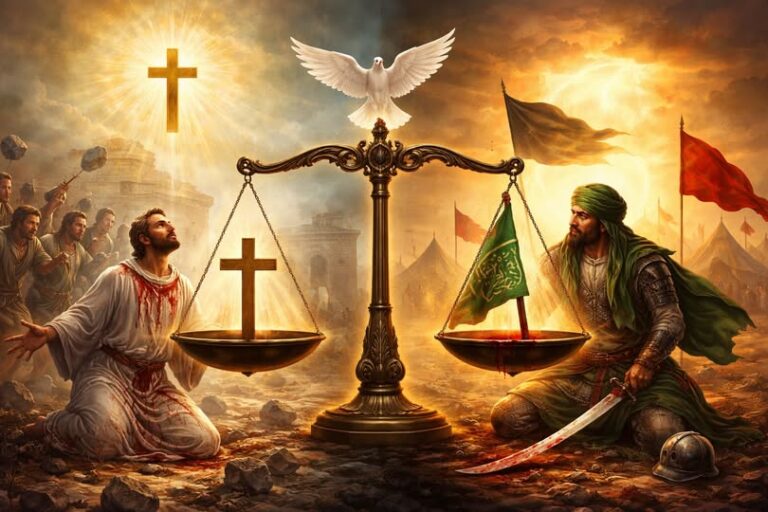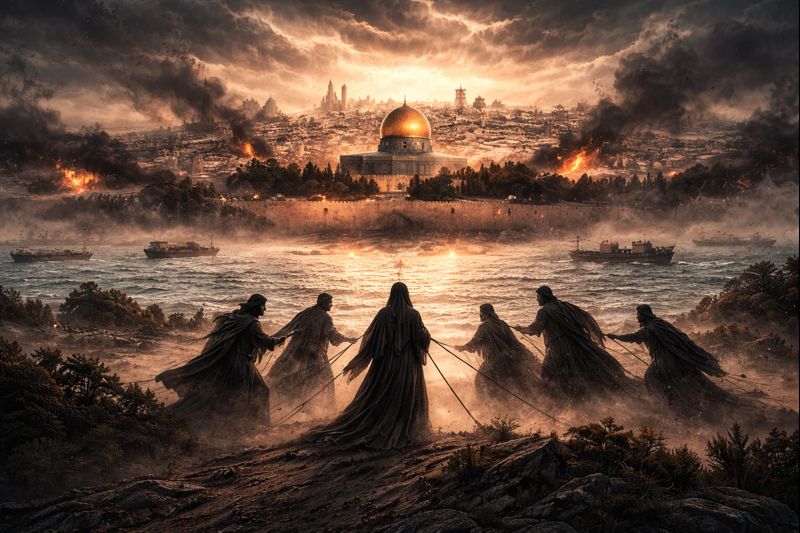
What follows is a thought exercise, not a prophecy, not a timeline, and not a claim that specific future events are fixed or inevitable. Eschatology always carries a real risk of error. The purpose here is pattern recognition, tracing theological and historical trajectories, and asking whether they resemble the kinds of developments Scripture repeatedly warns about. This is exploration, not prediction.
Erdogan as a Theological Actor, Not a Political One
Erdogan cannot be understood as a conventional nationalist leader. His rhetoric, symbolism, and policies consistently frame authority in civilizational and religious terms. He presents himself as heir to Ottoman legacy, defender of Islam, and guardian of Jerusalem against Israel. In doing so, he collapses the boundary between political loyalty and religious obligation. Scripture consistently treats this fusion of power as dangerous. The most threatening rulers in the biblical narrative are not those who merely abuse authority, but those who sacralize it and present submission as morally righteous.
The Western Blind Spot That Normalized the Pattern
Western leadership often treated Erdogan as a difficult but necessary partner rather than a revisionist actor with ideological ambition. Transactional, leader-to-leader diplomacy allowed him to frame himself as indispensable while downplaying Islamist commitments. This produced tolerance rather than restraint. Turkish actions against the Kurds were excused, Islamist factions under Turkish protection were politically laundered, and hostility toward Israel was treated as rhetorical rather than theological. Over time, the West became conditioned to accept things it once would have rejected outright.
Syria and the Successor Pattern
That conditioning becomes most visible in Syria. Out of prolonged civil war and jihadist fragmentation emerged a leader forged in chaos rather than institutions. Authority did not arise from reform or consensus but from survival, consolidation, and rebranding. Without repudiating the ideology that produced him, he adopted the posture of a restrained statesman and presented himself as necessary for stability. The shift from pariah to legitimate interlocutor marks a threshold Scripture repeatedly associates with dangerous authority.
Qatar as the Financial and Narrative Enabler
Any serious theological reading of this constellation must include Qatar. Qatar functions as a financial, diplomatic, and media enabler, allowing Islamist movements to survive long enough to be reframed and normalized. While presenting itself as a neutral mediator, it has consistently funded, hosted, or protected Islamist actors across the region. Through money, safe harbor, and narrative control, Qatar supplies legitimacy without overt rule. Biblically, this resembles the supporting power that sustains rebellion rather than the ruler who embodies it directly.
Saudi Arabia as the Prostitute Destroyed by the Beast
The role of Saudi Arabia aligns closely with Revelation’s description of the prostitute. Revelation presents her as wealthy, globally connected, and economically indispensable, partnered with kings and merchants before being destroyed by the very system she helped sustain.
She is associated with ports, ships, and global trade, with merchants and sailors watching her destruction from the sea. At the same time, she is shown in a wilderness, a desert context that is integral rather than incidental. This combination of maritime commerce and desert geography is central to the imagery.
Saudi Arabia’s power flows through coastal ports on the Red Sea and Persian Gulf, global shipping lanes, and energy exports, while its interior remains desert. Its legitimacy is religious, grounded in custodianship of Mecca and Medina, but its wealth is economic and maritime. Revelation does not require the prostitute to be the holiest city itself. It describes a religious economic system whose authority is legitimized by sacred space and sustained by global commerce.
Saudi Arabia also exported Islamist ideology worldwide, financing mosques, clerics, and institutions that shaped modern political Islam. In Revelation’s terms, this makes her a system builder rather than the final ruler. She rides the beast before being hated, stripped, devoured, and burned. Her destruction is internal and deliberate, serving consolidation rather than conquest.
Magog as Turkey and Syria, Not a Distant Power
A strong scriptural case can be made that Magog is best located in Anatolia and the northern Levant rather than in a distant Eurasian power. In Ezekiel, the threat consistently comes from the far north relative to Israel, which in the ancient world points to Turkey and northern Syria. Gomer and Togarmah are also placed in this same Anatolian sphere. Magog functions as the land and the system, the geographic and ideological base from which the final threat emerges.
Gog as the Antichrist Figure
In Ezekiel 38–39, the central figure is not Magog but Gog. Magog is the land. Gog is the ruler, described as the chief prince of Magog. His authority is inseparable from the system he commands. Gog is presented as a singular leader who directs a multinational coalition against Israel in the latter days and is destroyed by direct divine intervention.
Nothing in the text requires Gog to be a birth name. Like Pharaoh or Caesar, Gog functions as a title, a throne name representing a ruler who embodies a recurring pattern of rebellion. Gog’s rise, coalition formation, confrontation with Israel, and final destruction align closely with the biblical portrait of the Antichrist. The danger in Ezekiel is personal before it is geopolitical.
Iran as a Coalition Partner and Instrument
Persia is explicitly named in Ezekiel’s coalition but is not emphasized as the lead actor. It appears as a participant rather than the organizer. Once Magog is understood as Turkey and Syria, Iran naturally occupies the role of a powerful but subordinate ally. Within this framework, Iran can plausibly function as one of the instruments used against Saudi Arabia rather than as the ultimate rival. Revelation allows for the beast and his allied kings to destroy the prostitute together. Iran does not need to rule the system to help dismantle a rival center of legitimacy.
Why Arabia Stands Apart in Ezekiel
One of the most overlooked details in Ezekiel is that Arabia is not part of the invading coalition. Sheba and Dedan appear instead as questioning observers. This places Arabia outside the unified movement rather than within it. Saudi Arabia does not fit comfortably into a system centered on Magog and Gog. Biblically, that makes it a problem to be resolved rather than a partner to be retained.
The King of the South and the Failing Southern Alliance
In Daniel 11, Egypt is clearly the King of the South. This identification is historical and geographical. However, Daniel also makes clear that the King of the South relies on allies, and that those alliances fail at the decisive moment.
The text emphasizes that help is given but lacks strength, that plans collapse, and that betrayal comes from those close at hand. The failure is not simply Egypt’s weakness, but the fragility of the alliance structure surrounding it.
Within the modern landscape, an Egypt-led southern alignment that includes Israel, Saudi Arabia, and the UAE functions coherently as a defensive, transactional coalition. It is stability-oriented rather than ideological. It exists by necessity rather than unity. That is precisely the kind of alliance Daniel portrays as failing under pressure.
Egypt remains the anchor as King of the South. The others function as partners rather than equals. When pressure intensifies, the alliance fractures, some elements are overwhelmed, others are discarded, and the southern counterweight ceases to matter.
Why Jerusalem and the Temple Mount Become Central
Jerusalem is not incidental in this pattern. In Islam, it is traditionally regarded as the third holiest site, centered on the Temple Mount and the Al-Aqsa compound. Mecca and Medina are tied to Muhammad’s earthly life and tribal authority. Jerusalem is tied to ascension, cosmic authority, and eschatological conflict.
If Mecca and Medina were discredited or rendered unusable through internal collapse, Jerusalem would be the only remaining site with sufficient theological gravity to function as a religious center. Rule from Jerusalem would not be foreign to Islamic eschatology but a logical culmination of it.
From a biblical perspective, this convergence is precisely what raises concern. False authority consistently attempts to enthrone itself where God has already placed His name. The Temple Mount is contested not because it lacks meaning, but because it carries too much of it.
How This Fits an Islamic Antichrist Framework
Within an Islamic Antichrist framework, the pieces align coherently without requiring prediction. Magog functions as the geographic and ideological axis in Turkey and Syria. Gog functions as the singular ruler who embodies and directs that system. Iran operates as a coalition partner and instrument. Qatar sustains the system financially and narratively. Saudi Arabia functions as the prostitute, a desert-based, port-driven religious economic system that helped build the ideology and is later destroyed by it. Egypt stands as the King of the South, leading a defensive alliance that ultimately fails. Jerusalem becomes the inevitable center once older authorities collapse.
Closing Clarification
None of this claims inevitability. None of it asserts that these outcomes must occur or that specific individuals fulfill prophetic roles. It is an exercise in tracing theological and historical trajectories and asking whether they resemble the patterns Scripture repeatedly warns about. Evil rarely announces itself. It arrives reframed, invited, justified, and normalized. Discernment does not require certainty about the future. It requires refusing to confuse normalization with wisdom.
Discussion Questions
- Scripture repeatedly shows false authority emerging through systems that blend political power, religious legitimacy, and economic influence. What warnings does the Bible give about this fusion, and why is it more dangerous than open persecution?
- In Daniel 11, the King of the South relies on alliances that ultimately fail. What does this suggest about the limits of human coalitions when they are driven by fear, convenience, or economic necessity rather than shared truth?
- Revelation describes a wealthy, desert-based trade system that partners with power and is later destroyed by it. Why does Scripture portray judgment as coming from within the system rather than from an external enemy?
- Ezekiel places the final threat not in abstract forces but in a ruler who embodies and directs a larger system. Why does Scripture consistently focus responsibility on leaders rather than allowing systems to diffuse blame?
- Jerusalem appears in Scripture as the focal point where competing claims of authority converge. Why does false authority consistently attempt to claim sacred space, and how should believers respond without falling into fear or speculation?
Want to Know More
- Joel Richardson, The Islamic Antichrist
A foundational work for understanding the Islamic Antichrist framework, tracing how Islamic eschatology, the Mahdi, and Isa differ fundamentally from the biblical Messiah and why Jerusalem plays a central role in end-time expectations. - Soner Çağaptay, The New Sultan: Erdogan and the Crisis of Modern Turkey
A detailed and well-sourced analysis of Erdogan’s ideological project, his neo-Ottoman vision, and how political Islam has been reintroduced into Turkish governance under the guise of nationalism and stability. - Mehran Kamrava, Qatar: Small State, Big Politics
An academic examination of Qatar’s outsized influence in the Middle East, focusing on its role as a financial, diplomatic, and ideological patron of Islamist movements while maintaining plausible deniability on the global stage. - Madawi Al-Rasheed, A History of Saudi Arabia
A critical history of Saudi Arabia that explains the kingdom’s legitimacy, its export of Wahhabi ideology, and the internal contradictions that make it both foundational to modern Islamism and vulnerable within revolutionary Islamist systems. - G. K. Beale, The Book of Revelation: A Commentary on the Greek Text
A rigorous scholarly commentary that emphasizes Revelation’s internal logic, including the pattern of systems turning on their own supporters and the theological significance of sacred space, authority, and false worship.
About the Author