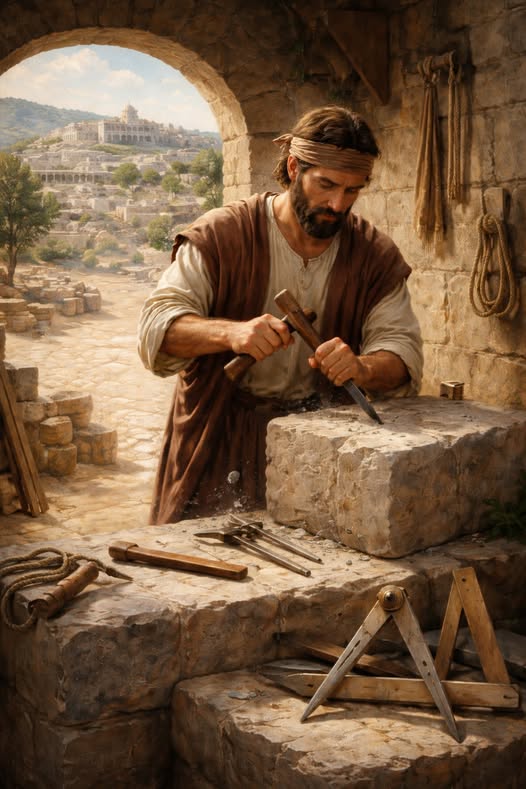
Few assumptions in Christian tradition are as entrenched and as rarely examined as the claim that Joseph was a carpenter in the modern sense of the word. The image of a quiet woodworker shaping furniture is so familiar that it often goes unquestioned. Yet this picture owes far more to later cultural imagination than to the linguistic and historical world of the Gospels themselves.
Reexamining Joseph’s trade is not a trivial exercise. Occupation in the ancient world shaped daily life, social standing, physical endurance, and the metaphors a household absorbed as part of ordinary experience. When the biblical language is allowed to speak within its original context, it points toward a form of work that was heavier, more physically demanding, and more closely aligned with the construction imagery that permeates Jesus’ later teaching.
The Meaning of Tekton
The Greek term used in the Gospels to describe Joseph’s occupation is tekton. This word does not denote a specialist in woodworking. In classical and Koine Greek usage, tekton functions as a broad occupational label for a builder or craftsman involved in construction, someone who makes, repairs, and assembles the structures people inhabit.
If the Gospel writers had intended to specify woodworking as the defining feature of Joseph’s trade, they had more precise vocabulary available. Their choice of a general construction term signals that the reader should resist importing modern categories into an ancient word. The question is not what tekton means in later European contexts, but what building required in first-century Galilee.
Building Materials in First-Century Galilee
That question is answered decisively by geography and architecture. First-century Galilee was not a timber-rich region. Wood existed and was used, but it was limited in quantity and often costly, especially for large projects. Most ordinary homes and village structures were not framed primarily in wood, nor was woodworking a dominant, standalone trade.
Stone, by contrast, defined the built environment. Houses, retaining walls, terraces, towers, cisterns, roads, and public structures were constructed largely from locally quarried limestone. Building meant cutting stone, shaping it, transporting it, and setting it accurately so foundations held and walls endured. A builder in Galilee could not avoid stonework. Stone was not a specialty material reserved for elite projects. It was the default material of everyday life.
Nazareth, Sepphoris, and the Construction Economy
Nazareth itself was a small village with limited internal demand for specialized artisans. However, it did not exist in isolation. A short distance away stood Sepphoris, a major urban center that underwent extensive rebuilding during the early Roman period. Large-scale reconstruction created sustained demand for builders capable of working in stone and participating in labor-intensive construction projects.
In this setting, a tekton from Nazareth is best understood as part of a regional construction economy rather than as a village furniture maker. The work would have been physically demanding, often seasonal, and tied to the rhythms of transport, repair, and large building efforts. This context reframes the social world Jesus grew up in. The household environment is not one of quiet craftsmanship, but of strenuous labor where accuracy and endurance mattered because failure carried real consequences.
Stone, Scripture, and Formation
Stone carries deep and consistent weight throughout Scripture. It is associated with permanence, testimony, judgment, and what endures under pressure. Altars are built of stone. Covenantal memory is marked with stones. The Law itself is inscribed on stone. These associations were part of Israel’s scriptural imagination long before the first century.
For a household shaped by masonry, however, stone was not merely symbolic. It was tactile, heavy, resistant, and unforgiving. Stone demanded careful preparation and proper placement. A poorly set stone did not merely look wrong. It compromised the entire structure. That lived reality gives added force to the way Jesus speaks about foundations, rock, and collapse. His construction imagery reflects a world where building well or poorly had visible and lasting consequences.
Second Temple and Temple-Construction Context
This stone-centered worldview is intensified when set within the context of Second Temple Judaism. The Temple and its surrounding complex were monumental stone structures that dominated religious life, national identity, and theological imagination. Sacred space was not abstract. It was architectural, measured, and physically imposing.
Within that framework, building language naturally carried theological meaning. Stones were examined, fitted, or rejected based on suitability and integrity. A cornerstone was not a decorative metaphor but the reference point that aligned the entire structure. When later biblical language speaks of rejected stones, cornerstones, and houses built by God, it draws from a cultural environment where stone construction and Temple consciousness shaped how people understood holiness, judgment, and belonging.
This context strengthens the case without speculation. It does not require claiming that Joseph worked on the Temple or participated in its construction. It simply recognizes that stonework occupied a central place in both the physical and religious world of the period, giving construction imagery an immediacy modern readers often miss.
Why “Carpenter” Became the Default
The dominance of “carpenter” in translation and tradition has a clear historical trajectory. As Christianity spread into regions where timber construction was common, translators naturally chose familiar occupational equivalents. Over time, that choice hardened into assumed fact, reinforced through art, preaching, and devotional literature.
None of this excludes the possibility that Joseph worked with wood. Builders used wood for doors, beams, yokes, tools, and roofing elements. The issue is emphasis. Neither the term tekton nor the Galilean building environment supports defining Joseph primarily as a woodworker. The broader and more historically grounded conclusion is that he was a general builder whose work centered on stone.
Conclusion
The biblical text does not require the image of Joseph as a furniture maker, and the historical context makes that image unlikely as a full or accurate description of his trade. Tekton is a general construction term. Galilee was built largely in stone. The regional economy favored builders connected to ongoing construction demand. The scriptural and Second Temple world attached serious theological weight to stone, foundations, and structural integrity.
Understanding Joseph as a stone mason or stone-centered builder does not romanticize his labor. It grounds it. It places the Holy Family firmly within the physical realities of first-century life and allows the construction imagery of Scripture and of Jesus’ teaching to be heard with the weight it originally carried. In a world where stone determined what stood and what fell, foundations were not metaphors first. They were facts of life.
Discussion Questions
- How does understanding the Greek term tekton challenge modern assumptions about Joseph’s occupation and social world?
- In what ways does the stone-built environment of first-century Galilee affect how we should read construction imagery in Jesus’ teaching?
- How does the Second Temple context deepen the biblical meaning of stones, foundations, and cornerstones beyond simple metaphor?
- Why do translation traditions and later cultural settings tend to override historical context when interpreting biblical occupations?
- How does viewing Joseph as a stone-centered builder rather than a modern carpenter shape our understanding of the incarnation and Jesus’ formative years?
Want to Know More
- Walter Bauer, Frederick W. Danker, William F. Arndt, and F. Wilbur Gingrich, A Greek-English Lexicon of the New Testament and Other Early Christian Literature (BDAG)
The standard scholarly lexicon for New Testament Greek. Essential for understanding the semantic range of terms like tekton without importing modern assumptions. - Craig S. Keener, The IVP Bible Background Commentary: New Testament
Provides reliable historical and cultural background for New Testament passages, including first-century occupations, material culture, and construction realities. - Joachim Jeremias, Jerusalem in the Time of Jesus: An Investigation into Economic and Social Conditions during the New Testament Period
A classic and still-cited study of labor, economy, and daily life in Second Temple Judaism, grounding discussions of work and trade in documented social history. - Mark A. Chancey, Greco-Roman Culture and the Galilee of Jesus
Examines the physical, cultural, and economic environment of Galilee, including urban development and construction activity relevant to understanding regional trades. - Eric M. Meyers and Mark A. Chancey, Alexander to Constantine: Archaeology of the Land of the Bible, Volume III
A comprehensive archaeological treatment of the Hellenistic and Roman periods, detailing building materials, construction practices, and regional infrastructure.
About the Author