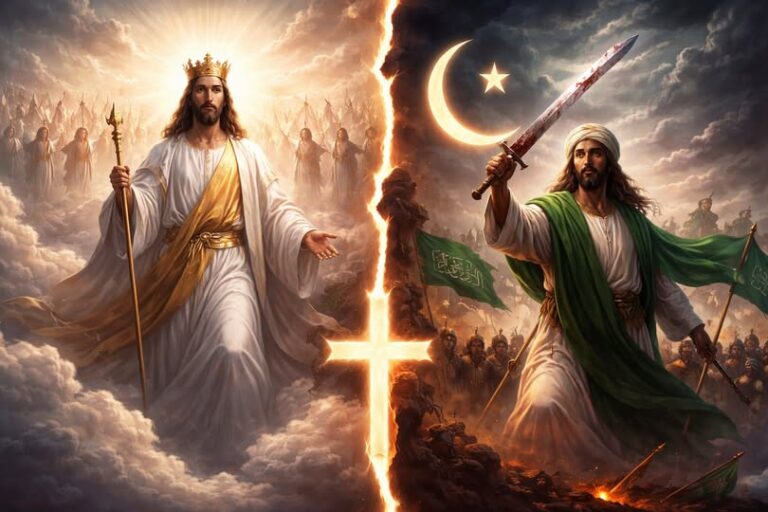
Christianity and Islam both use the word martyr, but the two religions give it opposite meanings. Christianity defines martyrdom as dying rather than killing. Islam defines martyrdom as dying while killing. These competing definitions cannot be blended. The clearest way to see the difference is to compare Telemachus, the Christian monk who died trying to stop violence, with the Islamic model of martyrdom found in early jihad campaigns.
The Historical Telemachus
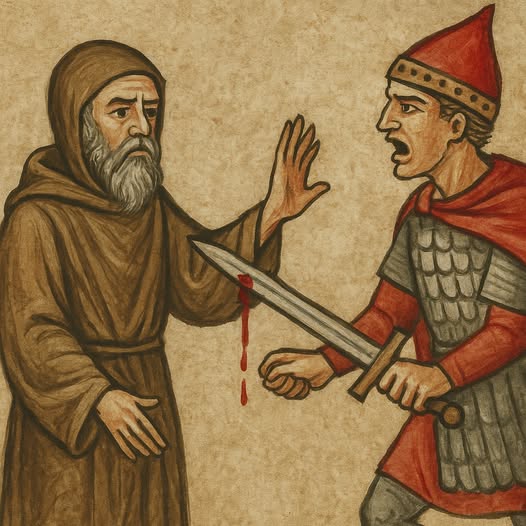
Telemachus lived in the early fifth century and came to Rome while gladiatorial combat still took place. He entered the arena during a fight and tried to stop the combatants. The crowd killed him by stoning. Emperor Honorius responded by abolishing the games. Telemachus died protecting life. He killed no one. He confronted a violent culture at the cost of his own life. The early Church honored him as a martyr because he acted as a witness to the character of Christ.
What Christian Martyrdom Means
Christian martyrdom comes from the Greek word martys, which means witness. A Christian martyr dies in loyalty to Christ. Sometimes this means refusing to deny Him. Sometimes it means refusing to join in violence or sin. Sometimes it means dying while protecting the innocent. The defining issue is not whether the Christian used force but why they acted. A believer may defend others, and if they die in that defense, their death is still a witness to the character of God. Christians never kill for spiritual reward or to advance the faith through force. Their goal is to preserve life, not take it. The Church honors martyrs because they choose faithfulness over survival and reflect the self-giving nature of Christ.
What Martyrdom Means in Islam
In early Islamic texts, the shahid is the fighter who dies in jihad. The Hadiths teach that he goes straight to Paradise and receives rewards that have no parallel in Christianity. His death is honored because he kills unbelievers and dies in the act of doing so. Islamic martyrdom is tied to conquest and expansion. It is not tied to witness. The shahid does not die refusing violence. He dies performing violence. These are not two versions of the same idea. They represent different visions of God and different understandings of salvation.
The Family Reward in Islamic Martyrdom
Islamic theology teaches that a martyr can intercede for seventy family members and bring them into Paradise. This turns violent death into a spiritual investment for a household. Mothers in radicalized communities often encourage their sons to seek martyrdom because they believe the entire family benefits from the act. Christianity rejects this idea completely. No Christian believes that killing others guarantees salvation for relatives. Loyalty to Christ is personal. No one inherits eternal life through another person’s violence.
A Historical Example of Islamic Martyrdom: The Reckless Charge at Mu’tah
Islamic sources describe a fighter at the Battle of Mu’tah who threw himself into the enemy ranks knowing he would die. He killed many opponents before falling. When some questioned if this was suicide, Muhammad praised him and declared him a martyr. His death is honored because he sought death while killing others. This example reveals the early Islamic model of martyrdom. It celebrates violent self-sacrifice that advances jihad. This is the opposite of Christian martyrdom, which refuses to kill even when threatened with death.
Why Telemachus Matters in This Comparison
Telemachus shows the heart of Christian martyrdom. He stood between men who intended to kill each other. He acted to stop bloodshed. He accepted death, but he caused no death. His willingness to die ended a violent institution. His story displays a Kingdom shaped by sacrificial love rather than conquest. When set beside the Mu’tah example, the contrast is unmistakable. One dies to save life. One dies to take life.
The Fruit of Each Definition
Christian martyrdom ends violence. Islamic martyrdom continues it. Christian martyrdom produces the protection of the vulnerable, the care of the weak, and the refusal to take innocent life. Islamic martyrdom produces suicide attacks, the killing of civilians, and the belief that dying while killing others brings honor. Telemachus saved future lives through his death. Jihadist martyrs end lives as proof of devotion. These actions cannot be confused with one another.
Why These Definitions Cannot Be Combined
Some argue that Christianity and Islam simply express the same ideal in different ways. The historical evidence does not support this. Telemachus shows loyalty to Christ by giving up his life to stop violence. The shahid at Mu’tah shows loyalty to Allah by taking lives in battle. One reveals a God who conquers through love. The other reveals a god who rewards death in warfare. These definitions come from different foundations and lead to different outcomes. They do not point toward the same truth.
Conclusion
Telemachus provides a clear picture of true martyrdom. He refused to kill and accepted death to protect life, but Christian martyrdom is not limited to nonviolence. A believer who dies defending the innocent can also be a martyr because the heart of Christian martyrdom is loyalty to Christ and the protection of those God values. Christianity never ties salvation or honor to killing others. It never teaches that violence earns a reward for the one who dies or for their family. Islam offers a competing definition built on violent jihad, promised rewards, and the belief that dying while killing unbelievers is the highest act of devotion.
These definitions cannot be blended. They reveal two very different visions of God and two very different ideas of what a faithful death looks like. Telemachus stands as a witness to the way of Christ, which values life and calls believers to lay themselves down rather than take life for spiritual gain.
Discussion Questions
- How does the story of Telemachus demonstrate the Christian belief that martyrdom protects life rather than takes it, and why is that central to Christian ethics?
- Why does Christian theology reject the idea that someone can gain salvation or benefit for others through killing, and how does this shape Christian views of violence?
- What does the Mu’tah example reveal about how Islamic tradition defines loyalty to God, and how does this differ from the Christian model of witness?
- How do the rewards promised to an Islamic martyr shape the way martyrdom is viewed in radicalized communities, especially among families?
- Why is it important to use historical examples rather than abstract ideas when comparing Christian martyrdom and Islamic martyrdom, and what can these examples teach us about the character of each religion?
Want To Know More
- David Cook, Martyrdom in Islam (Cambridge University Press, 2007)
A leading scholarly study on how martyrdom developed within Islamic thought. Cook examines the Qur’an, Hadiths, early Islamic battles, and the later rise of suicide martyrdom. - W. H. C. Frend, Martyrdom and Persecution in the Early Church (Baker Academic reprint of Princeton University Press edition)
A classic scholarly work on Christian martyrdom, exploring how early Christians understood witness, suffering, and the refusal to use violence. - Herbert Musurillo (translator), The Acts of the Christian Martyrs (Oxford Early Christian Texts, Oxford University Press)
A primary source collection of early Christian martyr accounts. These texts show how the earliest believers defined faithful witness and nonviolent suffering. - Michael Bonner, Jihad in Islamic History: Doctrines and Practice (Princeton University Press, 2006)
A clear historical overview of jihad, including how death in battle came to be viewed as the ideal model of Islamic martyrdom. - Michael Gaddis, Christian Martyrdom and Political Violence (University of California Press, 2005)
An in-depth look at how Christian martyrdom functioned within the Roman world, with a strong focus on nonviolence and witness.
About the Author