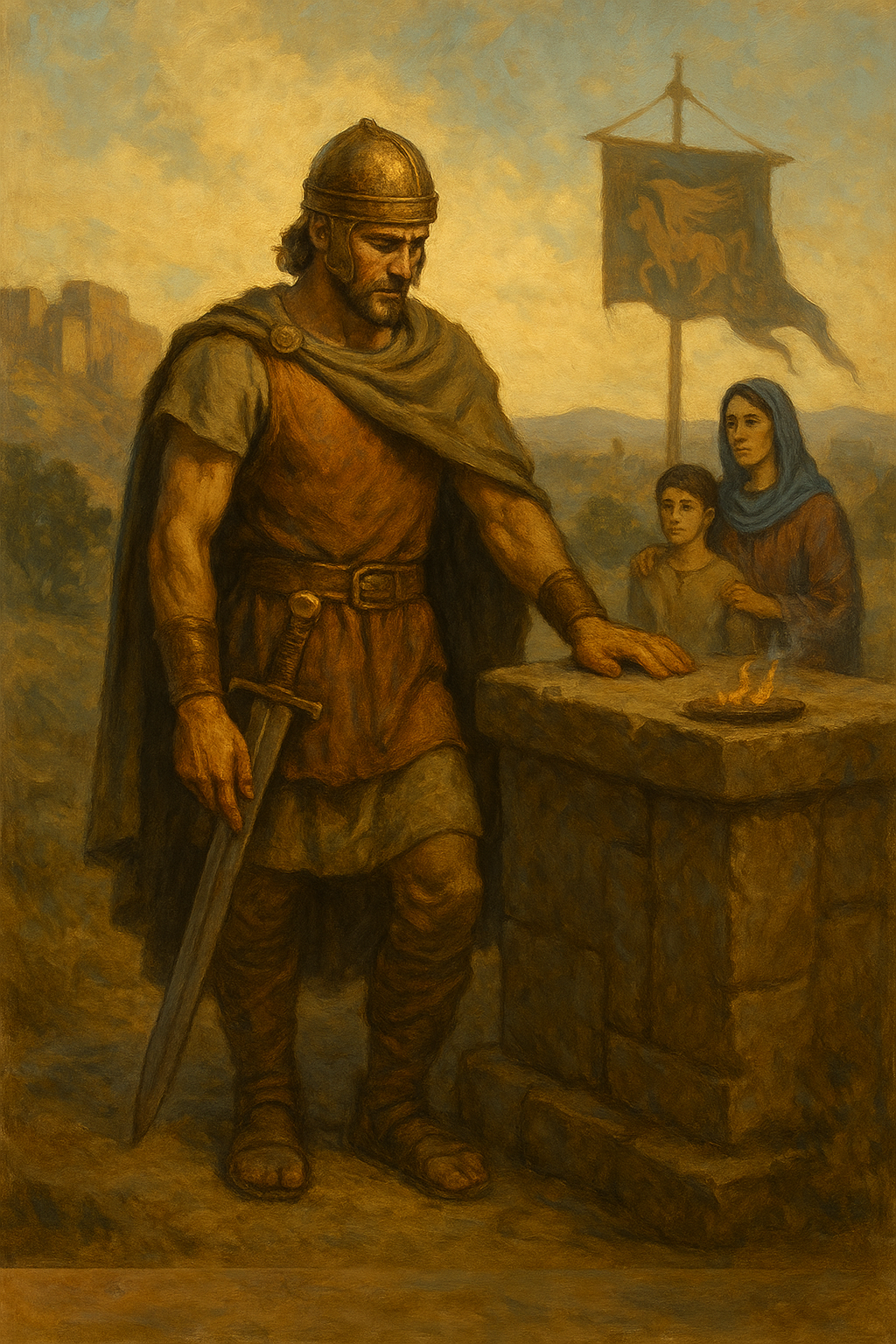
In the ancient world, warfare was not merely a matter of survival or conquest. It was a crucible that forged identity, reshaped communities, and defined glory. Yet amid the grand narratives of kings and conquests, the fate of the ordinary soldier often goes unexamined. What happened to the men who survived the battlefields? How were they received when they returned to their homes, wounded, hardened, or victorious? The answers vary significantly across the Ancient Near East (ANE), the covenant society of Israel, and the imperial structure of Rome. These differences reveal not only how each culture treated its warriors but also what it ultimately valued.
Expendable Heroes: Veterans in the Ancient Near East
The empires of the ANE, Mesopotamia, Assyria, Babylon, and the Hittite world, relied heavily on seasonal military service, conscripting men from farming communities to serve the ambitions of kings. Military campaigns were extensions of royal authority, and success on the battlefield was seen as confirmation of divine favor on the monarch. While elite warriors and loyal guards might be rewarded with land or gifts, these favors were reserved for those who directly served the palace or temple apparatus.
There was no formal veteran class, no pension structure, and no institutional care for the wounded. Injuries were part of the cost of service, and once a man was no longer of use to the king or the army, he faded into the background. Soldiers were anonymous in public records unless they were tied to royal propaganda. Cultural memory in the ANE glorified kings as divine agents but rarely remembered the common men who fought for them. The treatment of veterans in these societies was utilitarian, offering temporary reward for temporary usefulness, with little regard for long-term honor or care.
Covenant Warriors: Israel’s Distinct Approach
Israel presented a radically different model, one that emerged not from imperial ambition but from covenantal identity. Warfare in ancient Israel was not a path to power but an expression of obedience to Yahweh. Most Israelite warriors were not professionals. They were sons, farmers, and craftsmen who responded to tribal calls to defend the land and the people. Rather than being glorified for their prowess, they were honored for their faithfulness to God’s purposes.
Torah law included broad exemptions for those newly married, starting a household, or afraid. This ensured that war did not consume life but remained a last resort for communal preservation. While Israel had no standing army pension system, it did preserve the names and deeds of its faithful warriors in Scripture, particularly in the lists of David’s mighty men. Memory, rather than material reward, became the means of honor.
Furthermore, Israel’s legal structure safeguarded land inheritance. A warrior could return to his farm, his house, and his tribe with dignity intact, protected by the communal laws that preserved his property and identity. If he returned wounded or impoverished, he was not left to fend for himself. The broader covenantal command to care for the poor and vulnerable extended to him. In Israel, the soldier was not absorbed into a war machine but remained embedded in a family-centered, theologically rooted society. His worth was not measured by conquest but by his role in the story of God’s faithfulness.
Rewarded and Recycled: Veterans in Imperial Rome
By the time Rome rose to power, a dramatic shift had occurred. Rome developed one of the most complex and far-reaching systems for managing and rewarding its veterans. This was a product not only of political necessity but of imperial genius. The Roman legionary was a professional soldier, often serving for twenty-five years or more. Service was grueling and dangerous, but Rome offered incentives that made it worthwhile.
Veterans received formal legal status as veteranus, and their discharge was often accompanied by generous rewards. These included monetary bonuses (praemia), land in conquered territories, and in the case of auxiliary troops, Roman citizenship. Veterans were also granted certain legal and tax privileges and were sometimes settled in colonies specifically designed to spread Roman culture and stabilize frontier regions.
This system served multiple functions. It ensured loyalty to the emperor, encouraged enlistment, and extended Roman influence through veteran colonists. It also helped prevent the chaos that came from disbanding unpaid or mistreated troops, a lesson Rome had learned the hard way during the late Republic.
Roman soldiers were also commemorated in inscriptions, tombs, and monuments. Though these honors often focused on higher-ranking officers, they reflected a broader cultural respect for military service. Yet the system was not purely about recognition. It was about control. Veterans were remembered because they had served Caesar’s purpose. Their honor was inseparable from their role in building and maintaining the empire. Rome’s treatment of its warriors was efficient and structured, but it was also calculated. It offered glory and reward, but always with imperial strings attached.
Three Worldviews, Three Legacies
Each culture’s treatment of veterans reveals what it cherished. The ANE prized royal dominance and divine kingship, offering short-lived rewards to those who furthered imperial campaigns. Once a soldier’s utility ended, so did his significance. Israel, by contrast, honored its warriors through communal memory and legal protections grounded in a theology of covenant. It did not elevate the soldier as a national hero, but it wove him into the fabric of a people defined by their relationship to Yahweh. Rome institutionalized its veterans, giving them land, rights, and status, not primarily out of gratitude, but to secure the empire’s borders and perpetuate its values.
Conclusion
Across the Ancient Near East, Israel, and Rome, the treatment of veterans was never just a logistical matter. It was a mirror of each society’s soul. The ANE saw warriors as expendable tools for royal ambition, offering little in the way of remembrance or care. Israel, shaped by covenant and communal responsibility, offered dignity through memory, legal protection, and spiritual framing. Rome, ever the strategist, turned its veterans into instruments of colonization, rewarding them richly but binding their legacy to the empire’s expansion. These contrasting approaches force us to ask what kind of legacy we build for those who risk everything in the defense of others. Do we honor them only when they serve the state, or do we remember them because their lives matter beyond utility? In the answer to that question, ancient values are revealed, and so are our own.
Discussion Questions
- How does the treatment of veterans in each culture reflect its underlying view of human worth and social responsibility?
- What does Israel’s emphasis on memory and covenant, rather than formal rewards, suggest about its understanding of military service and community?
- In what ways did the Roman veteran system serve both the individual soldier and the goals of imperial expansion?
- Why do you think the Ancient Near East, despite its wealth and power, lacked long-term care or recognition for its warriors?
- How might the modern church draw lessons from Israel’s approach to honoring sacrifice without glorifying violence or conquest?
Want to Know More?
- Cooley, Alison E. The Cambridge Manual of Latin Epigraphy. Cambridge University Press, 2012.
A valuable resource for understanding how Roman veterans were commemorated through inscriptions, offering insight into public memory and imperial propaganda. - Hallo, William W., and K. Lawson Younger Jr., eds. The Context of Scripture: Volume II, Monumental Inscriptions from the Biblical World. Brill, 2000.
An excellent collection of ANE inscriptions that reveal how warfare, kingship, and the role of soldiers were framed in official records. - Niditch, Susan. War in the Hebrew Bible: A Study in the Ethics of Violence. Oxford University Press, 1993.
Explores the theological and ethical dimensions of warfare in ancient Israel, including how soldiers were portrayed and remembered in the biblical narrative. - Keppie, Lawrence. The Making of the Roman Army: From Republic to Empire. University of Oklahoma Press, 1998.
Traces the development of the Roman military system and includes a detailed discussion of veteran rewards and the political utility of military colonies. - Walton, John H., ed. Ancient Israelite Literature in Its Cultural Context: A Survey of Parallels Between Biblical and Ancient Near Eastern Texts. Zondervan, 1989.
Provides helpful comparisons between Israelite and ANE practices, including the treatment of warriors, covenant obligations, and societal values.
About the Author