From the beginning, the Church treated the Incarnation as a reality that reshaped existence rather than a historical moment to be briefly acknowledged. Scripture itself establishes this posture. John does not narrate the birth of Jesus sentimentally or chronologically. He declares that the eternal Word became flesh and took up residence among humanity, presenting the Incarnation as an ontological shift rather than a biographical detail. Paul frames Christ’s entrance into the world in the same way, describing it as the turning point of the ages, the decisive act from which history would now unfold.
Because of this understanding, the Church never regarded the Nativity as something that could be exhausted in a single observance. When the celebration of Christ’s birth took shape in Christian worship, it was framed as something to be inhabited rather than marked and passed. God had entered His creation and remained within it. Time itself, therefore, had to reflect that permanence rather than returning immediately to ordinary patterns.
Why Christmas Was Extended Rather Than Repeated
The Twelve Days of Christmas are not an embellishment added to December 25, nor are they a repetition of the feast itself. They represent a deliberate refusal to compress the Incarnation into a moment that could be quickly consumed and discarded. In biblical thought, certain acts of God demand duration rather than immediacy. Israel does not leave Egypt and instantly resume ordinary life. Resurrection is followed by forty days of instruction.
Pentecost is approached through preparation rather than haste.
The Church applied this same logic to the Nativity. By extending Christmas across twelve days, believers were trained to remain within the meaning of the Incarnation instead of rushing past it. The number twelve was not chosen decoratively. Throughout Scripture, twelve signifies ordered authority and covenantal structure, from the tribes of Israel to the apostles who form the foundation of the Church. The Twelve Days quietly proclaim that the child in the manger is already the foundation of a new governing order, not merely an image of humility or warmth.
Epiphany as Manifestation, Not Reflection
Epiphany does not exist to add atmosphere or sentiment to Christmas. It exists to disclose identity. The word itself means manifestation, and its placement after the Twelve Days is deliberate. What Christmas announces, Epiphany reveals. The Incarnation is not left ambiguous. It is clarified, exposed, and placed before the world.
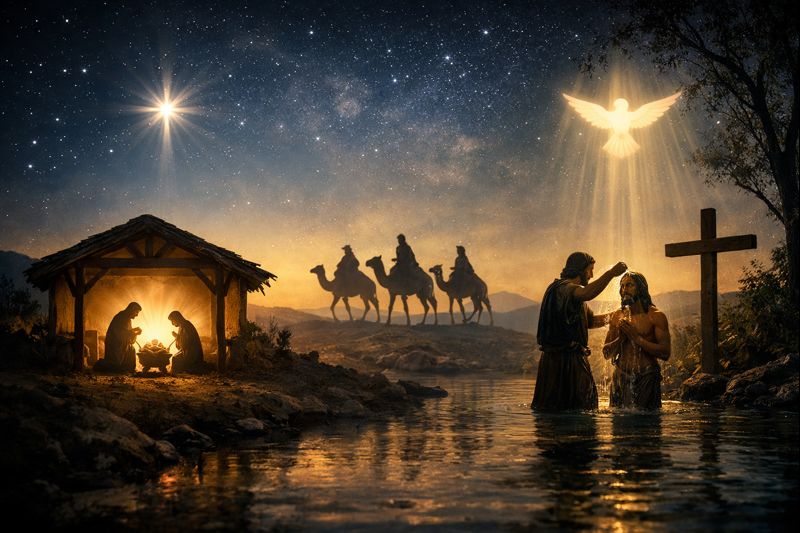
In the Western Church, this revelation centers on the visit of the Magi. These figures are often softened in retelling, but Matthew presents them as elite specialists associated with royal courts and political authority. Their arrival in Jerusalem asking about a newborn king was not devotional curiosity. It was recognition of legitimacy. Matthew notes that Herod was troubled, and all Jerusalem with him, because the implication was unmistakable. A rival authority had been identified. The gifts offered were acknowledgments of kingship, priesthood, and death, not ornamental gestures. Epiphany exposes what Christmas implies. Christ’s rule is real, recognized, and destabilizing to existing power.
Epiphany in the East and the Public Naming of Christ
In the Eastern Church, Epiphany focuses on the baptism of Christ, an emphasis that carries the same theological force through a different event. At the Jordan, Christ is identified openly and unmistakably. The Father speaks, the Spirit descends, and the Son stands revealed before witnesses. This is not a private spiritual moment but a public declaration enacted within history.
Gregory of Nazianzus preached that this event was the manifestation of Christ as God, which is why Epiphany was often called Theophany in the East. The emphasis is not on discovery but on identification. God names His Son before the world. From that point forward, uncertainty is no longer possible. Revelation has occurred, and the world is confronted with the identity of the one who has entered it.
The Twelve Days as Liturgical Theology
Early Christian preaching during the Christmas season consistently bound the Nativity to themes of authority, judgment, and renewal. Augustine reminded his congregation that the one lying in the manger was the one through whom all things were made, refusing any separation between humility and sovereignty. Leo the Great preached that Christ’s birth marked the irreversible union of divine and human nature, a union that would never be undone.
These sermons were not seasonal ornamentation. They were theological formation. The Twelve Days functioned as liturgical theology, using time itself to teach believers how to understand reality after the Incarnation. Christmas was not treated as an emotional pause or a sentimental retreat. It was proclaimed as the moment when normal had been replaced by something new.
Why the Christian Calendar Moves Forward
The Christian calendar does not revolve endlessly or return to a mythic starting point. It advances. Christmas gives way to Epiphany. Epiphany leads into ministry, conflict, death, resurrection, and reign. The Incarnation is not reenacted annually as though it were part of a cosmic cycle. It is proclaimed as a once-for-all act that propels history toward its conclusion.
This forward movement reflects the Church’s conviction that God has acted decisively within history and that history now moves toward judgment, resurrection, and restoration. The Twelve Days exist because the Incarnation was understood as irreversible. Acts that permanently alter history cannot be treated casually or briefly, nor can they be confined to a single commemorative moment.
The Modern Collapse of the Season
When Christmas is reduced to a single day, its theological weight collapses with it. When Epiphany disappears from Christian consciousness, the Incarnation becomes sentimental rather than authoritative. The Church did not originally structure time this way because it enjoyed ceremony or complexity. It did so because the reality it confessed demanded it.
The loss of the Twelve Days is therefore not merely cultural. It is theological. It trains believers to experience Christmas as an emotional high point rather than a governing truth that reshapes how history itself is understood and lived.
Conclusion
The Twelve Days of Christmas and the feast of Epiphany were never about filling space on a calendar or preserving tradition for its own sake. They were about disciplining time to bear the weight of what had occurred. Christmas declares that God has entered His creation. The Twelve Days insist that this reality cannot be rushed, managed, or dismissed. Epiphany announces that Christ has been revealed and that the world now stands accountable to who He is.
The Church shaped time this way because the Incarnation was understood as a decisive and enduring act within history, one that altered how history itself was to be experienced and ordered. The birth of Christ was not treated as an isolated event whose significance could be acknowledged and then left behind. It was understood as the moment when God entered His creation in a manner that permanently changed its direction. By extending Christmas and moving deliberately toward Epiphany, the Church embedded this conviction into the rhythm of communal life. Time was organized to reflect the belief that history now unfolded in light of the Incarnation, moving forward under its implications rather than returning to a prior state.
Discussion Questions
- How does treating Christmas as a season rather than a single day change the way the Incarnation is understood theologically, and what is lost when Christmas is compressed into a moment rather than inhabited over time?
- The lesson argues that the Twelve Days function as a statement about authority and order rather than sentiment. In what ways does this challenge modern portrayals of the Nativity that emphasize vulnerability without kingship?
- Why is Epiphany placed after Christmas rather than alongside it, and how does this sequence reflect the movement from incarnation to revelation found in the Gospels themselves?
- Compare the Western emphasis on the Magi with the Eastern focus on Christ’s baptism at Epiphany. How do these two emphases communicate the same theological claim about Christ’s identity using different events?
- The article claims that the loss of the Twelve Days and Epiphany represents a theological shift rather than merely a cultural one. What assumptions about time, history, and authority are revealed by the modern collapse of the Christmas season?
Want to Know More
- Andrew McGowan, Ancient Christian Worship: Early Church Practices in Social, Historical, and Theological Perspective
McGowan provides one of the clearest scholarly treatments of how early Christian worship developed, including feasts, seasons, and the shaping of sacred time. His work is especially useful for understanding how practices like extended festivals emerged from theology rather than from popular custom or external pressure. - Paul F. Bradshaw and Maxwell E. Johnson, The Origins of Feasts, Fasts and Seasons in Early Christianity
This is a standard academic work on the development of the Christian calendar. Bradshaw and Johnson carefully trace how Christmas, Epiphany, and other seasons formed in different regions, emphasizing liturgical logic and theological meaning rather than polemical or conspiratorial explanations. - Maxwell E. Johnson, Between Memory and Hope: Readings on the Liturgical Year
Johnson explores how the Christian liturgical year functions as theology expressed through time. His treatment of Christmas and Epiphany is particularly helpful for understanding why these feasts were ordered sequentially and how they were meant to shape Christian perception of history. - Augustine of Hippo, Sermons for Christmas and Epiphany
Augustine’s sermons provide direct primary-source evidence for how the early Church preached the Nativity and Epiphany together. He consistently links the humility of Christ’s birth with His cosmic authority, demonstrating that the Twelve Days were never intended to sentimentalize the Incarnation. - Leo the Great, Sermons
Leo’s Christmas and Epiphany sermons are foundational for Western Christian theology of the Incarnation. He explicitly teaches that Christ’s birth marks the permanent union of divine and human nature and frames the Nativity as an event with ongoing historical consequences rather than a momentary celebration.
About the Author