The modern instinct to separate athletics from religion would have been incomprehensible in the ancient world. The Olympic Games were not a neutral sporting event later decorated with religious symbolism. They were founded as an act of pagan worship from the outset. Athletics functioned as the medium through which devotion, honor, and allegiance were offered to the gods.
Competition was never the end goal. The purpose of the games was to secure divine favor and affirm a theological vision of order, authority, and human flourishing under the gods.
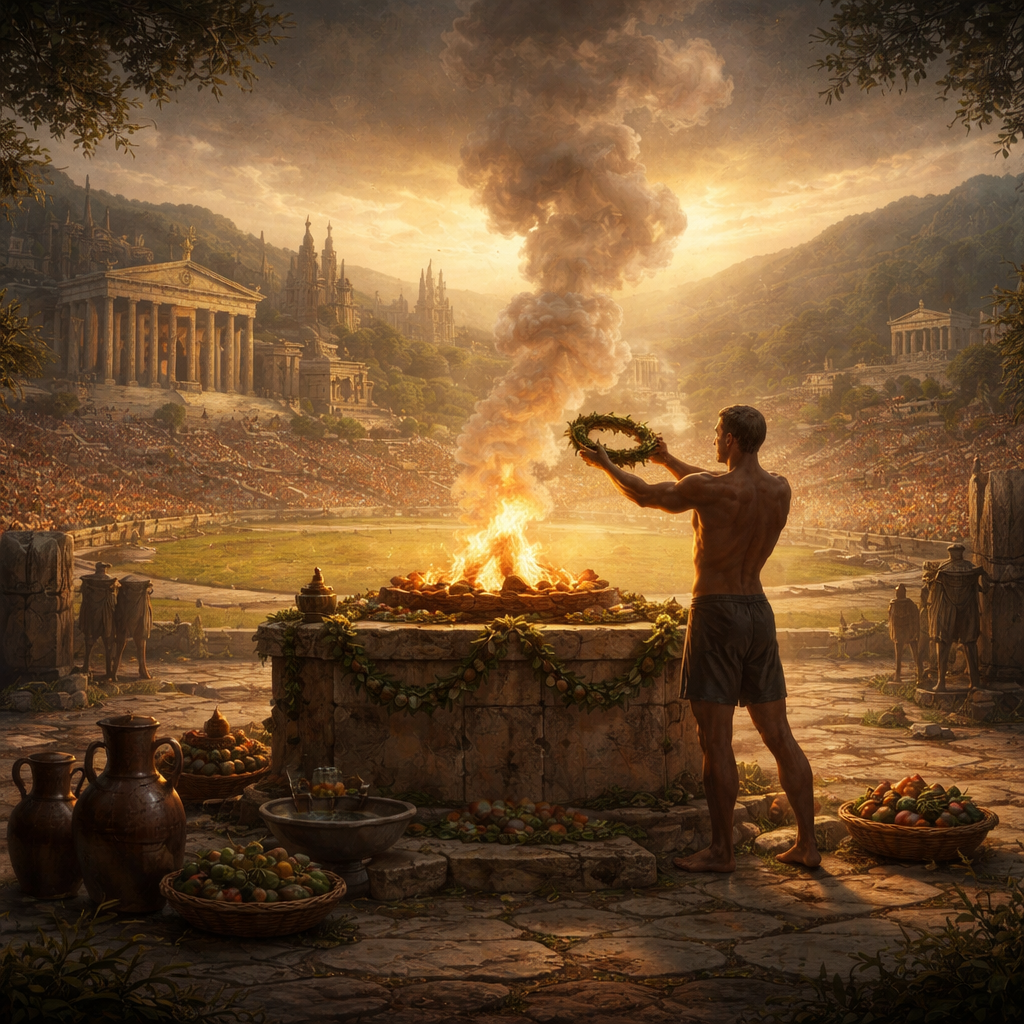
The first recorded Olympic Games took place in 776 BC at Olympia, a site that was never understood as civic or recreational space. Olympia was sacred ground. Its defining feature was the Altis, a walled holy precinct filled with temples, altars, sacred groves, and treasuries overflowing with votive offerings. The stadium and training facilities were deliberately embedded within this cultic landscape. Athletic competition occurred under the assumption that the gods were present, watching, and judging.
Zeus, Divine Kingship, and Moral Authority
The Olympic Games were dedicated to Zeus, worshiped at Olympia not merely as a sky deity but as the supreme divine king. Zeus was believed to uphold justice, enforce oaths, and preserve cosmic order against chaos. This understanding shaped the moral framework of the games. Athletes swore solemn oaths before statues of Zeus, calling down divine judgment upon themselves if they cheated or violated the rules. These oaths were not symbolic gestures or social contracts. Perjury was believed to provoke real divine punishment.
Fair competition was therefore a theological requirement before it was a moral one. Cheating was not simply unethical behavior. It was impiety. Legitimate victory signaled divine favor, while disgrace or punishment could indicate divine displeasure. The games functioned as a public demonstration of divine authority over human action and communal life.
Sacrifice as the Foundation of the Games
At the heart of the Olympic festival stood sacrifice. Before any athletic contests began, animals were offered on massive altars, culminating in the hecatomb, the sacrifice of one hundred oxen. Blood was poured out, smoke ascended toward heaven, and communal feasting followed. These acts were believed to establish divine presence and secure goodwill toward the Greek world.
Competition followed sacrifice, not the other way around. This order was essential. Without sacrifice, the games had no religious legitimacy. Strength, speed, and endurance were not viewed as self-generated achievements but as gifts granted by the god and returned through disciplined performance. Athletics only had meaning because they took place within a system of worship.
The Body as a Cultic Offering
Within this pagan framework, the human body itself functioned as an offering. Athletic training demanded strict discipline, self-control, and endurance, all of which were interpreted as acts of devotion. The perfected body displayed order, harmony, and submission to divine authority. Victory was not personal self-expression but visible proof of divine favor.
Practices such as competing nude reinforced this theology. The unclothed body symbolized idealized humanity exposed before divine judgment. The stadium became a ritual space where honor and shame were enacted before the gods and the community. Failure was not merely social embarrassment. It was religiously significant because it occurred under divine observation.
Sacred Time, Sacred Order, and the End of the Ancient Games
During the Olympic festival, warfare between Greek city-states was suspended under a sacred truce. This pause in violence was not humanitarian. It was theological. Sacred time had begun, and peace was demanded by divine authority. Political power temporarily yielded to religious obligation, reinforcing the belief that divine authority outranked human conflict.
The ancient Olympics ended abruptly in AD 393 when pagan sacrifice was banned as part of the Christianization of the Roman Empire. This decision struck at the foundation of the games. Without sacrifice, oaths, and cultic devotion, the Olympics could not function. They were never preserved as a neutral cultural tradition because neutrality was never their purpose.
The Modern Olympics and the Return of Myth
When the Olympic Games were revived in 1896, they were intentionally framed as a secular alternative to religious formation. The modern Olympics emerged from a nineteenth-century European context shaped by secular humanism, which assumed that moral virtue, unity, and discipline could be cultivated through sport without reference to God. Explicit worship was removed, religious language was avoided, and the games were presented as a neutral, universal space grounded in reason and progress rather than theology.
That experiment did not hold. Over time, the modern Olympics developed ceremonies, symbols, and narratives that function in recognizably religious ways. Torch rituals, opening liturgies, moral signaling, and the elevation of athletes as cultural icons gradually filled the vacuum left by the rejection of Christianity. What returned was not Christian symbolism but mythic and pre-Christian imagery, because when transcendence is desired but Christ is excluded, older symbolic systems reassert themselves.
Recent opening ceremonies have made this shift unmistakable. The appearance of Bacchus, positioned within visual frameworks historically associated with the Last Supper, represents not neutrality but substitution. In the ancient world, pagan worship was explicit and honest about its objects. In the modern world, the same symbolic language reappears under the banner of art and expression. The trajectory from secular idealism to open mythic symbolism demonstrates that humanity does not move beyond worship. It only changes what is placed at the center.
Nationalism as a Modern Form of Worship
Alongside the return of mythic symbolism, the modern Olympics also developed a second substitute for Christianity: the sacralization of the nation. This shift became unmistakable at the 1936 Summer Games in Berlin, where athletics, ceremony, spectacle, and national identity were deliberately fused into a single ideological performance. The games functioned as a public liturgy of national destiny. Flags replaced altars, anthems replaced hymns, and the athlete’s body became a living symbol of national virtue, strength, and legitimacy.
What the Berlin Games demonstrated was not a historical anomaly, but a structural possibility embedded within the modern Olympic framework. Sport proved capable of carrying religious weight once directed toward the nation. After the war, overt racial ideology was rejected, yet the liturgical structure remained. Medal counts became moral scorecards. Opening ceremonies became curated national myths. Host nations used spectacle to tell the world who they are, what they value, and why they matter.
This form of nationalism functions religiously because it demands allegiance, sacrifice, and identity formation. It offers transcendence through history rather than heaven and meaning through collective achievement rather than redemption. When combined with mythic symbolism, it recreates many of the functions once held by explicit pagan worship. The modern Olympics therefore reveal not the absence of religion, but its relocation.
Conclusion
The history of the Olympic Games, ancient and modern, exposes a consistent truth about human nature. Humans are inherently liturgical beings. We organize our bodies, our discipline, our time, and our achievements around what we worship. Scripture does not condemn religion as structure or ritual. It condemns allegiance given to false gods.
Remove the true God, and worship does not disappear. It reemerges in older forms, wearing new clothes, whether in myth, nation, or spectacle. The Olympics do not tell the story of humanity becoming secular. They tell the story of humanity remaining religious.
Discussion Questions
- How does viewing the ancient Olympic Games as an act of worship change the way we think about the relationship between religion and public life in the ancient world?
- Why was sacrifice necessary for the Olympic Games to have meaning, and what does that reveal about how the Greeks understood power, success, and divine favor?
- In what ways did the ancient Olympics treat the human body as a religious offering, and how does that differ from or resemble modern views of athletic excellence?
- How does the evolution of the modern Olympics challenge the claim that secular spaces can remain truly neutral over time?
- What lessons can Christians draw from the shift toward mythic symbolism and sacralized nationalism in modern global events that claim to be non-religious?
Want to Know More
- Walter Burkert, Greek Religion
Burkert’s classic work provides a detailed and reliable overview of Greek religious practice, including sacrifice, sacred space, ritual, and the role of the gods in public life. His treatment helps clarify why events like the Olympic Games functioned as worship rather than entertainment. - Stephen G. Miller, Ancient Greek Athletics
Miller offers a historically grounded study of ancient athletic festivals, with particular attention to Olympia. He demonstrates how athletics, ritual, and religion were inseparable in Greek culture, correcting modern assumptions about sport as a secular activity. - Donald G. Kyle, Sport and Spectacle in the Ancient World
Kyle situates ancient athletics within their broader social and religious context, showing how public spectacle reinforced theological, political, and cultural values. This work is especially helpful for understanding the Olympic Games as a form of ritualized communal identity. - Richard Mandell, The Nazi Olympics
Mandell’s study of the 1936 Berlin Games documents how the modern Olympics were deliberately transformed into a political and ideological spectacle. It provides essential historical grounding for understanding nationalism as a form of modern civic religion expressed through sport. - John J. MacAloon, This Great Symbol: Pierre de Coubertin and the Origins of the Modern Olympic Games
MacAloon examines the philosophical and cultural assumptions behind the revival of the Olympics in the nineteenth century. His work shows how secular humanism shaped the modern Games and why religious symbolism inevitably reemerged despite attempts at neutrality.
About the Author