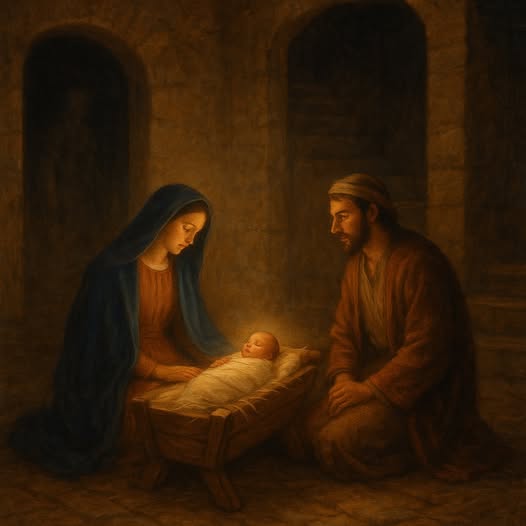
For centuries, Christians have pictured Mary and Joseph wandering through Bethlehem as an innkeeper turns them away, forcing them to seek refuge in a stable. This image has shaped Christmas pageants, art, and cultural imagination throughout the Christian world. Yet when the biblical text is examined closely and paired with what we know of first-century Jewish life, a very different picture emerges. The traditional narrative is memorable, but many of its details developed long after the time of Jesus and are not found in Scripture.
The Biblical Text and the Question of Translation
The idea of a commercial inn appears in the nativity story because of a single word in Luke 2. Older translations rendered the Greek term kataluma as inn. This choice created the familiar scene of Mary and Joseph standing before a public lodging house, rejected by a frazzled innkeeper. However, kataluma does not refer to a commercial inn. It is the standard Greek term for a guest room in a private home.
Luke himself demonstrates that he knew the distinction. When he describes an actual commercial inn in the parable of the Good Samaritan, he uses the proper Greek term pandocheion. Because he clearly differentiates the two in his writing, it is evident that he intended kataluma in Luke 2:7 to refer to a private house, not a business. This means the famous line about there being no room at the inn should instead be understood as no room in the guest room.
Hospitality and Family Expectations in First Century Judea
Understanding the cultural setting reinforces this conclusion. Hospitality in Jewish society was a serious moral duty. Families were expected to welcome travelers, especially relatives. Joseph was returning to the town of his ancestors. Bethlehem was a small village, and it is almost certain that Joseph had extended family there. Turning away family members would have brought shame upon a household.
This makes the traditional image of cold rejection unlikely. A far more probable scenario is that Mary and Joseph were welcomed into a home already full of relatives who had also arrived for the census. Space was limited, not because of indifference, but because of the large number of family members sharing the house.
How Judean Homes Help Clarify the Setting
Archaeology and literary evidence provide a clear picture of the typical Judean home. Most houses included a main family room, an attached upper guest room, and a lower area or adjacent cave where animals were brought in at night. Feeding troughs, including mangers carved into stone, were common fixtures in these lower spaces.
If the guest room was already occupied, the family would host visitors in the main living area. When Mary went into labor, she likely moved to the lower section for privacy and space. The presence of a manger fits naturally in this part of the house. The nativity does not require a detached stable or barn. It fits seamlessly within the layout of a normal first-century household.
Tradition Versus the Biblical Text
As the nativity story traveled across cultures and centuries, Christian tradition began to fill in details that Luke never recorded. One of the most enduring additions is the figure of the innkeeper. He appears nowhere in Scripture, yet he became one of the most recognizable characters in Christmas retellings. His origins lie in the medieval mystery plays that dramatized biblical stories for public performance. These plays frequently expanded scenes by adding dialogue, characters, and emotional elements that helped convey moral lessons to largely illiterate audiences.
The innkeeper served as a convenient dramatic device. He provided a human face for the problem of limited space and created a moment of tension that heightened the emotional impact of the story. As these performances spread throughout Europe, their additions became deeply embedded in Christian imagination. Over time, the innkeeper moved from being a theatrical invention to being treated as part of the biblical narrative itself.
This blending of tradition and text illustrates how easily later interpretations can overshadow the cultural and linguistic details of the ancient world. Tradition is not necessarily misleading or harmful, but it must be held with awareness. When Christians distinguish between what the text actually says and how later centuries chose to imagine the scene, the nativity becomes even richer. Returning to Luke’s account removes the layers added by time and allows the historical setting of Jesus’s birth to shine through with clarity.
Reframing the Nativity Story
When the nativity is understood through its historical and cultural context, the story becomes more grounded and more intimate. Jesus was not born in isolation or rejection. He entered the world within a crowded family home filled with relatives returning for the census. The manger becomes a symbol of domestic humility rather than social abandonment. The birth of Jesus is marked not by exclusion but by the simple reality of full rooms and limited space during a major gathering.
This perspective enhances the narrative rather than diminishing it. It draws attention to the beauty of God entering the ordinary rhythms of human life.
Theological Significance of a Household Birth
A birth within a family home fits the larger theological pattern of the incarnation. God does not enter the world through the halls of power. He arrives in the midst of a normal household, surrounded by people who represent the everyday life of Israel. The manger emphasizes humility, but the home emphasizes nearness. The incarnation is not a story of God approaching humanity from a distance. It is a story of God dwelling among His people in the most ordinary and human way possible.
Conclusion
The traditional nativity scene has shaped Christian memory for centuries, but a closer reading of Scripture reveals a more historically accurate and culturally rooted narrative. The word often translated as inn refers to a guest room. Jewish hospitality makes rejection unlikely. The architecture of Judean homes explains the presence of the manger. The innkeeper belongs to medieval dramatizations rather than the Gospel of Luke.
What emerges is a nativity that is both humble and warm. Jesus enters a crowded family home during a moment of national movement and communal life. The true setting of His birth highlights the depth of the incarnation and the nearness of God to His people. This is the beauty of the nativity as Luke intended it to be understood.
Discussion Questions
- How does understanding the correct meaning of the word kataluma change the way we picture the birth of Jesus, and why do you think the traditional translation of inn persisted for so long despite the linguistic evidence?
- In what ways does the cultural expectation of hospitality in first-century Judea challenge the familiar image of Mary and Joseph being turned away by strangers? What does this reveal about the values and social dynamics of the world Jesus was born into?
- How does archaeological evidence about Judean household structures help clarify the nativity story, and why is it important to consider historical context when interpreting biblical narratives?
- What are the potential dangers of allowing later traditions, such as the medieval innkeeper, to overshadow the details provided by Scripture? How can Christians appreciate tradition while maintaining fidelity to the biblical text?
- How does the image of Jesus being born within a crowded family home, rather than a remote stable, shape our understanding of the incarnation and God’s decision to enter human life in such an ordinary and intimate setting?
Want To Know More?
- Jesus Through Middle Eastern Eyes by Kenneth E. Bailey
A foundational work that examines the life of Jesus through the lens of Middle Eastern culture, including an in-depth discussion of the nativity and why the traditional “inn” interpretation misses the historical realities of first-century village life. - The Birth of the Messiah by Raymond E. Brown
A scholarly but accessible study of the infancy narratives in Matthew and Luke. Brown carefully analyzes translation issues, cultural expectations, and the historical setting of Jesus’s birth. - The New Testament in Its World by N. T. Wright and Michael F. Bird
A comprehensive volume that situates the entire New Testament within its Jewish and Greco-Roman environment. Wright’s treatment of first-century customs and social structures helps clarify passages like Luke 2. - The Jesus I Never Knew by Philip Yancey
Although devotional in tone, this book engages serious scholarship and challenges traditional assumptions about Jesus’s birth, life, and ministry. Yancey includes a clear discussion of the nativity’s cultural background. - Sitting at the Feet of Rabbi Jesus by Ann Spangler and Lois Tverberg
A well-researched exploration of Jesus’s Jewish world, focusing on how understanding the culture, language, and daily life of first-century Jews enriches the reading of the Gospels, including the birth narratives.
About the Author