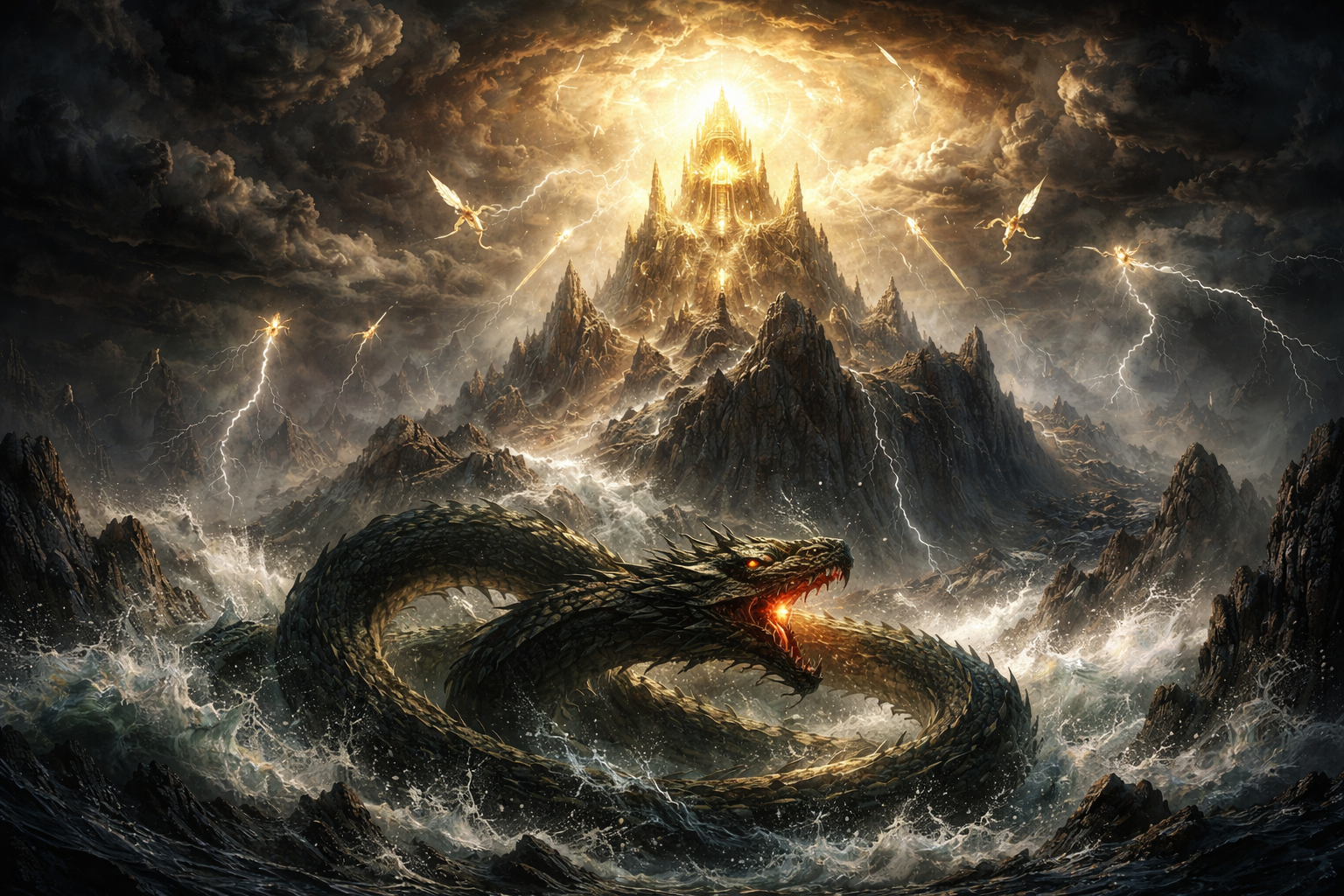
Across the ancient world, the storm god occupies the role of cosmic hero. He commands thunder and lightning, rides the clouds, ascends the sacred mountain, and claims authority over both gods and humans. His legitimacy rests on a repeated narrative pattern. Chaos threatens creation, often embodied as a dragon or sea serpent, and the storm god defeats it through overwhelming force. Order is said to emerge from this victory, and kingship is framed as the natural reward for violent conquest.
The biblical text speaks within the same symbolic universe, yet it refuses the logic that undergirds these stories. Scripture does not deny chaos, nor does it ignore the existence of rebellious spiritual powers. What it rejects is the claim that authority is established by domination or that violence confers moral legitimacy. As the biblical narrative progresses, the storm god’s story is not refined or repurposed but steadily dismantled. By the time Revelation is reached, the figure who once claimed to defeat the dragon is no longer ambiguous. He is revealed as the dragon himself, and the entire mythological framework that supported his claim to power collapses under that exposure.
The Storm God Pattern in Ancient Mythology
In the mythologies of the ancient Near East and Mediterranean world, the storm god’s ascent follows a remarkably stable structure. He begins as one among many divine figures, often without clear supremacy, but rises through conflict with a chaos power that threatens the established order. The chaos figure is frequently associated with the sea, the deep, or monstrous serpentine imagery, representing instability and resistance to control. Victory over this figure is interpreted as proof of fitness to rule.
In Ugaritic tradition, Baal’s identity as cloud rider and rain giver is inseparable from his battle with Yam, the personified sea. Yam’s challenge threatens both divine hierarchy and human survival, and Baal’s triumph secures his kingship. His palace on the cosmic mountain functions as a visible symbol of authority, reinforcing the idea that rule belongs to the one who can subdue chaos through strength. Storm imagery becomes the language of legitimacy, not merely of power.
Mesopotamian mythology intensifies this logic by making violence the foundation of creation itself. Marduk’s defeat of Tiamat does not simply restore order. It produces the cosmos. Her divided body becomes the material from which heaven and earth are formed, and the gods proclaim Marduk king precisely because his violence has proven effective. Greek mythology preserves the same theological grammar. Zeus’s battle with Typhon threatens Olympian rule, and his victory through lightning secures his throne. Across cultures, domination becomes virtue, conquest becomes creative, and kingship is defined by the ability to control chaos rather than by moral authority.
Yahweh and the Biblical Refusal of Storm God Kingship
The Hebrew Bible deliberately employs storm imagery while severing it from storm god theology. Yahweh commands the winds, sets boundaries for the sea, and dwells above the heavens, yet His authority is never depicted as something achieved through combat with a rival deity. He does not become king by defeating chaos. He is king because He is Creator, and His sovereignty precedes both rebellion and resistance.
Chaos in the biblical worldview is not an equal power locked in eternal struggle with God. It is a created and bounded reality that remains subject to divine restraint. The sea roars, but it does not rule. The great creatures of the deep inspire awe, but they do not rival Yahweh’s authority. Storms respond to His word rather than legitimizing His throne. This framework dismantles the storm god’s core claim that order must be wrestled into existence through violence.
Within this theological vision, Satan is never portrayed as a heroic figure or a necessary ruler. He does not create, sustain, or restore. His defining actions are deception, accusation, and the pursuit of worship he is not entitled to receive. Where storm god myths celebrate ascent through force, Scripture presents Satan’s ambition as fundamentally unlawful. His desire for authority is not misunderstood heroism but rebellion that lacks any grounding in rightful rule.
The Moral Inversion at the Center of the Storm God Myth
The power of the storm god myth lies in its moral inversion. Violence is framed as responsibility. Domination is reframed as protection. Chaos is cast as the ultimate threat, allowing any act committed in the name of order to appear justified. Kingship becomes an exercise in control rather than stewardship, and obedience is demanded as the price of stability.
This inversion mirrors Satan’s strategy as portrayed in Scripture. He does not reject the idea of order. He redefines it around himself. By presenting himself as the one who restrains chaos, he disguises rebellion as necessity and tyranny as service. The storm god myth trains both divine and human audiences to accept coercion as benevolence and fear as the foundation of peace.
Scripture consistently undermines this illusion by refusing to narrate Satan as a stabilizing force. His actions fracture communities, corrupt worship, and deepen disorder even when they promise security. The order he offers never heals or restores. It centralizes power, silences dissent, and demands allegiance without righteousness, exposing the storm god’s promise as structurally empty rather than temporarily flawed.
Revelation and the Exposure of the Dragon
Revelation resolves what ancient myth deliberately obscured. Satan is no longer implied through borrowed imagery or symbolic overlap. He is identified directly as the dragon, the ancient serpent, the deceiver of the whole world. This identification functions as a theological verdict rather than a narrative flourish. The one who claimed to defeat chaos is revealed to have always embodied it.
This exposure reframes the entire storm god tradition. The myths were not partial glimpses of truth awaiting correction. They were sustained narratives that inverted reality by casting rebellion as heroism. Chaos was never the storm god’s enemy. It was his instrument, his environment, and ultimately his identity, masked by claims of protection and order.
Revelation also rejects the expectation of endless cosmic cycles. The dragon is not overcome by greater violence or absorbed into a new balance of power. He is defeated by divine authority and faithful witness, and his downfall comes through exposure rather than escalation. His claim to rule collapses because it is shown to be fraudulent at its core, leaving no theological space for his continued legitimacy.
Theological Implications
This trajectory explains why Scripture resists syncretism so forcefully. Yahweh is not the greatest storm god among rivals. He is the Creator to whom storms, seas, and powers already belong. Satan’s imitation of storm god kingship is not confusion but counterfeiting, an attempt to claim authority through fear, coercion, and spectacle rather than through righteousness.
Revelation functions as the interpretive lens through which ancient myth is finally understood. The cosmic conflict was never a contest between equal powers competing for sovereignty. It was rebellion masquerading as heroism, sustained by moral inversion and finally stripped of its symbols. What remains after that exposure is not a defeated god but an unmasked liar.
Conclusion
Ancient mythologies celebrate a storm god who conquers chaos and earns the right to rule. Scripture tells a far more unsettling story. The figure who claimed to protect creation was always the deceiver, and the chaos he claimed to restrain was the very thing his rule multiplied.
Revelation does not introduce a new enemy. It removes the mask from the old one and leaves his claims without shelter.
The storm god never lost his throne. He never possessed one.
Discussion Questions
- Why do ancient mythologies consistently portray kingship as something earned through violent conquest of chaos rather than through moral authority or creation, and how does this shape how societies understand power?
- How does the biblical portrayal of Yahweh’s authority challenge the assumption that order must be established or maintained through domination and fear?
- In what ways does the storm god myth train people to accept coercive or tyrannical leadership as necessary for stability, both in ancient cultures and in modern systems?
- How does Revelation’s identification of Satan as the dragon reinterpret earlier mythological claims about who truly controls chaos and disorder?
- Why is the exposure of false legitimacy in Revelation more theologically significant than simply portraying Satan as a powerful enemy who is eventually defeated?
Want to Know More
- Michael S. Heiser, The Unseen Realm
This book lays out the divine council worldview that undergirds the biblical understanding of spiritual authority, rebellion, and illegitimate rule. Heiser’s treatment of chaos imagery, hostile elohim, and Satan’s role as accuser rather than rival creator directly supports the lesson’s argument that Satan is not a storm god hero but a counterfeit ruler exposed in Revelation. - John H. Walton, Ancient Near Eastern Thought and the Old Testament
Walton provides critical background on how Ancient Near Eastern cultures understood kingship, cosmic order, and divine combat. His work is especially helpful for seeing where the Bible intentionally diverges from storm god theology, rejecting the idea that order must be established through violent domination. - Mark S. Smith, The Ugaritic Baal Cycle, Volume 1: Introduction with Text, Translation and Commentary of KTU 1.1–1.2
This scholarly treatment of Baal’s mythology examines his conflict with Yam and his claim to kingship on the cosmic mountain. It is essential for understanding how the storm god narrative functioned in its original context before being challenged and overturned by biblical theology. - G. K. Beale, The Book of Revelation: A Commentary on the Greek Text
Beale situates Revelation within the symbolic and theological world of the Old Testament, showing how John reuses and reinterprets ancient imagery. His analysis of the dragon motif and Satan’s exposure in Revelation 12 is particularly relevant to the lesson’s climax. - Patrick D. Miller, The Divine Warrior in Early Israel
Miller explores divine warrior imagery in the Hebrew Bible while carefully distinguishing Yahweh’s kingship from pagan storm god violence. This work helps clarify why biblical conflict language does not legitimize domination but instead reinforces Yahweh’s unique and preexisting authority.
About the Author