The great pagan epics of the ancient world are often treated as imaginative mythology or cultural background with little theological relevance. Read through a Divine Council Worldview, however, they preserve a consistent picture of reality as experienced under hostile spiritual authority. These texts do not describe a fictional cosmos. They describe life as it appears when divine rule is real, fractured, and morally corrupt.
When the Iliad, the Odyssey, and the Aeneid are read together, they form a coherent theological progression. They move from divine rebellion to human endurance under rival spiritual powers, to the institutionalization of that corruption in empire. What they never imagine is the removal of those powers or the restoration of righteous rule.
Divine Authority Is Real but Morally Corrupt
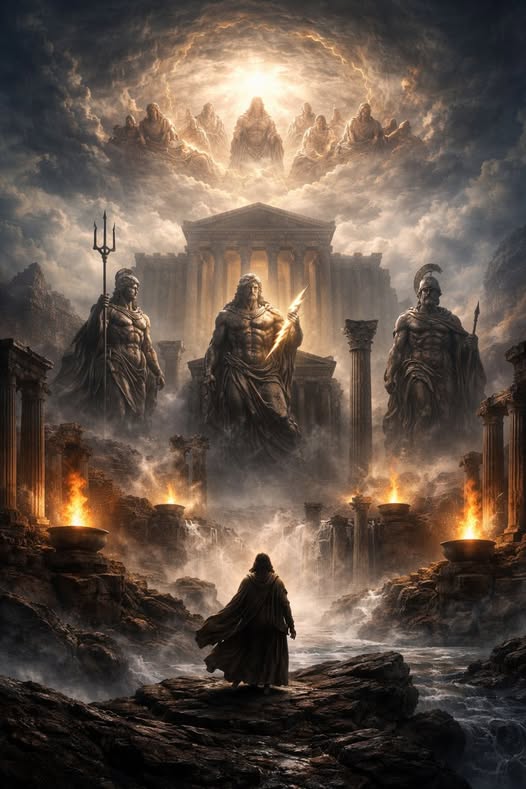
The Iliad presents a world in which divine authority is active, visible, and deeply compromised. The gods are not distant abstractions but direct participants in human violence. They take sides in war, manipulate outcomes, deceive one another, and escalate destruction for their own purposes. Human conflict is not merely political or personal. It is the overflow of divine rivalry into history.
Zeus presides over this council, but he does not judge in any meaningful moral sense. He manages outcomes to preserve balance rather than justice. Atrocity is tolerated because the system values stability over righteousness. Wrath is not corrected but glorified, and honor replaces justice as the governing virtue. From a Divine Council perspective, this reflects a world already under rebellious spiritual rule, where authority still functions but its purpose has been inverted.
Human Life Becomes Endurance Under Rival Powers
The Odyssey shifts the focus from open warfare to prolonged survival. The divine rebellion has not ended, but it has become systemic. Odysseus is not primarily suffering because of moral failure. He is trapped between competing divine interests. One power aids him, another opposes him, and the presiding authority intervenes only to prevent collapse, not to resolve injustice.
Wisdom in this world is not truth that liberates but skill that allows survival. Revelation is partial, strategic, and never complete.
Assistance is real, but always conditional. Human agency exists, but only within boundaries set by hostile powers. Suffering is not exceptional. It is normal because the system governing the world is itself corrupt.
Corrupt Rule Is Embedded Into History and Empire
The Aeneid represents the final stage of this progression. What was chaotic in the Iliad and oppressive in the Odyssey becomes permanent in history. Divine authority is no longer merely contested. It is institutionalized. Fate replaces justice, and destiny overrides mercy.
Aeneas is praised not for moral clarity but for obedience to inevitability. He abandons, conquers, and kills because history demands it. Empire is not a tragic byproduct of divine conflict. It is its fulfillment. Violence is sanctified as necessary, and piety is redefined as loyalty to the system rather than righteousness. From a Divine Council perspective, this is what happens when rebellious spiritual powers entrench themselves in nations and cultures. Corruption becomes tradition, and oppression becomes virtue.
The Pagan Epics Preserve the Problem Without the Solution
Read together, these epics form a single theological arc. The Iliad reveals divine rebellion erupting into human war. The Odyssey portrays humanity enduring life under rival spiritual authorities. The Aeneid shows those authorities embedding themselves into empire and destiny. What unites them is not confusion, but limitation.
There is no judgment of the gods. There is no end to their authority. There is no hope of liberation. The system can stabilize itself, restrain chaos, and perpetuate order, but it cannot correct itself. That absence is not accidental. A system cannot imagine its own overthrow.
Conclusion
The pagan epics preserve a memory of real cosmic structures, but from inside the rebellion rather than from the perspective of the Most High. They accurately describe life under hostile spiritual rule while normalizing its brutality and inevitability. Scripture does not deny this world. It confronts it.
Where the epics accept corrupt authority, the Bible condemns it. Where the epics glorify endurance, the Bible promises deliverance. Where the epics sanctify empire, the Bible announces its end. In Divine Council terms, these texts are not rival theologies. They are unintentional witnesses, testifying to the depth of the problem that only the biblical narrative claims to resolve.
Discussion Questions
- If the pagan epics accurately describe a world ruled by real but corrupt spiritual authorities, what does that suggest about the origin of similar themes of divine conflict, fate, and human suffering across multiple ancient cultures?
- In what ways do the Iliad, the Odyssey, and the Aeneid normalize human suffering as inevitable, and how does that differ from the biblical claim that suffering under hostile powers is temporary and subject to judgment?
- How does the portrayal of wisdom in the Odyssey as survival skill rather than moral truth challenge modern assumptions about knowledge, enlightenment, and spiritual guidance?
- The Aeneid presents obedience to destiny and empire as the highest virtue. How does this contrast with the biblical concept of righteousness as loyalty to God even when it conflicts with nations, rulers, or historical inevitability?
- Why is the absence of judgment or accountability for the gods in these epics theologically significant, and how does that absence help clarify the uniqueness of the biblical declaration that the rulers of the nations will be judged and removed?
Want to Know More
- Michael S. Heiser, The Unseen Realm: Recovering the Supernatural Worldview of the Bible
Provides the foundational Divine Council framework, explaining the reality of spiritual rulers over the nations, their rebellion, and their coming judgment. This lens makes sense of why pagan epics preserve coherent but morally corrupt systems of divine authority. - Lowell K. Handy, Among the Host of Heaven: The Syro-Palestinian Pantheon as Bureaucracy
Explains how ancient pantheons were understood as structured administrations with hierarchy, delegated authority, and jurisdiction. This helps clarify why divine councils appear across cultures and why epic portrayals of the gods reflect ordered systems rather than random myth. - Walter Burkert, Greek Religion
A standard academic treatment of Greek religious thought and practice. Burkert shows how the gods functioned as real explanatory agents within Greek theology, grounding the Iliad and the Odyssey as expressions of lived belief rather than symbolic fiction. - Clinton E. Arnold, Powers of Darkness: Principalities and Powers in Paul’s Letters
Examines New Testament teaching on hostile spiritual powers and their influence over nations and cultures. This work provides a clean bridge between the epic worldview of divine conflict and the biblical claim that these powers are real, opposed, and destined for defeat. - John H. Walton, Ancient Near Eastern Thought and the Old Testament: Introducing the Conceptual World of the Hebrew Bible
Provides essential background on how the ancient world understood divine authority, cosmic order, and the relationship between gods and nations, helping readers see why Scripture’s claims about Yahweh’s rule and judgment of corrupt powers are revolutionary.
About the Author