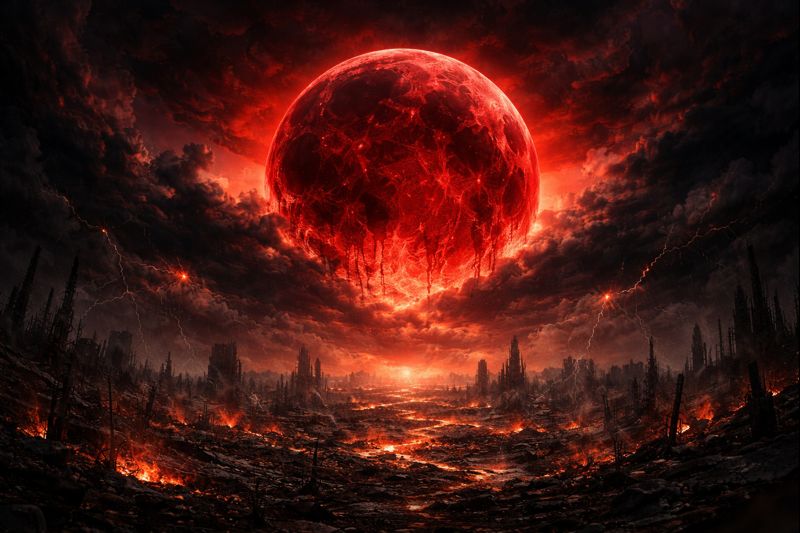
“The sun will be turned to darkness and the moon to blood before the coming of the great and glorious day of the Lord.”
Joel 2:31, later quoted in Acts 2:20, has become a favorite prooftext for modern prophecy speculation centered on lunar eclipses and so-called blood moons. That reading fails at the level of genre, context, and apostolic interpretation. But the persistence of the blood moon theory points to a deeper issue than simple misreading. It reveals a strange and recurring impulse within modern Christianity to domesticate the miraculous by explaining it in naturalistic terms. Joel’s language exposes both errors at once. It is neither an astronomical forecast nor an invitation to soften divine action into something comfortably explainable.
Prophetic Imagery and the Language of Upheaval
Joel is writing as a Hebrew prophet using a well-established symbolic vocabulary. In prophetic literature, cosmic imagery functions as a way of describing moments when God decisively intervenes in history. The sun, moon, and stars represent order, stability, and continuity. When those lights are described as darkened, altered, or failing, the message is not that astrophysics is changing but that the existing order is being judged and overturned by Yahweh.
This pattern appears repeatedly throughout the Old Testament. Isaiah uses cosmic darkening language to describe the fall of Babylon. Ezekiel uses it for Egypt. Amos applies it to Israel’s covenant judgment. In none of these cases did the prophets expect literal cosmic collapse. The language communicates terror, reversal, and the loss of security. Joel stands squarely within this tradition. Treating his words as an astronomical prediction ignores how prophetic language actually works.
Why the Blood Moon Reading Fails
The blood moon interpretation collapses almost immediately once genre is respected. A lunar eclipse is a routine, predictable, regionally limited event that occurs on a regular schedule. Nothing about it signals divine judgment, covenantal crisis, or historical upheaval. The idea that Joel was pointing to such an event would have been unintelligible to his audience and anticlimactic to his message.
The phrase “the moon to blood” is not a technical description of an eclipse. Blood, in prophetic literature, signifies violence, slaughter, and judgment. The image communicates saturation. It portrays a world so marked by divine reckoning that even the heavens are described in terms of bloodshed. This is not subtle language. It is meant to shock and to warn, not to be plotted on a calendar.
Predictability Undermines the Claim Entirely
There is also a simple but devastating practical problem with identifying Joel’s language with lunar eclipses. Eclipses are predictable with extraordinary precision. If Joel were referring to blood moons in the modern sense, then the timing of the Day of the Lord would be knowable in advance. Charts could be drawn, dates narrowed, and expectations scheduled. Scripture explicitly rejects that framework.
Biblical descriptions of the Day of the Lord consistently emphasize suddenness, surprise, and unavoidability. It comes like a thief, not like a calendar reminder. Anchoring it to regularly occurring, mathematically predictable celestial events directly contradicts how Scripture describes divine judgment. If the signs were ordinary and foreseeable, they would cease to function as signs.
This alone should disqualify the blood moon theory. A predictable phenomenon cannot serve as the marker of an event Scripture presents as unexpected and disruptive.
The Track Record of Date-Setting Is One of Harm and Failure
This is not merely a theoretical concern. Blood moon teaching has repeatedly been used as a tool for dating prophecy, and it has failed every time. Leaders announce timelines, followers rearrange expectations, and when the predictions collapse, the damage is borne by the people who trusted them. Disillusionment, spiritual burnout, and cynicism toward Scripture often follow.
History shows that failed date-setting does not strengthen faith. It erodes it. Scripture’s warnings against fixing dates are not arbitrary. They exist precisely because the human desire to know the timetable of divine action has a long record of producing disappointment and harm. Blood moon theories repeat the same mistake under a new astronomical vocabulary.
If Literal, Then Unmistakably Supernatural
Even if one insists on reading Joel’s words literally, the result still undermines the blood moon theory. A literal darkening of the sun and a moon truly turned to blood would not resemble a lunar eclipse in any meaningful way. It would be a supernatural act of God, visible, unmistakable, and disruptive on a global scale. Scripture does not portray divine signs as ambiguous phenomena that require interpretation after the fact.
Biblical examples of cosmic signs associated with God’s action are never minor or debatable. The darkness at the crucifixion was not a scheduled eclipse. It was an obvious, extraordinary sign that something unique was occurring. If Joel 2:31 refers to a literal event, it describes something far more dramatic than a predictable celestial occurrence that happens repeatedly throughout history.
The Deeper Issue: Explaining Away the Miracle
The blood moon theory exemplifies a broader theological problem. There is a persistent tendency within modern Christianity to explain miracles in naturalistic terms. In an effort to appear rational, credible, or compatible with scientific frameworks, believers sometimes feel compelled to reduce divine action to rare but ordinary natural processes. The irony is that this impulse undermines the very nature of a miracle.
A miracle, by definition, is not merely an unusual natural event. It is a direct act of God that transcends normal patterns and signals His intervention. Scripture does not hesitate to present God’s actions as overtly supernatural. Seas part, the sun stands still, the dead are raised, and darkness falls at the death of Christ. These events are not subtle. They are not explained away. They are presented as unmistakable signs of divine authority.
Trying to turn Joel’s imagery into a lunar eclipse does not defend biblical faith. It diminishes it. It suggests discomfort with a God who acts visibly and decisively in history, preferring instead a God whose actions can be explained without challenging modern sensibilities.
The Day of the Lord Is the Point
Joel’s concern is not celestial timing but the Day of the Lord. That phrase refers to Yahweh’s decisive intervention to judge, purge, and ultimately restore. The cosmic imagery serves to communicate the magnitude and seriousness of that intervention. It is theological language, not scientific data.
Joel’s message is a call to repentance and to recognition of God’s authority. Turning the passage into a discussion about eclipses replaces moral urgency with speculative distraction and shifts attention away from what the text is actually demanding of its hearers.
The Apostolic Interpretation Closes the Door
Acts 2 provides the controlling interpretation of Joel 2:31. Peter quotes the passage and applies it to the events surrounding Christ’s death, resurrection, ascension, and the outpouring of the Spirit. He does not point his audience toward future astronomical signs. He declares that Joel’s words are being fulfilled in redemptive history unfolding before them.
Any interpretation that contradicts the apostolic application is not an alternative reading. It is a misreading. The blood moon theory does not merely add to Joel’s meaning. It replaces it.
Conclusion
Joel 2:31 is not about blood moons or eclipses. It is about the Day of the Lord and the unmistakable reality of divine intervention. The imagery is symbolic, and if taken literally, would still describe a supernatural act far beyond any routine natural phenomenon. The attempt to anchor God’s judgment to predictable celestial events not only misunderstands prophetic genre but strips the text of its urgency and power. When Scripture is allowed to speak on its own terms, both the blood moon theory and the impulse to tame the miraculous fall away, and Joel’s warning regains its full force.
Discussion Questions
- How does recognizing prophetic genre change the way we read Joel 2:31, and what specific interpretive errors arise when symbolic language is treated as scientific description?
- Why does the predictability of lunar eclipses fundamentally conflict with biblical descriptions of the Day of the Lord as sudden and unexpected?
- In what ways does the attempt to explain Joel’s imagery as a natural phenomenon reveal a broader discomfort with the supernatural in modern Christianity?
- How does Peter’s use of Joel 2 in Acts 2 limit or correct later attempts to reinterpret the passage around future signs or timetables?
- What is lost theologically and pastorally when divine judgment and intervention are reframed as subtle or explainable natural events rather than unmistakable acts of God?
Want to Know More
- Leslie C. Allen, The Books of Joel, Obadiah, Jonah, and Micah
A respected NICOT commentary that treats Joel’s imagery within its ancient prophetic context and explains how cosmic language functions symbolically rather than as literal astronomical prediction. - John Barton, Joel and Obadiah
A focused scholarly commentary that situates Joel firmly within the prophetic tradition and carefully unpacks the theological meaning of judgment imagery without collapsing it into natural phenomena. - Douglas Stuart, Hosea–Jonah
This Word Biblical Commentary volume provides strong discussion of prophetic genre and symbolism, including the use of cosmic disturbance language to communicate covenant judgment and divine intervention. - Craig S. Keener, Acts: An Exegetical Commentary, Volume 1
A detailed and historically grounded treatment of Acts 1–2 that explains Peter’s quotation of Joel and why Acts 2 governs Christian interpretation of Joel 2:28–32. - Walter Brueggemann, The Prophetic Imagination
A classic and widely cited work that explains how prophetic literature uses vivid imagery, metaphor, and poetic exaggeration to convey theological reality rather than literalistic description.
About the Author