This lesson is written in support of the people of Iran. Its aim is not to demonize an entire population, justify foreign intervention, or reduce a complex society to a single narrative. It seeks to make a clear and necessary distinction between an oppressive ideological system and the men and women living under it, many of whom are actively resisting that system at extraordinary personal cost. Any critique offered here is directed at an ideology and a ruling structure, not at the dignity, humanity, or moral capacity of the Iranian people themselves.
Iran Before Islamic Rule
In the early and mid-20th century, Iran was moving steadily toward modernization. Under Reza Shah Pahlavi and later Mohammad Reza Shah, the country pursued secular governance, industrial development, expanded education, and legal reforms modeled on Western systems. Religious authorities were intentionally excluded from political power, not as an attack on faith itself, but as a safeguard against clerical domination of the state. The goal was to build a modern nation capable of participating fully in global political, economic, and cultural life without being ruled by religious law.
By the 1960s and 1970s, Iran functioned as a modern nation-state in visible and tangible ways. Women attended universities, entered professional fields, and participated in public life without religious compulsion. Civil law governed the courts rather than Islamic jurisprudence, and the legal system reflected European models rather than sharia. Tehran was culturally and economically connected to Europe and the United States, and while the political system was authoritarian, the structure of society itself was broadly secular. Islam existed as a religion practiced by individuals and communities, but it did not govern the nation.
People and Ideology Are Not the Same
That distinction is essential, especially in a conversation this charged. Muslims are not the problem. They are imagers of Yahweh, endowed with conscience, moral intuition, love of family, and the capacity for courage, compassion, and goodness. Many Iranians who identify culturally or nominally as Muslim opposed the Islamic Revolution from the beginning and continue to resist the regime today, often at extraordinary personal cost. Imprisonment, torture, and execution have been routine tools used against those who simply refused to submit.
Condemning Islam as an ideology does not require condemning the people trapped beneath it. A biblical worldview demands that the distinction be maintained precisely because human beings are not reducible to the systems that rule them. Systems can and must be judged. People must never be dehumanized for surviving under them.
Islam as a Governing System
Islam was never designed as a private or inward-facing faith. From its origin, it functioned as a comprehensive system encompassing belief, law, warfare, governance, and social order. Muhammad acted not only as a religious figure but as a lawgiver, head of state, and military commander, and that fusion of authority is foundational rather than accidental. Islam does not possess an internal mechanism for permanently separating religious authority from political power.
Islamic law does not recognize a lasting division between mosque and state. Sharia is not meant to coexist indefinitely with secular legal systems as one option among many. It is meant to replace them. This does not mean that every Muslim consciously desires that outcome, but it does mean that the internal logic of the system consistently moves in that direction when restraints are removed and religious authority gains control of the state.
Moderation as Restraint, Not Reform
Historically, Islam has often appeared moderate when constrained by forces external to it. Monarchies, secular constitutions, colonial administrations, cultural syncretism, and modern nation-states have all limited Islam’s political reach and curtailed its governing claims. These restraints made coexistence possible, not by reforming Islam’s core structure, but by holding it in check.
Those restraints do not arise from Islamic doctrine itself. They exist in tension with it. When they weaken or collapse, the system does not evolve into something more pluralistic. It reasserts its original claims with remarkable consistency.
The Iranian Revolution and the Predictable Outcome
When dissatisfaction with the Shah reached a breaking point in the late 1970s, Islamic leaders did not invent a new ideology. They removed the restraints that had kept Islam out of direct political control. Ayatollah Khomeini’s doctrine of velayat-e faqih provided a Shi’a mechanism for enforcing what Islam already demands: governance under divine law administered by religious authority rather than popular consent.
Once power was secured, the outcome was immediate and entirely predictable. Secular courts were dismantled, sharia replaced civil law, and clerics assumed control over government, education, media, and public morality. Political dissent was no longer treated as opposition to the state, but as rebellion against God Himself. Women were stripped of legal equality, mandatory veiling was imposed, and apostasy and blasphemy became capital crimes. These were not excesses or betrayals of the system. They were its intended function.
A Nation Held Hostage
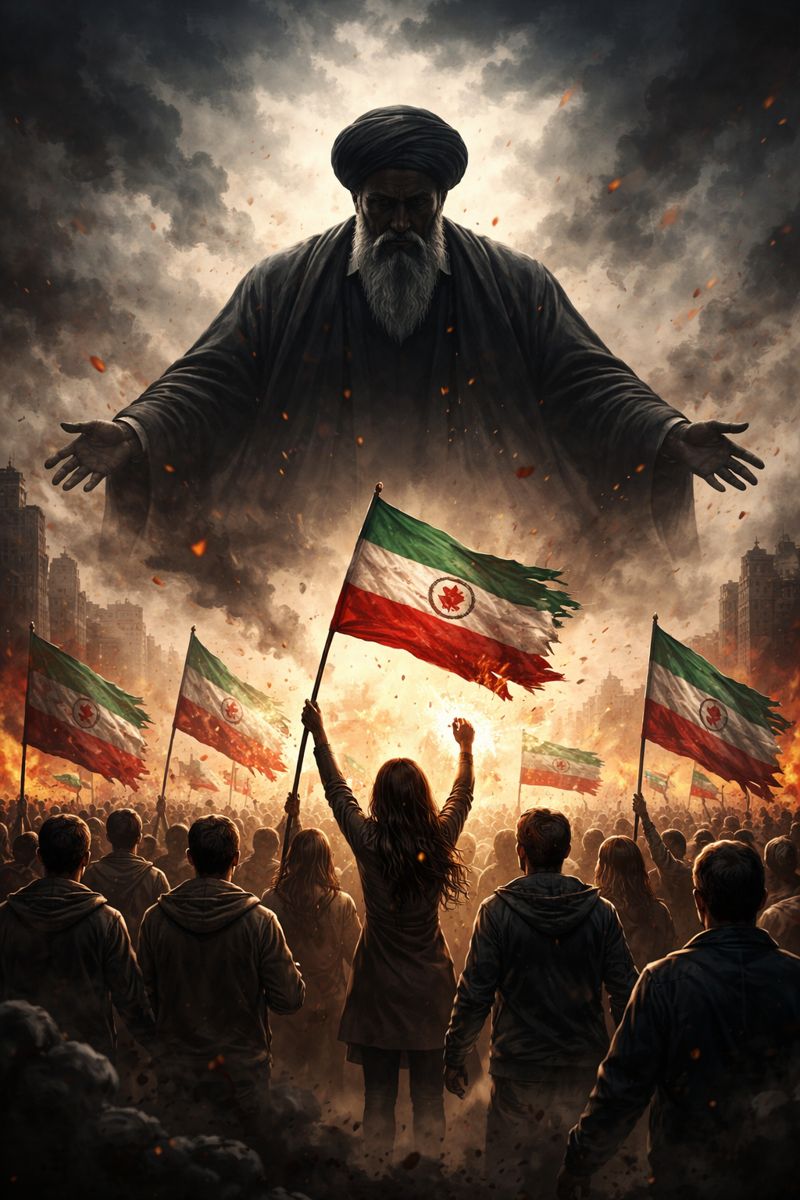
Today, Iran is not a nation unified behind Islamic rule. It is a nation held hostage by it. The ruling Islamist class lives largely separated from the population it governs, concentrated in protected enclaves tied to clerical authority and Revolutionary Guard power. Ordinary Iranians live under constant surveillance, economic collapse, and ideological suffocation, while those who rule them enjoy insulation, privilege, and immunity.
Nationwide protests, open defiance by women, public mockery of clerics, and chants calling for the end of the Islamic Republic reveal a fundamental truth. The people have rejected Islamist rule. This is not a rebellion against God or spirituality. It is a rejection of those who claim divine authority to dominate others.
Twelver Theology and the Logic of Provocation
Iran’s regime is not merely Islamist. It is explicitly Twelver Shi’a, and that theological framework becomes uniquely dangerous when the regime begins to lose control. Twelver Shi’ism centers on the belief that the twelfth imam, the Mahdi, is hidden and will return at a moment of extreme global chaos, injustice, and upheaval. Stability and reform are not signs of progress within this framework. Collapse itself becomes meaningful.
As long as the regime believes it can maintain control, Twelver theology primarily functions as a justification for authority. When control begins to slip, the same theology can shift toward intentional provocation. Crisis is no longer something to avoid. It becomes something to accelerate. Escalation can be reframed not as desperation, but as participation in a divine timetable that must be fulfilled.
In that context, extreme actions are not necessarily seen as failures or miscalculations. They can be interpreted as catalysts meant to force divine intervention and hasten the return of the Mahdi. Regional war, mass casualties, and destabilizing acts are no longer merely political risks. They become theological tools. A regime that believes catastrophe precedes redemption has far fewer internal brakes when facing defeat, and deterrence loses much of its power.
Islam, Daniel, and the Antichrist Pattern
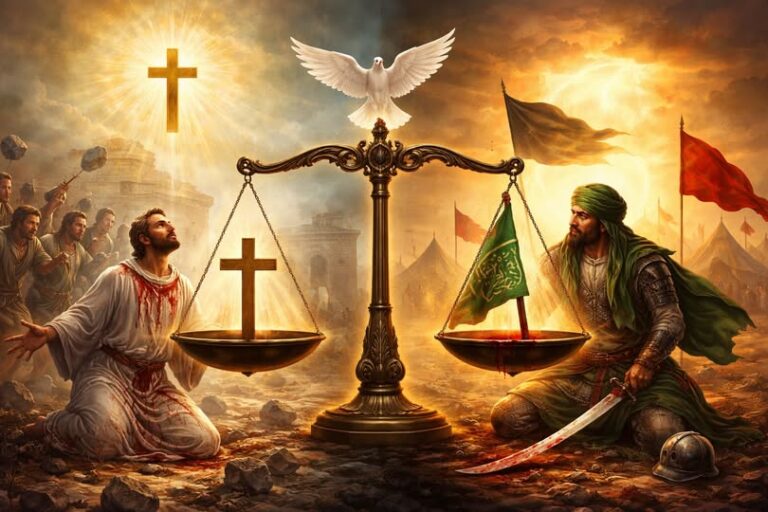
From a biblical prophetic framework, Islam aligns not merely as a competing religion, but as part of the antichrist system itself. The Caliphate fits the pattern of the fourth empire described in Daniel, marked by iron strength, violent expansion, and the crushing of nations. Unlike earlier empires, it fused political domination with religious absolutism, demanding submission not only to rule, but to belief.
Islam does not merely deny Christ. It replaces Him with a counterfeit. Jesus is reduced to a prophet, stripped of His divinity, crucifixion, resurrection, and authority to judge. This is not a minor theological disagreement. It is antichrist by definition.
Why the Church Is Exploding in Iran
Beneath the surface of repression, something remarkable is happening. The underground Church in Iran is growing rapidly, and it is doing so largely beyond the reach of Western missionaries or public preaching. Many Iranians are coming to Christ through dreams and visions of Jesus Himself, encountering Him directly in a system that forbids the Gospel and punishes conversion with death.
When Islam reaches its doctrinal end state, it strips away illusions. What remains is fear, control, and spiritual emptiness. Into that vacuum, Christ appears. Those responding are not abandoning morality or culture. They are responding to truth where enforced certainty has collapsed.
Conclusion
Iran’s story is not ultimately about culture, ethnicity, or even political history. It is about what happens when an ideology that cannot tolerate limits is allowed to rule without restraint. The Islamic Republic did not descend into repression because it failed to live up to Islamic ideals, but because it implemented them in the manner its theology demands once religious authority is fused with state power.
That reality does not diminish the dignity of the people living under the system. It explains their resistance to it. Millions of Iranians have experienced a regime that promised moral clarity and divine justice while delivering fear, corruption, and permanent coercion. What they are rejecting is not God or meaning, but a structure that claimed divine authority while silencing conscience and criminalizing dissent. The uprising unfolding across Iran is therefore not a revolt against faith, but a refusal to accept domination disguised as holiness.
The danger of the present moment lies in the nature of the regime itself. A collapsing Twelver Islamist state is not simply unstable. It is theologically primed to interpret chaos as purposeful and escalation as necessary. When leaders believe disorder can hasten redemption and catastrophe can summon divine intervention, restraint loses its moral force, making the final phase of such a regime more dangerous than its period of strength.
At the same time, the collapse of ideological authority has stripped away the illusions that once sustained it. As the promises of Islamic governance fail openly, many Iranians are encountering Christ apart from institutions, intermediaries, or political power. The growth of the underground Church reflects moral clarity emerging where coercion has exhausted itself. People are responding to truth precisely because enforced certainty has been exposed as hollow.
Iranians are not defined by the system that oppresses them, nor by the ideology imposed in their name. They are imagers of Yahweh, capable of conscience, courage, and faith even under extreme repression. Whatever political future Iran faces, its people are not its problem. They are its hope.
Discussion Questions
- How does the article distinguish between Islam as an ideology and Muslims as people, and why is maintaining that distinction theologically and ethically important?
- In what ways does Iran’s history demonstrate that moderation within Islam has often depended on external restraints rather than internal doctrinal reform?
- How does Twelver Shi’a theology change the risk profile of a collapsing regime, and why does belief about the return of the Mahdi matter politically as well as religiously?
- What does the growth of the underground Church in Iran suggest about the relationship between coercive religious systems and genuine faith?
- If Islam functions as part of an antichrist system within a biblical prophetic framework, how should Christians think about evangelism, compassion, and solidarity with those living under Islamic rule?
Want to Know More
- Joel Richardson, The Islamic Antichrist: The Shocking Truth About the Real Nature of the Beast
A direct and unapologetic examination of Islam through a biblical prophetic lens. Richardson argues that Islam aligns structurally and theologically with the antichrist system described in Scripture, making this book especially relevant to the article’s Daniel framework and its critique of Islamic end-state governance. - Vali Nasr, The Shi’a Revival: How Conflicts Within Islam Will Shape the Future
A foundational academic work on Shi’a Islam and Twelver theology. Nasr explains how eschatology, clerical authority, and grievance shape Iranian behavior, helping readers understand why Iran’s regime responds dangerously when under threat. - Ray Takeyh, Guardians of the Revolution: Iran and the World in the Age of the Ayatollahs
A detailed historical and geopolitical analysis of the Islamic Republic, written by a leading Iran scholar. Takeyh traces how revolutionary ideology, clerical rule, and the Revolutionary Guard fused into the system now facing widespread internal resistance. - David Garrison, A Wind in the House of Islam
A missiological study documenting the rapid growth of Christian movements within Muslim-majority societies, including Iran. Garrison provides firsthand accounts of underground churches, dream-based conversions, and why Islam’s failures often precede mass evangelistic breakthroughs. - Samuel M. Zwemer, The Cross Above the Crescent
A classic work on Islam and Christian witness by one of the most influential missionary scholars in Islamic studies. Zwemer’s insistence on seeing Muslims as redeemable imagers of God while critiquing Islam as a system aligns tightly with the heart of this article.
About the Author