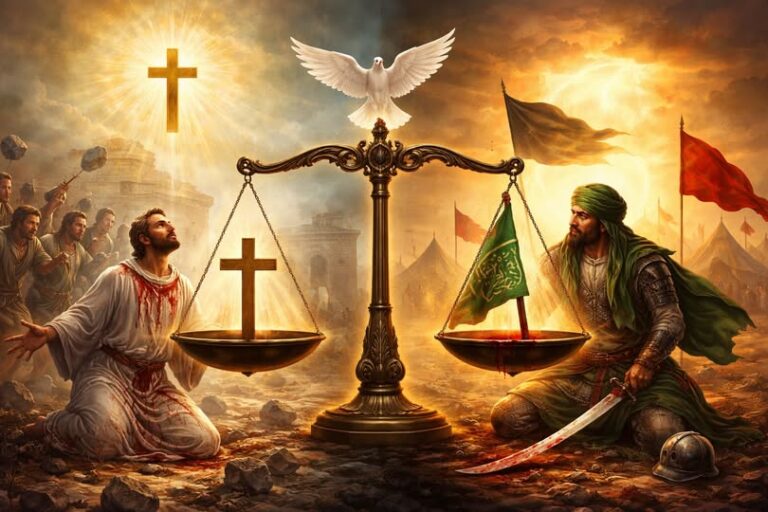
Modern Christmas observance often treats the birth of Jesus as a private, sentimental moment detached from politics, power, or public consequence. In the first-century world, such a separation would have been unintelligible. Births of significant figures were public claims, titles carried political weight, and “good news” was not religious poetry but an announcement of authority.
The Gospels place the birth of Jesus deliberately within the reign of Caesar Augustus, not as a historical footnote but as a theological provocation. From the moment Christ is announced, two competing visions of order, peace, and sovereignty stand side by side. Christmas is not merely the story of a child born in humility. It is the declaration of a rival gospel spoken into the heart of the empire.
The Imperial Gospel of Rome
By the time of Jesus’ birth, Augustus had reshaped the Roman world and carefully constructed his public identity. Central to that identity was his claim to divine legitimacy. After Julius Caesar’s assassination, the Roman Senate officially declared Caesar a god, honoring him as Divus Julius. As Caesar’s adopted son and heir, Octavian took the title Divi Filius, “son of the divine one,” a designation that became foundational to his authority. Augustus did not need to claim divinity outright. His power rested on being the son of a god sanctioned by the state itself.
This divine sonship was paired with a broader imperial narrative. Augustus was hailed as savior of the world and bringer of peace, the ruler who ended civil war and restored order. Inscriptions and civic propaganda celebrated his reign as the beginning of a new era marked by stability and prosperity. Yet this peace was not achieved through justice or reconciliation. It was enforced through military dominance, taxation, and the suppression of dissent. Roman peace flowed downward from power and was maintained by the threat of violence.
Imperial decrees, royal milestones, and significant events in Augustus’ life were regularly described as “good news” for the world. This language framed political control as cosmic benefit and cast Roman rule as the foundation of order itself. Allegiance to Rome was not optional but the basic condition for security, status, and survival. Within this framework, authority was inherited, enforced, and justified by divine association.
Against this backdrop, claims about a new savior, a new lord, or a new kingdom were not abstract theological ideas. They were direct challenges to Rome’s understanding of authority and legitimacy. When the Gospels speak of a Son, a Savior, and a Lord entering the world, they do so in deliberate contrast to an empire whose ruler claimed divine sonship through a dead man elevated by political decree.
Luke’s Subversion of Imperial Language
Luke anchors the birth of Jesus firmly within the machinery of imperial power. His narrative opens with a census decreed by Caesar Augustus, a reminder that Rome’s authority reaches into every household and governs even the most ordinary details of life. Yet the true announcement of “good news” does not come from the palace or the forum. It comes from angels speaking to shepherds, men on the margins of society with no political influence or social prestige.
The language Luke uses is unmistakable. A savior is born. He is called Lord. Peace is proclaimed. These were titles and promises already claimed by Caesar, yet Luke deliberately reassigns them to a child born in poverty, far from the centers of political power. The contrast is intentional and sharp. Rome proclaims peace through dominance and control. Heaven announces peace through the arrival of one who will rule without violence. Luke is not presenting an alternative spirituality or a private religious experience. He is offering an alternative vision of lordship that quietly but decisively undermines imperial claims.
Matthew’s Counter-King Narrative
Matthew approaches the birth of Jesus from a different angle but with the same underlying tension. His account is saturated with the language of kingship, rivalry, and threat. Wise men arrive seeking a king, and their question immediately exposes the fragility of Herod’s authority. Herod does not respond with curiosity or celebration but with fear, because the presence of a rival claim triggers the instinctive reaction of threatened power.
Herod’s massacre of the children of Bethlehem exposes what political insecurity always produces. Violence is the default response of rulers who believe their authority is absolute and unchallengeable. Matthew does not soften this reality or turn it into background scenery. From the beginning, the reign of Christ provokes resistance from those who hold power by force. Jesus is presented as a king whose authority does not depend on Rome, whose legitimacy does not require imperial approval, and whose survival does not rely on armies. This is not a sentimental story designed to evoke warmth. It is a confrontation that reveals the cost of competing claims to sovereignty.
Why Early Christians Took Christmas Seriously
Early Christians did not romanticize the birth of Christ or treat it as a harmless religious symbol. Confessing that Jesus was Lord was not poetic devotion or private belief. It was a declaration of allegiance that carried real and often dangerous consequences. To proclaim Christ’s authority was to deny the ultimate authority of Caesar, and everyone in the Roman world understood what that implied.
The incarnation meant that no ruler, system, or empire could claim final control over human life. This is why persecution followed proclamation. Christianity was not considered dangerous because it encouraged moral improvement or personal spirituality. It was dangerous because it reshaped loyalty, identity, and hope at their deepest levels. Christmas mattered because it marked the moment when divine authority entered history in visible form, quietly but decisively undermining every competing claim to sovereignty.
What Christmas Means in a World of Power
The political force of Christmas does not depend on aligning Christ with modern movements or causes, nor does it require turning the gospel into a partisan weapon. It operates at a deeper level. The birth of Jesus challenges every system that grounds its legitimacy in fear, coercion, or violence. Christmas declares that true authority does not originate from status, wealth, or military strength but flows from self-giving, faithfulness, and obedience to God.
The incarnation relativizes all earthly power without retreating from the reality of political life. Every ruler, institution, and ideology stands measured against a kingdom that arrives not by force but by truth, not through domination but through faithfulness.
Conclusion
Christmas was never merely the story of a child in a manger. It was the announcement of a rival kingdom spoken into the heart of the empire, a claim that could not be absorbed into Roman propaganda or neutralized by political power. Rome promised peace through domination. Christ brought peace through humility and sacrifice.
That claim did not end with the fall of Rome. It continues to confront every age that places its hope in power rather than in God. Whether empires acknowledge it or not, the rival gospel proclaimed at Christmas still stands.
Discussion Questions
- In the Roman world, titles such as “lord,” “savior,” and “good news” carried political authority. How does recognizing this context change the way the Gospel birth narratives are understood?
- Why do Luke and Matthew deliberately place the birth of Jesus within systems of imperial and royal power rather than presenting it as a purely private or spiritual event?
- How does Herod’s response to the birth of Jesus reveal the nature of political power when it perceives a threat to its authority?
- What did confessing “Jesus is Lord” communicate in a society where allegiance to Caesar was expected, and why would this confession have been viewed as dangerous?
- How does understanding Christmas as the announcement of a rival kingdom challenge modern sentimental or purely cultural approaches to the holiday?
Want to Know More
- N. T. Wright, Jesus and the Victory of God
A foundational work for understanding how Jesus’ life and message functioned as a direct challenge to the political and theological claims of Rome, including the use of titles like “Lord” and “Savior.” - Warren Carter, The Roman Empire and the New Testament: An Essential Guide
A clear and historically grounded introduction to how Roman imperial ideology shaped the world of the New Testament and how the Gospels respond to imperial power. - Richard A. Horsley, Jesus and Empire: The Kingdom of God and the New World Disorder
Examines how Jesus’ proclamation of the kingdom confronts domination systems, with careful attention to Roman power structures and resistance language in the Gospels. - Paul Zanker, The Power of Images in the Age of Augustus
A classic scholarly study of Augustan propaganda, showing how imagery, titles, and public narrative were used to shape loyalty and identity throughout the empire. - N. T. Wright, The New Testament and the People of God
Provides essential background on Second Temple Judaism, Roman rule, and the worldview assumptions that inform how early Christians understood authority, kingship, and history.
About the Author