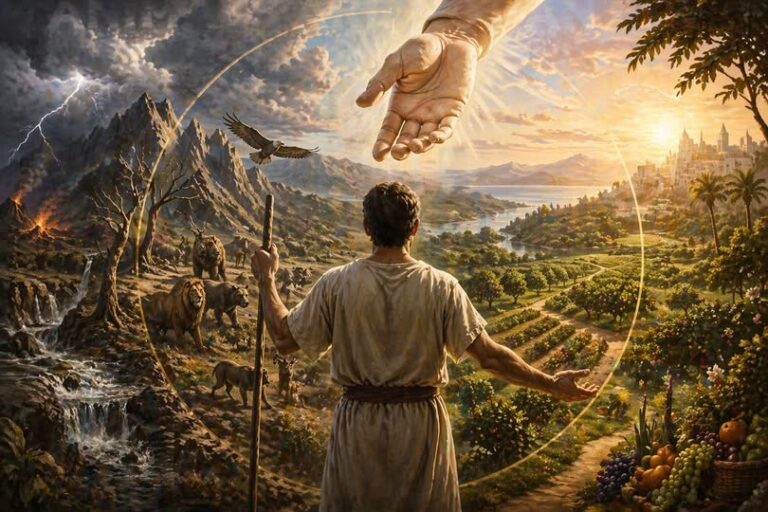
One of the most persistent questions about Genesis 3 is why God did not simply erase Adam and Eve and begin again. From a modern perspective, a reset seems efficient and even merciful. The first humans failed, the world fractured, death entered the story, and suffering followed. If God is sovereign and omnipotent, why not wipe the slate clean and start fresh with a new pair who might succeed where the first failed?
Scripture does not frame the Fall as a failed experiment. It presents it as the opening crisis in a covenantal story that God fully intends to bring to completion. Genesis is not the account of God abandoning humanity after disappointment. It is the account of God choosing to bind Himself to humanity even after rebellion. The narrative does not move backward toward replacement but forward toward redemption. That trajectory is not accidental. It reveals something fundamental about how God views His human imagers and the role they play in His purposes.
Judgment Without Erasure
When Adam and Eve sin, the text makes clear that God confronts them directly and personally. He questions them, exposes their fear and blame shifting, and announces consequences that will shape human history, including pain, toil, fractured relationships, and mortality. Yet the judgment is measured and purposeful rather than annihilating. God does not revoke the image. He does not unmake humanity. Instead, He clothes them, preserves their lives, and sends them out into a world that will now resist them but will still remain under His sovereign care.
In the middle of the consequences, Genesis 3:15 introduces hope. The promise that the seed of the woman will crush the serpent establishes that the story is not ending in defeat. Judgment and mercy are interwoven from the beginning. Humanity is disciplined, but it is also preserved and given a future. That preservation signals that God has not abandoned His original intention for human rule and representation.
Exile as Protection, Not Rejection
The expulsion from Eden is often read purely as punishment, but the text provides a theological rationale that deepens our understanding. Humanity is barred from the Tree of Life so that it will not live forever in a fallen condition. Immortality fused with corruption would have sealed rebellion into permanence. An eternal race of sinful imagers would not be redemption. It would be irreversible ruin.
By restricting access to the Tree of Life, God limits the damage of sin and preserves the possibility of restoration. Mortality becomes the space in which redemption unfolds. The biblical storyline confirms this interpretation. Revelation 22 reintroduces the Tree of Life, removes the curse, and restores access in a renewed creation. The arc from Genesis to Revelation shows that exile was severe but not ultimate. It functioned as a necessary boundary that prevented permanent corruption while God worked out His redemptive plan in history.
Why a Reset Would Not Solve the Real Problem
Erasing Adam and Eve would not have solved the underlying issue because the problem was not defective craftsmanship. Humanity was created as imagers entrusted with delegated authority over creation. Real authority implies real freedom, and real freedom carries the possibility of misuse. If God desired creatures who genuinely reflect His rule and character, then the capacity for rebellion was inseparable from that calling.
A second pair of humans would have faced the same test and the same possibility of failure because the risk is built into the dignity of agency itself. Scripture does not treat redemption as a desperate adjustment after a failed launch. It presents redemption as the means by which God defeats evil without dismantling the structure of human responsibility. This is why Christ is called the last Adam.
He does not replace humanity with a different order of being. He represents humanity faithfully. Where the first Adam grasped autonomy, the second submits in obedience. God answers rebellion not by deletion but by incarnation, entering the human condition to restore it from within.
The Rebellion of the Rebel Gods
The fate of the rebellious elohim unfolds differently. Psalm 82 depicts spiritual rulers entrusted with oversight of the nations who corrupt justice and abuse their authority. Genesis 6 describes divine beings crossing boundaries, taking human wives, and contributing to catastrophic corruption before the flood. Second Temple Jewish literature, particularly 1 Enoch, elaborates on their imprisonment, and the New Testament affirms that trajectory. Second Peter 2:4 and Jude 6 describe angels who sinned and are kept in chains under darkness until judgment.
Unlike humanity, these beings are not depicted as deceived novices acting in ignorance. They function within the divine council and operate from a position of knowledge and proximity to God’s authority. Their rebellion is portrayed as a calculated distortion of entrusted power. Scripture offers no covenant of restoration for them, no mediating incarnation, and no promise of future glorification. Instead, their authority is stripped and their judgment fixed.
Why the Outcomes Differ
The distinction between these two rebellions lies not in the scale of the damage but in the nature of the rebels and the context of their authority. Adam and Eve are deceived, tempted, and immature in their understanding of the full consequences of their choice. Their rebellion is real and devastating, but it is bound up with limitation and vulnerability.
The rebellious elohim act from clarity and delegated governance over nations. Their corruption is not a moment of confusion but a sustained abuse of power from within the heavenly administration. Scripture treats this kind of rebellion as treason at the highest level rather than tragic weakness. Humans fall from a place of probation. The rebel gods fall from a place of administration.
Redemption and Covenant
Redemption is not something God owes to any creature. It flows from covenantal commitment. From Genesis onward, God binds Himself to humanity’s destiny. He calls Abraham, forms Israel, and ultimately enters history in Christ. The incarnation confirms that humanity’s restoration is central to God’s purposes.
No parallel covenant is extended to fallen spiritual beings. Instead, the New Testament declares that redeemed humanity will judge angels. The beings who sought to dominate and corrupt humanity are displaced by glorified humans united to Christ. The storyline culminates not in the elevation of angels but in the vindication and exaltation of faithful human imagers.
Conclusion
Genesis 3 and the rebellion of the elohim present two acts of defiance that result in two distinct outcomes. Humanity receives exile, mortality, and discipline, but also promise, incarnation, and restoration. The rebellious spiritual rulers receive removal, imprisonment, and final judgment.
The difference is not favoritism. It reflects covenantal purpose and the unique role humanity plays in God’s design for creation. God does not erase His imagers when they fall. He commits Himself to restoring them and reclaiming the authority that corrupt powers attempted to seize. The larger biblical story is not about a divine reset. It is about divine redemption accomplished through the obedience of the last Adam and the ultimate displacement of rebellious spiritual rule.
Discussion Questions
- Why does Scripture move forward with redemption instead of backward toward replacement after Genesis 3, and what does that reveal about God’s covenantal commitment to humanity?
- In what way does barring access to the Tree of Life function as mercy rather than mere punishment, and how does Revelation 22 complete that arc?
- How does understanding Adam as covenant representative, rather than viewing the Fall as a design flaw, reshape how we think about free will, responsibility, and redemption?
- Why does Scripture treat the rebellion of the elohim as fixed judgment rather than redeemable failure, and what does that tell us about authority and accountability?
- How does the promise that redeemed humanity will judge angels reinforce the idea that God’s ultimate plan is not to elevate spiritual beings, but to vindicate and glorify faithful human imagers?
Want to Know More
- Michael S. Heiser, The Unseen Realm: Recovering the Supernatural Worldview of the Bible (Lexham Press). Heiser reconstructs the biblical divine council worldview and explains Psalm 82, Genesis 6, and the judgment of corrupt spiritual rulers, showing how this framework carries into the New Testament.
- Michael S. Heiser, A Companion to the Book of Enoch: A Reader’s Commentary, Vol. 1: The Book of the Watchers (1 Enoch 1–36). A detailed examination of the Watchers tradition that illuminates how Second Temple Judaism understood the rebellion of divine beings and their imprisonment.
- G. K. Beale, A New Testament Biblical Theology: The Unfolding of the Old Testament in the New (Baker Academic). Beale traces the Adam theme across Scripture and demonstrates how Christ fulfills humanity’s original commission rather than replacing humanity with a different order of being.
- G. K. Beale, We Become What We Worship: A Biblical Theology of Idolatry (IVP Academic). Beale explores how worship shapes human identity, connecting image theology, idolatry, and restoration within the larger biblical narrative.
- John H. Walton, The Lost World of Adam and Eve: Genesis 2–3 and the Human Origins Debate (IVP Academic). Walton situates Genesis 2–3 within its Ancient Near Eastern context and clarifies humanity’s role as imagers, helping explain why redemption, not reset, drives the biblical storyline.
About the Author