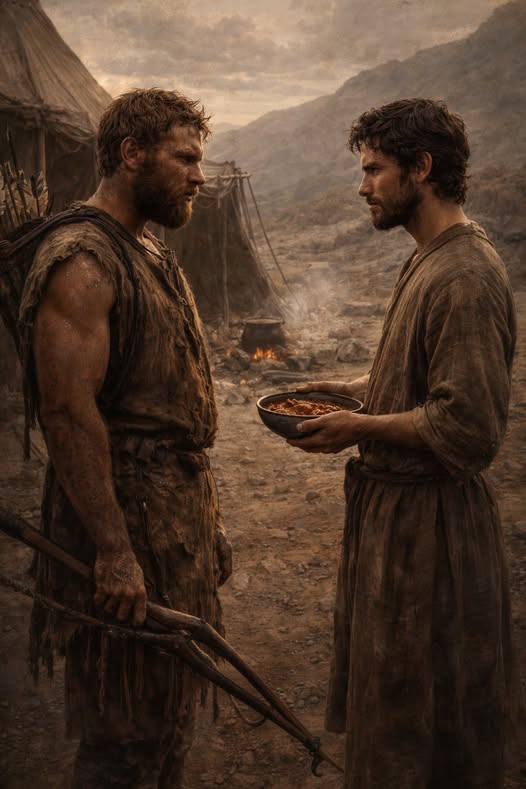
The account of Jacob and Esau is intentionally written to provoke discomfort. Scripture does not frame the story as a simple moral contrast between virtue and vice, nor does it attempt to protect Jacob from the reader’s judgment. Instead, it places Jacob’s actions in full view and allows the reader to react honestly to his manipulation, deceit, and exploitation of familial trust. The frustration many readers feel toward Jacob is not accidental or misplaced. The narrative is constructed to make the reader wrestle with the tension between divine election and human moral failure rather than resolving it prematurely.
This story is not about identifying a hero. It is about understanding how God’s covenant purposes move forward through deeply flawed individuals without pretending those flaws are insignificant. The discomfort the story generates is part of its theological function.
The Birthright and the Nature of Jacob’s Sin
Esau’s sale of his birthright is often treated as the central moral failure in the story, but the narrative places greater weight on Jacob’s response to that failure. Esau treats the birthright with contempt, valuing immediate physical relief over long-term covenant responsibility. That choice matters, and the text does not excuse it. However, Esau’s failure does not legitimize Jacob’s actions, nor does it shift responsibility away from Jacob’s character.
Jacob’s sin is not that he desires the blessing. The promise concerning the younger son was already spoken before either brother acted. The problem is that Jacob does not trust God to accomplish what God has declared. Instead of waiting, he grasps. Instead of trusting, he manipulates. He behaves as though God’s purposes require deception in order to succeed. The text underscores this by slowing the narrative during Isaac’s deception, drawing attention to Jacob’s repeated lies and his willingness to invoke God’s name to legitimize fraud. The absence of editorial commentary is deliberate. Scripture does not excuse Jacob. It exposes him.
Election Does Not Equal Approval
Scripture is explicit that God’s choice of Jacob precedes his actions, but this is not presented as moral endorsement. Divine election in this narrative does not function as a reward for virtue. It functions as a declaration of purpose that does not depend on human merit. This distinction is essential for understanding the story’s theology.
God does not choose Jacob because he is righteous, nor does He overlook Jacob’s sin. Instead, God commits Himself to a man who will require discipline, exposure, and transformation over the course of his life. Election intensifies accountability rather than erasing it. If covenant participation depended on moral superiority, the covenant would fail immediately. The narrative forces the reader to confront a God who remains faithful to His purposes while refusing to minimize the seriousness of human sin.
Consequence as Discipline Rather Than Erasure
Jacob’s later life is not portrayed as evidence that God ignored his wrongdoing. It is portrayed as the outworking of it. The patterns established early in Jacob’s character echo throughout his story. He deceives and is deceived. He manipulates relationships and later suffers relational fracture within his own household. He shows favoritism and watches that favoritism tear his family apart.
God does not intervene to shield Jacob from the natural consequences of becoming a manipulator. Instead, Jacob is allowed to live inside the character he has formed. This is not abandonment or retribution. It is discipline through consequence. The story demonstrates that divine mercy does not remove moral gravity. It allows it to do its formative work.
Wrestling as the End of Strategy
The turning point in Jacob’s story does not occur when he becomes morally exemplary. It occurs when he is exhausted of options. At the river, Jacob is isolated, fearful, and facing consequences he cannot manage. The wrestling encounter is not a test of strength or cleverness. It is the collapse of strategy.
Jacob clings because he has nothing left to manipulate. He leaves the encounter wounded and renamed, marked physically and permanently by the realization that blessing is not seized through cunning but received through dependence. The limp matters because it signifies a fundamental shift in how Jacob relates to God. The transformation does not erase his past. It reorients his future.
Why the Story Still Confronts the Reader
The narrative resists simplistic moral sorting. Esau is not portrayed as righteous, but neither is Jacob portrayed as admirable. God is neither passive nor impressed by manipulation. The story allows the reader to feel satisfaction when Jacob suffers because justice is real and actions matter. That reaction is not rebuked by the text.
The deeper confrontation emerges when the reader recognizes Jacob’s instincts in themselves. The temptation to secure blessing through shortcuts. The impulse to justify compromise when the desired outcome appears aligned with God’s purposes. The fear that patience might cost too much. The story functions as a mirror, not a fable.
Conclusion
The story of Jacob and Esau does not exist to rehabilitate Jacob’s reputation or to soften divine justice. It exists to show how God advances His covenant purposes without pretending sin is harmless or irrelevant. Jacob is chosen, disciplined, wounded, and transformed across a lifetime shaped by consequence and mercy working together.
God’s faithfulness does not bypass human failure. It works through it, exposes it, and reshapes it. That tension is not resolved neatly because it reflects reality. This is not favoritism. It is mercy that refuses to lie about the cost of being chosen.
Discussion Questions
- Jacob’s desire for the birthright aligns with God’s stated purpose, yet his methods are clearly sinful. How does this tension challenge the idea that good intentions or correct theology can justify unethical actions?
- The narrative allows the reader to feel satisfaction when Jacob later suffers the consequences of his deception. What does this suggest about how Scripture views justice, discipline, and moral accountability within God’s covenant purposes?
- Divine election in Jacob’s story precedes both his wrongdoing and his transformation. How does this shape our understanding of election as purpose rather than approval, and how does it guard against both pride and despair?
- Jacob’s life is marked by patterns of deception that return to him through others. In what ways does the concept of formative consequence differ from punishment, and why is that distinction important for understanding God’s discipline?
- The turning point in Jacob’s story occurs when he can no longer rely on strategy or manipulation. How does Jacob’s wrestling at the river redefine what faith looks like when control, leverage, and certainty are stripped away?
Want to Know More
- Gordon J. Wenham, Genesis 1–15
Wenham’s commentary provides careful literary and theological analysis of the Jacob and Esau narratives, showing how the text intentionally exposes Jacob’s deception without excusing it. He highlights the narrative pacing, repetition, and irony that frame Jacob as morally compromised while still central to God’s covenant purposes. - John H. Walton, Genesis
Walton situates the Jacob and Esau account within its Ancient Near Eastern context, particularly the cultural significance of birthrights, blessings, and inheritance. His work helps clarify why Esau’s contempt for the birthright matters while also showing why Jacob’s manipulation represents a failure of trust rather than clever faithfulness. - Nahum M. Sarna, Genesis
Sarna emphasizes the ethical and theological tensions within Genesis, especially the distinction between divine election and human behavior. His treatment of Jacob is especially helpful for understanding how Scripture preserves moral ambiguity without resolving it into simplistic moral lessons. - Walter Brueggemann, Genesis
Brueggemann explores the theme of struggle as central to Israel’s identity, arguing that Jacob’s life embodies the reality of faith formed through conflict, consequence, and transformation. His work highlights how the narrative refuses to idealize its patriarchs while still presenting them as vehicles of divine promise. - Tremper Longman III, How to Read Genesis
Longman provides a framework for reading Genesis as theological narrative rather than moral fable, helping readers understand why characters like Jacob are portrayed honestly and unsparingly. His approach helps guard against flattening the story into either moral endorsement or cynical rejection.
About the Author