The New Testament account of Jesus casting “Legion” into a herd of pigs is often approached as a strange exorcism story whose main purpose is to demonstrate Jesus’s power over demons. Read in isolation, the details can seem excessive or even confusing. Read against the broader biblical and Ancient Near Eastern background, however, the episode functions as a deliberate theological confrontation.
Jesus is not merely liberating an individual. He is publicly dismantling a death-centered religious worldview that treated tombs, the underworld, and the dead as legitimate sources of authority. What the Law regulated and later condemned, Jesus confronts directly and decisively.
Death Religion in the Ancient Near East
In the Ancient Near East, death was not simply the absence of life. It was a realm believed to retain power, memory, and access to hidden knowledge. Cultures shaped by Hurrian, Canaanite, and Mesopotamian religion assumed that the boundary between the living and the dead was permeable and could be navigated through ritual. Ancestors were honored, then consulted, and eventually invoked as mediators capable of influencing events among the living.
Necromancy was not fringe superstition but a coherent religious system in which the dead functioned corporately rather than individually, often conceived as collective powers that exercised authority from the underworld. Within that worldview, death was dangerous but useful, something to be managed, appeased, and accessed rather than resisted.
The Torah’s Escalating Response to Death
The Torah’s treatment of death reflects a developing response to this surrounding religious logic. Leviticus addresses death primarily through impurity categories. Corpses, graves, blood, and contact with spirits are treated as contaminating because death exists outside Yahweh’s life-giving presence. At this stage, the concern is containment. Death must not be ritualized, normalized, or invited into Israel’s worship. Mediums and spiritists are condemned, but the emphasis remains on defilement and divided loyalty rather than outright treason.
Deuteronomy reflects escalation. Prolonged exposure to Canaanite religion had pushed ancestor honor beyond remembrance into mediation. As a result, necromancy is no longer treated as impurity but as covenant betrayal. Consulting the dead is grouped with divination and child sacrifice because all assume access to power apart from Yahweh. Regulation has failed, so prohibition replaces it. Israel is explicitly told it does not need the dead because Yahweh alone provides revelation through His prophets. Death is no longer merely dangerous. It is rival authority.
Pork and Chthonic Symbolism
The prohibition against eating pork belongs to this same polemic. In the Ancient Near East, pigs were not standard offerings to high gods associated with order, blessing, and fertility. They were consistently associated with funerary rites, underworld appeasement, and purification rituals connected to death. Pork consumption and pig sacrifice functioned within a chthonic symbolic system rather than within normal temple worship.
Refusing pork was therefore not a hygienic measure but a theological one. It marked Israel’s refusal to participate in death-oriented ritual logic. This is why later prophetic texts explicitly pair eating pig flesh with tomb rituals and spirit practices. These are not disconnected violations but coordinated expressions of allegiance to death religion.
The Legion Episode as Enacted Theology
Against this background, the details of the Legion episode become precise rather than puzzling. The possessed man lives among tombs, locating him socially, ritually, and spiritually in the realm of the dead. He is not merely afflicted. He is dominated by death. When the spirits identify themselves as “Legion,” they speak as a collective, consistent with Ancient Near Eastern conceptions of underworld powers as corporate entities rather than individual personalities. Death rules in mass.
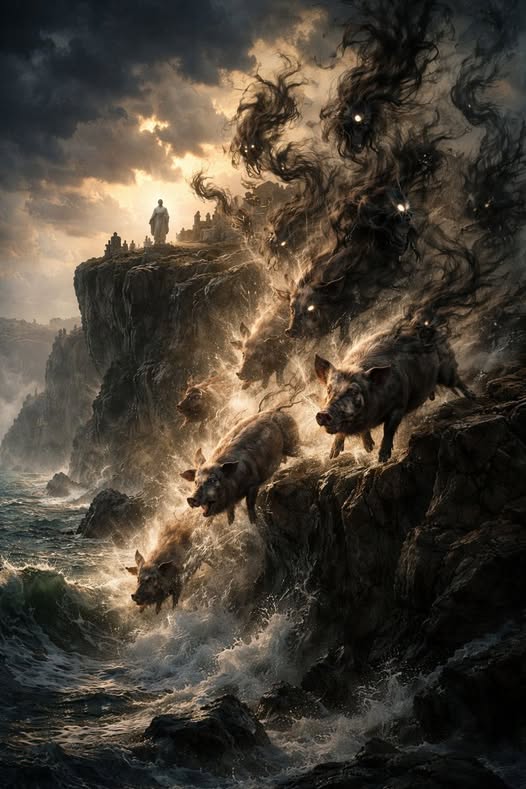
This confrontation also takes place in Gentile territory, within a region where death was not merely feared but economically and ritually managed. The presence of a large herd of pigs signals an established system operating comfortably within chthonic categories the Torah rejects, indicating a local economy aligned with death-oriented religious logic. When Jesus drives the spirits into the pigs, and they are destroyed, He is not only stripping death of spiritual authority but collapsing its material and social usefulness as well.
The name “Legion” would have carried additional weight in a region where Roman military power was enforced largely by local recruits drawn from Syria, Transjordan, and neighboring Arab populations. These soldiers were Roman in discipline and loyalty, but culturally shaped by the same death-oriented religious world that normalized tomb cults, underworld appeasement, and chthonic ritual logic. This overlap helps explain why the imagery of collective occupation, domination of bodies, and rule through violence resonates so naturally here, as Jesus confronts not merely a spiritual affliction but the deeper authority of death that both necromantic religion and imperial power draw upon.
The request to enter pigs is not incidental. Within chthonic logic, pigs are appropriate vessels for death-aligned powers. Jesus permits the transfer not as accommodation but as exposure. The spirits move into animals symbolically associated with the underworld and immediately rush into the sea, which in biblical theology represents chaos, death, and the abyss. This is not relocation. It is de-authorization. Death is returned to death and denied continued embodiment among the living.
Where These Spirits Come From
Within the biblical and Second Temple framework, the spirits encountered in episodes like Legion are not presented as fallen angels but as death-bound beings whose existence is tied to human corruption and divine judgment. Jewish literature consistently associates hostile spirits with the disembodied remnants of the Nephilim destroyed in the Flood, whose violent legacy continued after their physical demise. These spirits are not rulers by creation or office but parasites of death, seeking embodiment, influence, and disruption among the living.
This origin explains their fixation on tombs, their collective identity, and their alignment with impurity and the underworld. They are not celestial rebels ruling from heaven but remnants of judgment operating from below, which is precisely why Jesus treats them not as rival authorities but as disposable intruders.
Fear, Restoration, and Authority
The reaction of the surrounding community is telling. Their fear cannot be reduced to economic loss. Their spiritual framework has collapsed. In death-centered religion, the underworld is managed through appeasement and careful boundaries. Jesus does not manage death. He breaks its claim. A man once ruled by tombs now sits clothed and sane, fully restored to the realm of the living. The powers that once controlled him are gone, and the old assumptions about negotiating with death no longer hold. That disruption is terrifying to those accustomed to coexistence with the underworld.
Resurrection Over Necromancy
Necromancy assumes the dead exercise authority now. Biblical theology insists the dead wait. That distinction is decisive. Jesus does not extract power from the dead or bargain with underworld forces. He demonstrates authority over death itself. The Legion episode anticipates resurrection theology by showing that death does not mediate blessing, knowledge, or control. It submits.
Conclusion
The story of Legion and the pigs is not an odd miracle or an unfortunate side effect of exorcism. It is a public repudiation of death religion. The tombs, the collective spirits, the pigs, and the sea all communicate the same theological claim. The dead are not authorities. The underworld is not a source of power. Death does not get a seat at the table. What Leviticus treated as dangerous, Deuteronomy condemned as treason, and the prophets denounced as rebellion, Jesus renders obsolete through action. This is not merely an exorcism. It is the defeat of death-centered theology by the God of the living.
Discussion Questions
- How does reading the Legion episode against Ancient Near Eastern death religion change the way you understand Jesus’s authority in this scene, compared to reading it as a simple exorcism?
- Why does the Bible treat necromancy and consulting the dead as a theological betrayal rather than merely a moral or ritual failure, especially when compared with surrounding cultures?
- In what ways do the tombs, the collective identity of “Legion,” the pigs, and the sea function together as a unified theological statement about death and the underworld?
- How does the biblical rejection of pork and chthonic symbolism help explain why the demons request the pigs and why their destruction is central to the meaning of the episode?
- How does resurrection theology ultimately dismantle necromantic thinking, and why is that distinction essential for understanding the gospel’s claim that Jesus is Lord over life and death?
Want to Know More
- Michael S. Heiser, Demons: What the Bible Really Says About the Powers of Darkness
A focused study of demonology in the Hebrew Bible and Second Temple Judaism, arguing from textual evidence that hostile spirits are associated with the dead and the legacy of the Nephilim rather than a Miltonic fallen-angel framework. - Karel van der Toorn, Family Religion in Babylonia, Syria and Israel
A foundational work on ancestor veneration, household cults, and interaction with the dead in the Ancient Near East, essential for understanding how remembrance slid into mediation and necromancy. - Derek P. Gilbert, The Gates of Hell Shall Not Prevail
A detailed examination of the biblical geography of rebellion, the association of gates, tombs, and underworld access points, and how Jesus’s ministry directly confronts death-centered spiritual authority, including episodes like the Gerasene demoniac. - Archie T. Wright, The Origin of Evil Spirits: The Reception of Genesis 6:1–4 in Early Jewish Literature
A rigorous academic treatment of how Second Temple Jewish texts understood the origin of evil spirits as the postmortem legacy of the Nephilim, grounding later demonology in judgment rather than angelic rebellion. - Philip S. Johnston, Shades of Sheol: Death and Afterlife in the Old Testament
An in-depth study of biblical conceptions of death, the underworld, and the limits placed on the dead, providing essential background for understanding why necromancy is rejected so strongly.
About the Author