Christianity has existed in Iran since the earliest centuries of the Church, long before the rise of Islam and the formation of the modern Iranian state. For much of that history, Christian communities such as Armenians and Assyrians were allowed to exist as protected minorities, provided they remained ethnically distinct and refrained from evangelizing Muslims. This arrangement changed fundamentally with the Islamic Revolution of 1979, which transformed Iran into a Shi’a Islamic theocracy. Under the new regime, religion became inseparable from state power, and Christianity ceased to be merely a tolerated minority faith and instead became a perceived ideological and political threat.
While Christianity itself was not formally banned, conversion from Islam was treated as apostasy and increasingly prosecuted under the language of national security rather than theology. Persian-language worship was restricted, evangelism was criminalized, and churches suspected of welcoming Muslim converts were closed or placed under constant surveillance. The intent was not simply to regulate Christianity but to prevent it from spreading beyond ethnic boundaries. What followed, however, was not the extinction of Christianity in Iran, but its relocation from public space into private homes, where faith could be practiced quietly and relationally.
What the Underground Church Is and Is Not
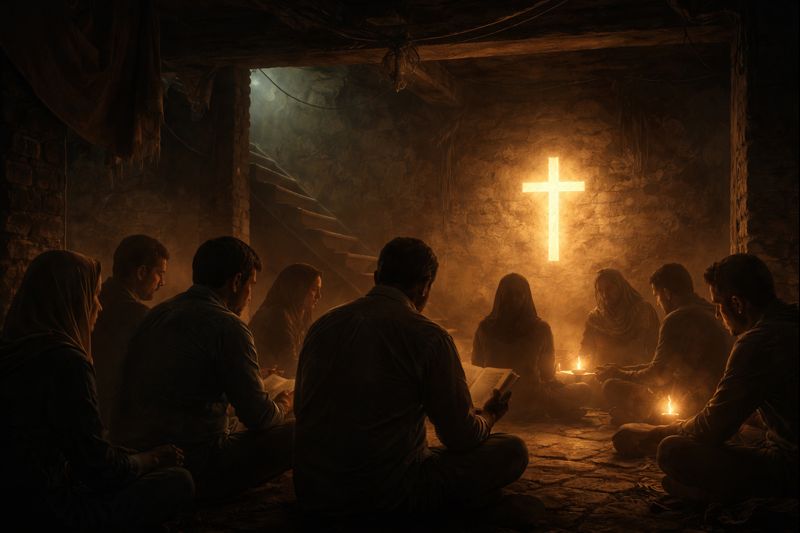
The underground church in Iran is often misunderstood as a single organization or coordinated movement, but it is neither centralized nor uniform. It consists of small, informal house fellowships that gather discreetly in private homes, often rotating locations to reduce the risk of detection. These gatherings emphasize trust, discipleship, and mutual accountability rather than formal leadership hierarchies or institutional visibility. The absence of public structure is not a deficiency but a deliberate adaptation to an environment where visibility invites repression.
These churches are underground not because secrecy is an end in itself, but because public Christian life for converts from Islam is illegal. Teaching Scripture in Persian, baptizing converts, or organizing worship outside state-approved ethnic churches can result in arrest and imprisonment. Iranian believers who leave Islam are denied any legal avenue for openly practicing their faith, leaving underground fellowship as the only viable option. What appears clandestine from the outside is, for believers, simply obedience under constraint.
Persecution as a Catalyst, Not a Deterrent
One of the defining characteristics of the Iranian underground church is that it has grown despite sustained persecution, and in many respects because of it. Government pressure has stripped Christianity of cultural comfort and social advantage, leaving conviction as the sole foundation of faith. There is no incentive to become a Christian in Iran, no social benefit to be gained, and no institutional protection to rely upon. Conversion therefore represents a conscious and costly decision rather than an inherited identity or cultural habit.
This reality produces a church that is resilient and deeply committed. Without buildings, budgets, or public platforms, the underground church spreads through personal relationships and discipleship rather than programs or events. Leadership is intentionally decentralized, ensuring that the arrest of one believer does not dismantle an entire network. Far from extinguishing Christianity, persecution has forced it into a form that is more flexible, less controllable, and ultimately more durable.
Why Christianity Is Spreading in Iran
The growth of Christianity in Iran cannot be explained by Western political influence or foreign missionary activity. Most conversions occur through personal relationships, private Bible reading, online engagement with Persian-language Christian material, and quiet conversations that take place entirely outside formal church settings. Many individuals encounter Christianity only after a prolonged period of personal searching and disillusionment with state-enforced religion.
For many Iranians, particularly among younger generations, Christianity is encountered not as a Western cultural identity but as an alternative vision of faith centered on grace, forgiveness, and personal relationship with God rather than coercion. The use of religion as a tool of political control has driven many to question inherited assumptions about faith and authority. In this context, following Christ often represents both a spiritual awakening and a rejection of religious authoritarianism, making conversion a deeply personal and transformative act.
Dreams, Visions, and the Call to Seek Christ
One of the most consistently reported features of conversion within the Iranian underground church is the prevalence of dreams and visions involving Christ. Across decades and independent testimonies, Iranian believers describe encounters in which Christ appears, speaks, or calls them to seek Him, often before they have had any meaningful exposure to Christianity. These accounts span regions, social classes, and educational backgrounds, forming a recognizable and recurring pattern rather than isolated anecdotes.
What distinguishes these experiences is not merely the dream itself, but what follows. Individuals frequently report being compelled to search for a Bible, contact a Christian, or explore Christian teaching online, sometimes at great personal risk. The dream functions as a catalyst rather than a conclusion, prompting further inquiry that leads to Scripture, discipleship, and eventual integration into an underground fellowship. The encounter initiates the journey, but faith is formed through teaching, community, and commitment.
Within an Islamic cultural framework where dreams already carry interpretive weight, such experiences are difficult to dismiss outright. For many converts, a dream of Christ becomes the moment when inherited religious assumptions fracture, opening the door to considering Christianity as something more than a forbidden or foreign faith. Importantly, underground churches do not treat these experiences as authoritative revelation or substitutes for Scripture. Instead, they consistently direct seekers to the Bible, framing dreams as invitations to seek truth rather than proof in themselves. In a nation where public evangelism is impossible, these encounters function as a means by which faith spreads without permission or institutional access.
Life Inside the Underground Church
Life within the underground church is marked by constant risk and careful discernment. House churches operate under the threat of surveillance, infiltration, and sudden raids, often resulting in arrests, confiscation of personal property, and prolonged interrogations. Believers are pressured to renounce their faith or provide information about others, turning trust itself into a matter of survival. Converts from Islam frequently face rejection from their families, loss of employment, and social isolation, compounding the personal cost of discipleship.
At the same time, these pressures forge strong communal bonds. Underground churches function as extended families, sharing resources, protecting one another, and providing spiritual support in the absence of institutional structures. Teaching is relational and practical, and new believers are quickly discipled to understand both the faith they are embracing and the risks that accompany it. This shared vulnerability cultivates a depth of commitment and mutual care that is difficult to replicate in contexts of safety and comfort.
Theology Shaped by Suffering
The theology of the Iranian underground church is shaped less by academic debate or denominational identity and more by lived experience under pressure. Scripture is read through the lens of endurance, faithfulness, and allegiance, and passages addressing suffering, persecution, and perseverance carry immediate relevance. Christianity is not presented as a path to comfort, success, or cultural influence, but as loyalty to Christ regardless of consequence.
This theological posture closely resembles that of the early church under Roman persecution, where faith was understood primarily as allegiance rather than lifestyle enhancement. The absence of cultural Christianity ensures that belief is tested quickly and repeatedly. What emerges is a theology grounded in trust, obedience, and hope, forged in circumstances where faith must be chosen and re-chosen in the face of real cost.
Discussion Questions
- How does the shift from public churches to private house fellowships in Iran challenge modern assumptions about what is essential for the Church to exist and grow?
- In what ways does persecution refine Christian faith rather than extinguish it, and how does the Iranian underground church illustrate this dynamic in practice?
- How should reports of dreams and visions of Christ be understood within a biblical framework that prioritizes Scripture while acknowledging God’s sovereignty in drawing people to Himself?
- What theological differences emerge between a church shaped by suffering and one shaped by cultural acceptance, and how might those differences expose weaknesses in Western Christianity?
- How does the cost of conversion in Iran reshape the meaning of discipleship, and what implications does that have for how believers in freer societies understand commitment to Christ?
Want to Know More
- Mark N. Bradley, Iran and Christianity: Historical Identity and Present Relevance
This scholarly work traces the presence of Christianity in Iran from antiquity through the Islamic era and into the modern period. Bradley provides essential historical context for understanding how Christianity survived as a minority faith and why the post-1979 political environment forced much of the church underground rather than eliminating it. - Mark N. Bradley, Too Many to Jail: The Story of Iran’s New Christians
One of the most important books on the modern Iranian house church movement, this work documents the growth of Christianity among Muslim-background believers. Bradley explains how persecution, decentralization, and relational discipleship have shaped a resilient underground church that the state has been unable to suppress. - Maryam Rostampour and Marziyeh Amirizadeh, Captive in Iran: A Remarkable True Story of Hope and Triumph
This firsthand memoir recounts the arrest and imprisonment of two Iranian women for their Christian faith. Their story offers rare insight into interrogations, prison life, and the role of faith under pressure, grounding discussions of persecution in lived experience rather than theory. - David Garrison, A Wind in the House of Islam
Garrison examines church-planting movements across the Muslim world, including Iran, documenting patterns of rapid growth, persecution, and discipleship. While broader in scope, this book is valuable for understanding how the Iranian underground church fits within a wider regional and theological phenomenon. - Reza Safa, The Coming Fall of Islam in Iran: Thousands of Muslims Find Christ in the Midst of Persecution
Written by an Iranian-born Christian leader, this book focuses specifically on conversion narratives within Iran, including the role of dreams, personal encounters, and underground fellowship networks. While more testimonial in tone, it provides firsthand cultural insight into why Christianity is spreading despite severe restrictions.
About the Author