The Islamic Republic of Iran is not simply an authoritarian state pursuing regional influence through conventional power politics. It is a revolutionary theocracy that understands itself as operating within a divinely ordered historical timeline. Twelver Shiism, and specifically belief in the return of the Twelfth Imam, Muhammad al Mahdi, is not treated as an abstract doctrine or distant hope. It functions as a governing framework that shapes legitimacy, violence, sacrifice, and the meaning of collapse itself.
This distinction matters because when a regime believes history must be forced toward divine fulfillment, the usual restraints of deterrence and self-preservation weaken. Escalation ceases to be a policy failure and becomes an act of obedience grounded in theology rather than pragmatism.
The Mahdi and the Theology of Rule
Twelver Shiism teaches that the twelfth Imam entered occultation and will return at the end of history to restore justice to a world dominated by corruption and tyranny. In Iran’s revolutionary system, this absence is not interpreted as a call to patience or humility in governance. It is treated as the justification for clerical rule. The Supreme Leader governs as the Mahdi’s representative, claiming authority over the state, society, and the direction of history itself.
This framing transforms political obedience into a theological obligation. Dissent is no longer disagreement over policy or leadership competence. It becomes resistance to divine purpose. As a result, repression is not framed as a tragic necessity but as faithfulness. When legitimacy is defined theologically, public consent loses its restraining power, and coercion becomes morally permissible.
Chaos as a Sacred Requirement
In Iran’s radicalized Mahdist framework, global chaos is not merely expected before the Mahdi’s return. It is required. Widespread injustice, war, and societal collapse are treated as the conditions that precede divine restoration. This belief collapses the boundary between expectation and action. History is no longer something to endure while waiting for divine intervention. It is something to accelerate through struggle.
This helps explain why the regime consistently favors unresolved conflict over peace. Frozen wars preserve tension. Proxy violence sustains instability. Escalation maintains revolutionary momentum. From this perspective, restraint delays redemption, and stability becomes suspect because it postpones divine intervention. Conflict therefor,e functions as confirmation rather than failure.
Internal Collapse and Apocalyptic Acceleration
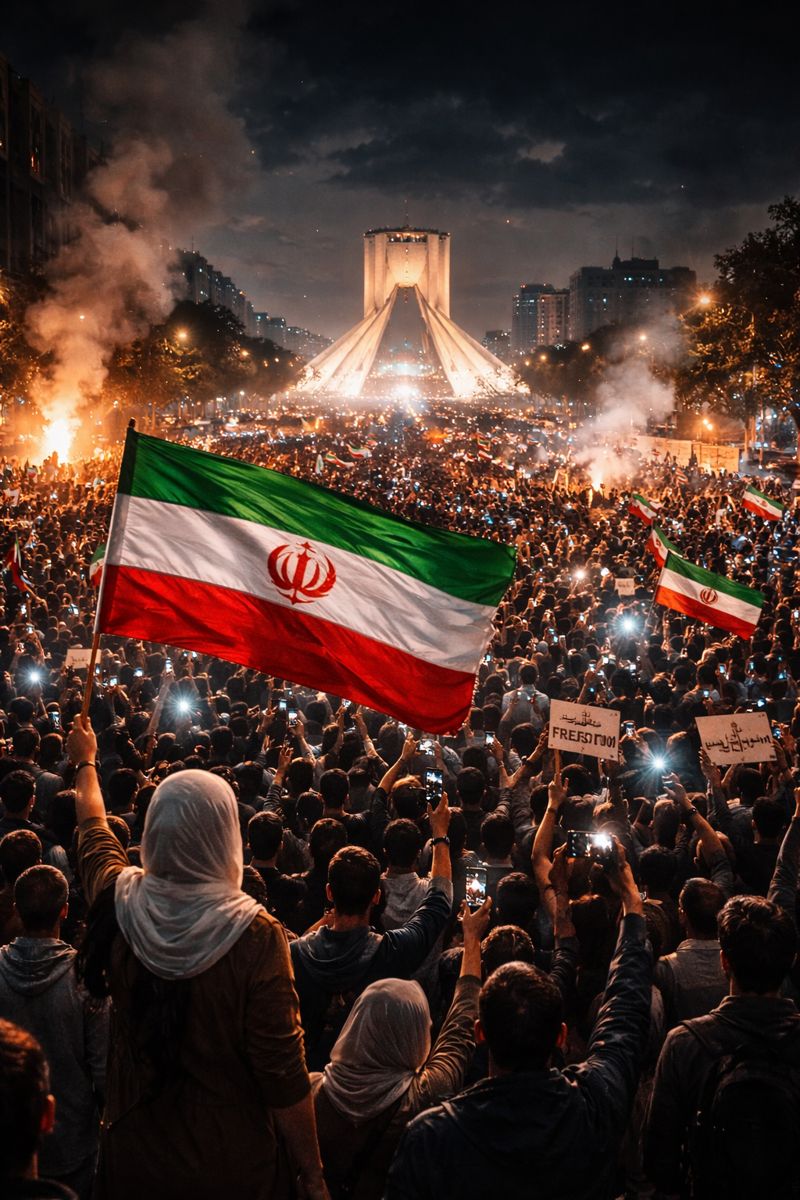
Iran’s internal condition intensifies this danger. Economic failure, mass protest, generational rejection, and open defiance of clerical authority have eroded the regime’s legitimacy. Large segments of the population no longer view the Islamic Republic as representing their future or even their faith. The state increasingly survives through force rather than consent, relying on repression, surveillance, and fear to maintain control.
In an ordinary political system, such instability would incentivize reform or de-escalation. In an apocalyptic system, it does the opposite. A regime that believes chaos precedes redemption cannot interpret unrest as a warning. Instability is reframed as confirmation that history is nearing its climax. When leaders believe they are losing power but must still fulfill a role in history, desperation follows, and escalation becomes attractive.
Proxies, Partners, and the Shrinking Margin for Error
Iran’s regional strategy has long relied on proxy forces to project power while avoiding direct confrontation. As these proxies weaken, fracture, or lose effectiveness, the regime’s margin for error narrows. Loss of influence abroad compounds instability at home and reinforces the perception that time is running out.
Iran’s relationships with isolated or sanctioned states provide pathways for indirect access to advanced weapons, delivery systems, and critical components. Ownership matters less than access. In a moment of acute desperation, deniable transfers and covert cooperation can provide catastrophic capability without formal declarations. When ideology treats catastrophe as meaningful rather than disqualifying, the threshold for use drops dramatically.
Weapons of Mass Destruction and Eschatological Risk
Classical deterrence theory assumes rational actors seeking survival and continuity. An apocalyptic regime does not prioritize survival in the same way. Within Iran’s revolutionary theology, catastrophe can be reframed as obedience and mass death as martyrdom. Weapons of mass destruction therefore do not need to achieve conventional military victory to be considered successful.
Their value lies in symbolism and disruption. A catastrophic strike that fractures regional order, provokes cascading instability, and signals theological resolve may be viewed as faithful even if it ensures retaliation. This renders assumptions about proportionality, signaling, and restraint unreliable when applied to Iran’s strategic calculus.
Israel, Saudi Arabia, and the Logic of Symbolic Targets
Within this framework, Israel is a theological obstacle whose continued existence contradicts Iran’s revolutionary narrative. However, Israel is not always the most useful trigger for chaos. Direct confrontation risks overwhelming retaliation and rapid regime destruction, which limits its utility as an escalation catalyst.
Saudi Arabia occupies a different role. As the Sunni custodian of Mecca and Medina, the House of Saud represents what Iran views as illegitimate and corrupt authority over Islam itself. In revolutionary Shia theology, sanctity is conditional on legitimacy. Because Saudi rule is seen as commercializing and corrupting the holy sites, those sites are treated as polluted rather than inviolable. Their destruction under Sunni control can be reframed as purification rather than sacrilege.
Western analysts routinely misread this dynamic because they project Sunni assumptions about restraint onto a Shia apocalyptic system that does not share them. In a framework where chaos precedes restoration, provoking global Islamic upheaval is not a cost to be avoided. It is the objective.
Conclusion
Iran’s strategic danger cannot be separated from its theology. This is a regime that interprets legitimacy, collapse, and violence through an apocalyptic framework in which chaos is not a failure but a catalyst. As internal unrest grows and regional leverage shrinks, the incentives that normally restrain state behavior weaken rather than strengthen. In that environment, symbolic targets, catastrophic escalation, and mass destabilization become thinkable not because the regime has lost control, but because it believes it is fulfilling a divine mandate.
Discussion Questions
- How does Iran’s belief that chaos precedes redemption change the way we should interpret its actions compared to a conventional authoritarian state?
- In what ways does defining legitimacy theologically rather than politically alter a regime’s response to internal unrest and external pressure?
- Why does an apocalyptic framework weaken traditional deterrence theory, especially when weapons of mass destruction are involved?
- How does Iran’s revolutionary Shia view of sanctity and legitimacy affect its willingness to target symbolic religious sites such as Mecca and Medina?
- What risks arise when analysts or policymakers interpret ideologically driven regimes through purely rational actor or cost-benefit models?
Want to Know More
- An Introduction to Shi‘i Islam by Moojan Momen
A standard academic introduction to Twelver Shiism that explains the Imams, the Occultation, Mahdist expectation, and how Shia theology differs fundamentally from Sunni assumptions. This is essential background for understanding how legitimacy and authority function in Iranian religious thought. - Apocalyptic Islam and Iranian Shi‘ism by Abbas Amanat
A definitive scholarly work on apocalyptic expectation within Iranian Shiism. Amanat traces how Mahdist belief has historically shaped political action in Iran, including revolutionary movements and state ideology. - The Shia Revival by Vali Nasr
Focuses on the geopolitical consequences of Shia identity and power, including Iran’s revolutionary posture and sectarian rivalry with Sunni powers. Useful for understanding why Saudi Arabia occupies such a symbolic role in Iran’s worldview. - Revolutionary Iran by Michael Axworthy
A historical and ideological analysis of post-1979 Iran that connects theology, nationalism, and revolutionary identity. Axworthy explains how ideology has repeatedly overridden pragmatic restraint in Iranian decision-making. - The Islamic Antichrist by Joel Richardson
Examines Islamic eschatology, including Mahdist expectation, and contrasts it with biblical theology. While written from a Christian perspective, it is valuable for understanding how apocalyptic belief functions as motivation rather than metaphor within Islamic movements.
About the Author