Jesus begins His public ministry outside Israel’s religious and territorial center. John’s placement of the baptism east of the Jordan is not incidental geography. It signals that Jesus’ kingship is announced not from within Yahweh’s inheritance, but from land long administered under rival rule. This turns the baptism into a public installation rather than a private devotional act. The heavenly voice functions as a proclamation, identifying the rightful king in a place where that claim will be resisted.
The Jordan crossing reinforces this reading. In Israel’s story, the Jordan marks the boundary between inheritance and opposition. Joshua crosses it to dispossess hostile powers. Elijah and Elisha cross it at moments of prophetic succession and authority transfer. Jesus reenacts the same movement because the mission is structurally the same. He does not begin by teaching neutral ground. He begins by asserting kingship in territory already ordered under another administration.
Bashan, the Serpent, and Underworld Domination
Bashan is remembered not simply as a hostile land, but as Rephaim land and serpent land. In Israel’s theological geography, Bashan is associated with the dead who still exert influence, with necromancy, and with illicit access to the underworld. The Rephaim are not merely remembered giants or fallen kings. They are the shades of the Nephilim, demonic beings associated with Sheol, summoned and invoked through forbidden practices, and believed to influence the living through possession and deception. Bashan becomes the land where death is treated as a source of power, and rebellion continues after judgment.
In biblical language, this serpentine identity is reinforced by the clustering of nachash, tannin, and Leviathan imagery around regions associated with Bashan and the far north, binding the land to the same underworld threat that claims wisdom, death, and dominion in defiance of Yahweh’s order. Serpent imagery here is not ornamental. It marks illicit domination seized through deception, coercion, and the manipulation of death, not rule derived from any delegated authority or divine appointment.
This is why Psalm 22 places the suffering righteous one among the bulls of Bashan. Bulls and serpents are not competing symbols.
Together they form the iconography of chaos kingship, violent strength above and coiled death below. The psalm situates the Messiah’s suffering inside a power structure that assumes control over both life and death. Bashan supplies this symbolic grammar because Bashan is remembered as the land where serpentine domination and underworld influence converge. By the time these traditions crystallized, Baal himself was no longer imagined merely as a storm-god but as one who claimed power over death through descent and return, presenting himself as a ruler who could pass through the underworld and emerge victorious.
Hermon, the Grotto, and the Gates of the Dead
The northern movement of Jesus’ ministry keeps the confrontation within this same underworld geography. Mount Hermon stands in Israel’s memory as the origin point of rebellion, the place where divine boundaries were first violated, and the corruption that produced the Nephilim began. Bashan is not adjacent by coincidence. It is the downstream territory where that rebellion’s legacy persists through Rephaim influence and necromantic practice.
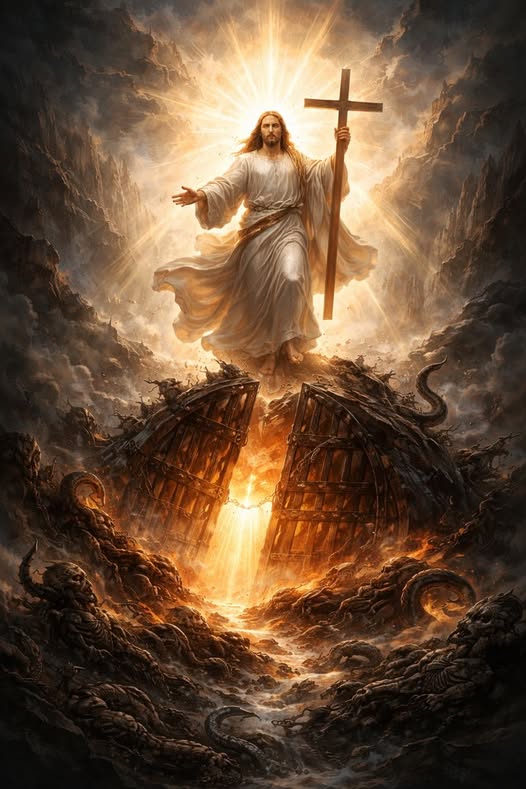
Caesarea Philippi and its grotto represent the later cultural expression of the same claim. The site was understood as an entrance to the underworld, a place where the boundary between the living and the dead could be accessed and exploited. When Jesus speaks of the gates of Hades in this region, He is not using metaphor. Gates signify jurisdiction and control. His declaration is that the grip exercised through death, deception, and illicit spiritual power will not withstand the advance of His kingdom.
The baptism establishes kingship in this territory. The Transfiguration unveils that kingship within sight of rebellion’s remembered source. The geography matters because the claim is being pressed where underworld domination once appeared unassailable.
From Encirclement to Exposure
What has been unfolding throughout the narrative is not merely increasing opposition, but deliberate proximity to death itself. The movement from beyond the Jordan, to Bashan, to Hermon, and finally to Jerusalem traces a steady approach toward the realm the powers claim as their final jurisdiction. Jesus does not stumble into death at the end of His ministry. He advances toward it. Each stage presses closer to the domain of the dead, until the crucifixion becomes not only execution but entry. What the rulers of Bashan and the gates of Hades claim as ultimate is not avoided but invaded.
Psalm 22 anticipates not only suffering, but confidence on the part of the powers that surround the righteous one. The bulls of Bashan encircle the Messiah because the rulers associated with death assume it is final and inescapable. The crucifixion becomes the moment when that assumption is exposed. The one they kill enters the realm they exploit and does not remain there.
The resurrection reveals the collapse of serpentine logic. Death is shown to be a weapon, not a throne. Power exercised through deception, possession, and fear fails when obedience proves stronger than coercion. The underworld powers are not imaginary. They are defeated.
Conclusion
Jesus does not wander through symbolic locations chosen for effect. He advances through territory shaped by rebellion, necromancy, and serpentine domination. The baptism beyond the Jordan announces kingship in land long marked by underworld influence. Bashan supplies the memory of serpent domination exercised through deception and death, not through any legitimate authority. Hermon preserves the origin of the rebellion that produced it. The cross exposes its fatal miscalculation, and the descent into the realm of the dead completes the confrontation. The Gospel announces forgiveness for humanity and the breaking of every illicit grip that claimed dominion through death. The map is not background. It is the campaign.
Discussion Questions
- How does tracing Jesus’ movement from beyond the Jordan to Bashan, Hermon, and finally Jerusalem change the way you understand His baptism and early ministry?
- In what ways does the biblical portrayal of Bashan, the Rephaim, and serpent imagery challenge modern assumptions that geography in Scripture is merely symbolic or incidental?
- How does the Baal Cycle’s portrayal of descent and return from the underworld clarify the difference between pagan cyclical views of time and the Gospel’s once-for-all defeat of death?
- Why is it theologically significant that Christ advances toward death deliberately rather than encountering it unexpectedly at the crucifixion?
- How does understanding the harrowing of hell as the culmination of a long campaign against death reshape the meaning of resurrection, judgment, and Christ’s kingship?
Want to Know More
- Michael S. Heiser, Reversing Hermon: Enoch, the Watchers, and the Forgotten Mission of Jesus Christ
This work traces the rebellion associated with Hermon, the legacy of the Watchers, and how Jesus’ ministry deliberately confronts that supernatural geography. It is foundational for understanding Hermon, Bashan, and the reclaiming of authority from corrupt spiritual rulers. - Stephen De Young, The Religion of the Apostles
De Young situates New Testament theology firmly within the ancient Mediterranean and Near Eastern worldview, including the role of Baal, underworld powers, and the pagan understanding of death, descent, and return. This provides critical background for the Baal Cycle material and the contrast between cyclical pagan time and the Gospel’s final victory. - John H. Walton, Ancient Near Eastern Thought and the Old Testament
Walton explains how ANE cosmology, sacred space, and divine conflict inform biblical theology without collapsing Scripture into myth. This is especially helpful for understanding why geography, land, and cosmic domains matter in the biblical narrative. - T. Desmond Alexander, From Eden to the New Jerusalem
Alexander traces the biblical theology of sacred space from Genesis to Revelation, showing how land, exile, death, and restoration are structurally connected. This supports the lesson’s emphasis on movement toward death as territory rather than abstraction. - J. B. Hood, The Messiah, His Brothers, and the Nations
This work explores how messianic kingship in Scripture is tied to the defeat of rival powers and the restoration of Yahweh’s rule over the nations, reinforcing the idea that Christ’s kingship is exercised through conquest of hostile domains, including death itself.
About the Author