In the age of social media, it has become increasingly common to see posts framed as exercises of spiritual authority rather than prayer. Statements such as “I proclaim that no one in your family will die in the next fifty years in Jesus’ name,” “I decree and declare financial breakthrough within twenty-four hours,” or “If you type ‘Amen,’ you will receive an unexpected blessing this week” circulate widely and are often shared without hesitation. These declarations are usually presented as acts of faith, sometimes even as obedience to God. Yet beneath their positive tone lies a worldview that is not merely unbiblical but fundamentally pagan. This is not the prayer life of Scripture. It is speech-magic dressed in Christian language.
The issue is not simply modern excess or theological sloppiness. These proclamations revive an ancient belief that spoken words themselves possess creative power and that reality can be shaped through confident speech. Scripture does not merely nuance that idea. It directly contradicts it. Biblical Christianity stands in opposition to the notion that human words can compel outcomes, even when God’s name is invoked.
Pagan Speech-Magic and the Illusion of Control
In the ancient world, speech was commonly viewed as a mechanism of power. Incantations, spells, charms, and ritual formulas were believed to manipulate divine forces or alter cosmic order. Whether in Mesopotamian incantation texts, Egyptian magical spells, or Greco-Roman magical papyri, the assumption remained consistent: correct words, properly spoken, could force reality to comply. The gods were treated as reactive, and the universe as programmable, provided the speaker possessed the right knowledge or authority.
Scripture rejects this worldview entirely. Yahweh is not manipulated, summoned, or compelled. He does not respond to technique, formula, or volume of confidence. He acts according to His will alone. This is why biblical law and prophetic literature consistently condemn sorcery, divination, enchantment, and magic. These practices are not merely immoral behaviors. They are theological crimes, because they attempt to seize an authority that belongs exclusively to God.
Imagers, Not Creators: The Limits of Human Authority
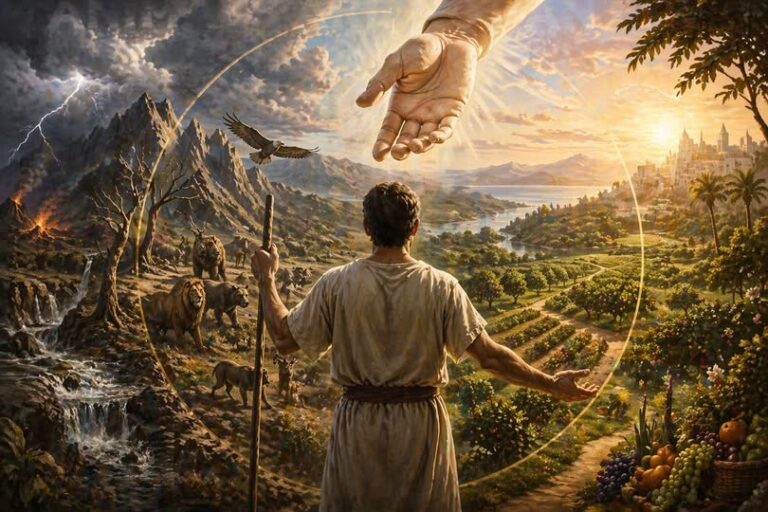
Scripture does teach that humanity was created as God’s imagers, appointed to represent His rule within creation. Humans are given real authority, but it is delegated, bounded, and derivative. Imaging God means reflecting His character through obedience, stewardship, and faithfulness. It never means sharing His divine attributes.
Even though mankind was created to be His imagers, Scripture is clear that only Yahweh can create something from nothing. That distinction is decisive. Humans act within creation. God alone calls creation into existence. No biblical text ever portrays a human, prophet, apostle, or believer as possessing the power to generate reality through speech. Whenever human authority is exercised in Scripture, it operates only in submission to God’s revealed will and never independently of it.
Only Yahweh Creates by the Power of His Word
Genesis establishes a boundary that Scripture never relaxes. Creation itself unfolds through divine speech. God speaks, and reality exists. Light appears because God commands it. Order emerges because God wills it. Life forms because God decrees it. No creature assists. No angel participates. No human imitates. Creative speech is presented as a uniquely divine act.
Psalm 33 reinforces this truth by declaring that the heavens were made by the word of the Lord and that creation stands because He commanded it. Isaiah goes further, portraying Yahweh as the one who speaks and brings forth what He declares, while explicitly denying that any other being shares that authority. This is not poetic exaggeration. It is theological definition. Creative speech belongs to God alone. It is not shared with humanity, not even with God’s imagers.
Human words carry weight, influence, and consequence. They shape relationships, convey truth or falsehood, and lead toward wisdom or destruction. They do not possess ontological power. When humans claim that their declarations shape reality itself, they are not exercising biblical faith. They are attempting to imitate a divine prerogative. That impulse is not Christian. It is pagan at its core.
New Thought as a Modern Carrier of an Ancient Pagan Idea
The nineteenth-century New Thought movement did not invent manifestation theology. It stripped ancient speech-magic of ritual language and repackaged it in psychological terms. Instead of spells, it spoke of affirmations. Instead of gods, it spoke of “the universe.” Instead of ritual authority, it emphasized belief and mental alignment.
When this system entered Christian spaces, it adopted Christian vocabulary while preserving pagan assumptions. Declarations replaced prayers. Confidence replaced submission. Speech replaced petition. Phrases such as “name it and claim it” or “speak it into existence” assume that human words activate creative power. That assumption directly contradicts the biblical teaching that only Yahweh creates by command. This is not a Christian overstatement. It is a foreign worldview smuggled into the Church under familiar language.
Scripture Forbids Declaring the Future Apart From God’s Will
James 4 directly confronts the presumption behind these proclamation practices. James rebukes believers who speak confidently about tomorrow as though it belongs to them. The issue is not planning or hope. It is authority. Scripture teaches that the future does not respond to speech. It unfolds according to God’s will. Biblical faith does not declare outcomes. It confesses dependence.
Pagan systems attempt to control the future through words. Biblical faith entrusts the future to God. The distinction could not be sharper.
False Assurances Have Always Marked False Prophets
Jeremiah 23 condemns prophets who proclaim peace, safety, and prosperity when God has not spoken. Their sin is not optimism. It is authority theft. They speak from their own imagination while claiming divine endorsement. Modern social media proclamations follow the same pattern. Promises of health, wealth, and protection are declared without covenant context, repentance, or obedience. The medium is modern. The offense is ancient. Speaking future outcomes in God’s name without His command is not faith. It is false prophecy.
Words Carry Moral Weight, Not Creative Power
Proverbs 18:21 does not teach that words create reality. It teaches that words shape consequences. Speech can heal or destroy, encourage wisdom or cultivate ruin. Scripture never teaches that human words override divine will. If they did, suffering would disappear wherever believers spoke boldly enough. Yet Christ promised tribulation, not immunity. The apostles suffered not because they lacked faith, but because God’s purposes extended beyond immediate comfort.
Biblical Prayer Rejects Pagan Control
The prayer of Jesus in Gethsemane dismantles speech-magic completely. Jesus does not decree escape or declare deliverance. He asks, and He submits. If the incarnate Son does not use prayer as a mechanism for control, then any theology that teaches believers to do so is fundamentally unchristian. Prayer is not command. It is submission.
The Spiritual Danger of Paganized Christianity
Manifestation-style proclamations are dangerous precisely because they appear spiritual while reshaping faith into technique. They train believers to expect control rather than trust, success rather than endurance, outcomes rather than obedience. When suffering arrives, faith collapses because it was never rooted in submission to God’s will. They also condition believers to accept false prophets, because when confidence replaces discernment, authority is mistaken for truth. Guaranteed blessings have always sold well. Scripture warned that they would.
Conclusion
Christian faith does not rest in declarations, formulas, or viral affirmations. It rests in the sovereignty of God. Prayer is not a spell. Faith is not force. God is not managed. Humans are imagers, not creators. Only Yahweh creates by His word.
When believers attempt to imitate divine speech, they do not demonstrate faith. They revive pagan magic under Christian labels. Biblical prayer places human desire before the throne of God and leaves the outcome in His hands.
Discussion Questions
- How does Scripture distinguish between humanity being created as God’s imagers and God alone possessing the authority to create by spoken word, and why does confusing those roles lead to false theology?
- In what ways does modern “decree and declare” language mirror ancient pagan speech-magic rather than biblical prayer, even when Christian terminology is used?
- Why does the Bible consistently condemn attempts to control outcomes through words, and how do passages like Genesis 1, James 4, and Jeremiah 23 establish clear limits on human authority?
- How does Jesus’ prayer in Gethsemane directly challenge manifestation theology, and what does it reveal about the proper posture of faith in suffering?
- What pastoral and spiritual dangers arise when believers are taught that faith guarantees control, success, or protection, and how does this reshape their understanding of God when hardship inevitably comes?
Want to Know More
- Kate Bowler, Blessed: A History of the American Prosperity Gospel
Bowler documents how prosperity teaching developed in modern Christianity and why promises of guaranteed blessing, health, and success became persuasive, providing historical context for why “decree and declare” language thrives despite its tension with biblical theology. - D. R. McConnell, A Different Gospel: Biblical and Historical Insights into the Word of Faith Movement
McConnell’s work is essential for understanding how Word of Faith theology absorbed New Thought metaphysics, especially the belief that spoken words activate spiritual power, and why this framework represents a departure from historic Christian doctrine. - Douglas R. Groothuis, Confronting the New Age: How to Resist a Growing Religious Movement
Groothuis exposes the underlying worldview of New Age spirituality, which helps readers see how modern manifestation practices align more closely with pagan and occult thought than with biblical prayer and submission to God. - Hank Hanegraaff, Christianity in Crisis
Hanegraaff offers a direct critique of prosperity theology and faith-formula teaching, showing how techniques that promise control over outcomes undermine biblical authority, sound doctrine, and a proper understanding of God’s sovereignty. - Gary A. Anderson and Markus Bockmuehl, Creation ex Nihilo: Origins, Development, Contemporary Challenges
This scholarly volume explores the biblical and theological foundations of creation from nothing, reinforcing the article’s central claim that creative speech belongs to Yahweh alone and is never shared with human imagers.
About the Author