One of the most common objections raised against classical Christian theology is the claim that Jesus’ prayers prove He is lesser than the Father. If Jesus prays, submits, and receives authority, the argument goes, then He cannot be fully God. Scripture, however, presents a very different picture. Christ’s prayers do not reveal inferiority of nature, but the depth of the incarnation and the priestly role He willingly assumed.
The doctrine of the Trinity, clarified at Nicaea, did not invent new categories. It articulated what Scripture already required Christians to confess: the Father is God, the Son is God, the Spirit is God, and yet God is one. The challenge was never whether Jesus prayed, but how to understand those prayers without denying either His divinity or His humanity.
The Incarnate Son and the Reality of Prayer
The New Testament consistently presents Jesus as praying. He withdraws to solitary places, gives thanks, intercedes for His disciples, and submits His will to the Father. These prayers are not symbolic gestures. They belong to His real human life.
In John 17, Jesus prays openly:
“Father, the hour has come; glorify your Son that the Son may glorify you, since you have given him authority over all flesh, to give eternal life to all whom you have given him.”
This is not a denial of divine authority. It is the incarnate Son speaking within the mission He has received. Authority is not absent from Christ; it is exercised according to the role He has assumed.
The same pattern appears in Gethsemane:
“Not my will, but yours, be done.”
Here, Scripture does not present a divided Trinity or competing divine wills. The human will of Christ freely aligns itself with the divine will. Obedience belongs to His humanity, not because He is lesser, but because He has truly become man.
Paul explains this posture with precision:
“Though he was in the form of God, he did not regard equality with God as something to be exploited, but emptied himself, taking the form of a servant.”
Christ does not lose equality with the Father. He refuses to cling to privilege and instead lives fully within human obedience.
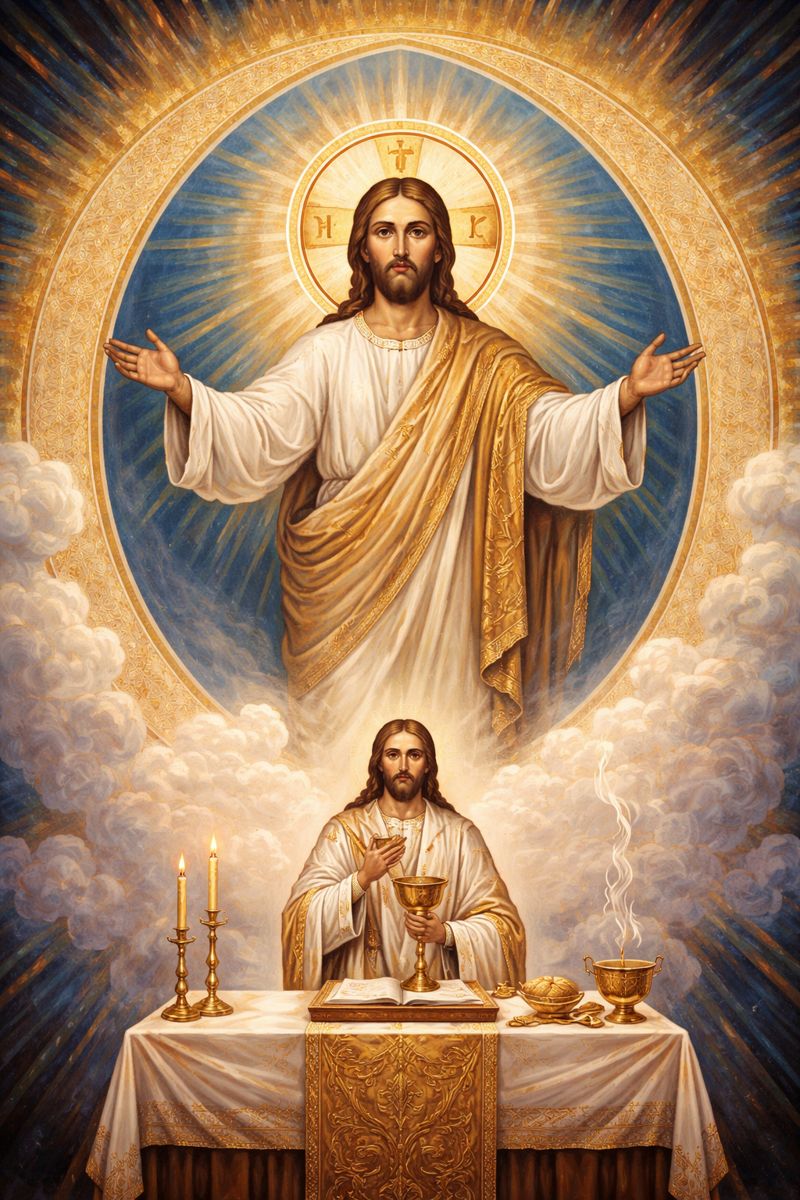
Christ as High Priest and Mediator
Scripture explicitly frames Christ’s earthly ministry in priestly terms. The Letter to the Hebrews is unambiguous:
“Every high priest chosen from among men is appointed to act on behalf of men in relation to God.”
Christ fulfills this role perfectly. Hebrews identifies Him as:
“A great high priest who has passed through the heavens, Jesus, the Son of God.”
A priest stands between God and humanity. He speaks to God on behalf of others. He offers obedience, intercession, and sacrifice. Prayer is therefore not incidental to Christ’s mission. It is essential to it.
Hebrews further states:
“Although he was a Son, he learned obedience through what he suffered.”
This does not imply moral deficiency or prior disobedience. It describes lived obedience within human experience. Christ obeys as humanity’s representative. Where Adam failed, Christ remains faithful.
As High Priest, Jesus must pray. He must submit. He must act from within the human condition. These actions do not diminish His divinity. They demonstrate the reality of His mediation.
Voluntary Subordination Within the Economy of Salvation
Scripture consistently distinguishes between Christ’s eternal identity and His role within salvation history. Jesus Himself says:
“The Son can do nothing of his own accord, but only what he sees the Father doing.”
This is not a confession of weakness. It is a declaration of perfect unity of will. The Son does nothing independently because He does nothing in opposition. His submission is voluntary and functional, not ontological.
Early Christian theology was clear on this point. Athanasius writes in his Letter to Epictetus:
“When the Word became flesh, He made the affections of the flesh His own… and when He prayed, He prayed as man, not as Word.”
The Word does not pray to Himself. The incarnate Son prays according to His human nature. To deny this is to deny the incarnation itself.
Athanasius further insists:
“The Word was not lessened by taking flesh, but rather the flesh was raised up by the Word.”
Christ’s lesser posture is assumed, not imposed. It belongs to His mission, not to His essence.
Deification and the Restoration of Humanity
The goal of Christ’s priestly obedience is humanity’s restoration. Athanasius famously states:
“He became man that we might become what He is.”
This does not mean that humans become divine by nature. It means humanity is healed, glorified, and brought into communion with God.
Psalm 8 declares:
“You have made him a little lower than the heavenly beings and crowned him with glory and honor.”
Hebrews applies this to Christ and to redeemed humanity:
“We do see Jesus, who for a little while was made lower than the angels, now crowned with glory and honor.”
Christ descends so that humanity may be raised. His voluntary humiliation makes glorification possible.
Paul describes this transformation in resurrection language:
“What is sown perishable is raised imperishable.”
Revelation speaks symbolically of shared inheritance:
“I will give him the morning star.”
These promises describe participation, not equality of essence. Communion, not absorption.
Conclusion
Jesus’ prayers do not reveal inferiority within the Trinity. They reveal the incarnation in action. As High Priest, Christ stands in humanity’s place before the Father. As the incarnate Son, He lives the obedience humanity failed to offer. As the eternal Word, He remains fully God while doing so.
His submission is voluntary. His lesser posture is functional. His obedience is redemptive. In Christ’s prayers, Scripture reveals both who God is and what humanity is meant to become.
Discussion Questions
- How does understanding Jesus as High Priest and mediator clarify why prayer and submission are necessary parts of His earthly ministry without implying inferiority of nature?
- Why is the distinction between ontological equality and functional or voluntary subordination essential for preserving both the Trinity and the incarnation?
- Hebrews states that Jesus “learned obedience through what he suffered.” How does this statement affirm Christ’s true humanity while avoiding the claim that He lacked righteousness or divine authority?
- How does Athanasius’ explanation that Christ prays as man, not as Word, protect against both Arian and modalist misunderstandings of Jesus’ prayers?
- In what way does Christ’s voluntary descent and priestly obedience establish the biblical foundation for deification as restored humanity, rather than humans becoming divine by nature?
Want to Know More?
- Athanasius of Alexandria, On the Incarnation
A primary patristic work explaining why the Word became flesh, how Christ’s true humanity operates without diminishing His divinity, and why obedience, prayer, and suffering belong to the incarnate mission rather than implying inferiority. - Athanasius of Alexandria, Four Discourses Against the Arians
Essential reading for understanding how early Christians distinguished between Christ’s eternal nature and His voluntary subordination in the economy of salvation, especially in response to claims that Jesus’ prayers proved He was a created being. - Gregory of Nazianzus, Theological Orations
Gregory directly addresses passages where Christ appears subordinate and explains how they must be read through incarnation and role, not essence. This work is foundational for orthodox Trinitarian theology. - Richard Bauckham, Jesus and the God of Israel
A rigorous biblical study showing how New Testament authors place Jesus within the unique divine identity of Israel’s God while still affirming His incarnate obedience and prayer life. - Thomas F. Torrance, The Mediation of Christ
A modern but theologically conservative work that develops Christ’s role as High Priest and mediator, explaining how Jesus’ prayers and obedience are essential to salvation rather than evidence of lesser divinity.
About the Author