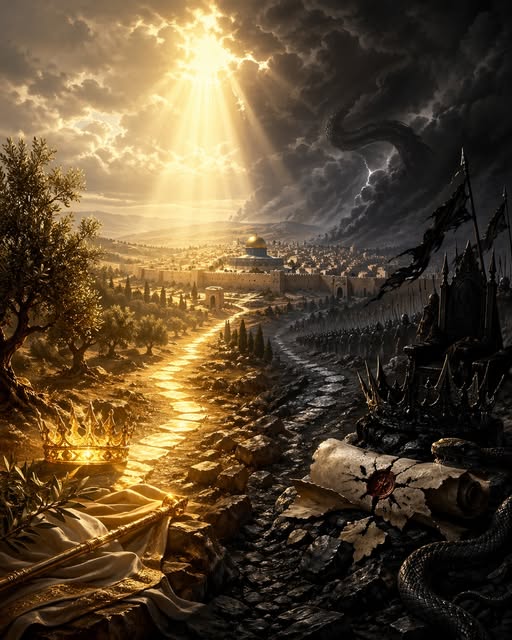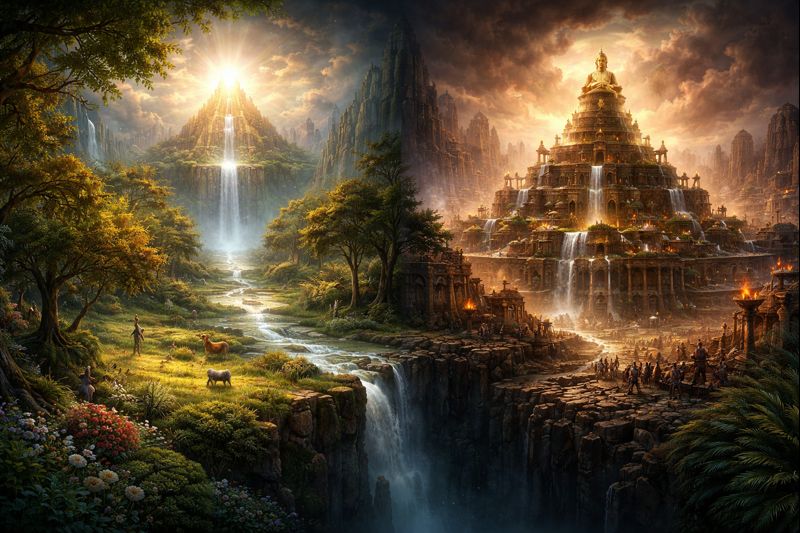
Babylon is presented in Scripture as far more than a powerful ancient city. It functions as a symbol of human ambition aligned with illegitimate spiritual authority, a place that repeatedly claims the right to define order, abundance, and sacred space apart from Yahweh. The Hanging Gardens of Babylon belong within this theological context. They are not merely an engineering achievement or a romantic legend, but a visual claim about who controls life, fertility, and the boundary between heaven and earth.
Historical Background of the Hanging Gardens
Ancient sources describe the Hanging Gardens as a series of elevated terraces rising above the city, supported by stone vaults and irrigated by an advanced system that drew water from the Euphrates. Classical writers such as Diodorus Siculus and Strabo emphasize their height, the presence of flowing water, and the cultivation of trees and plants brought from distant regions. The gardens are commonly associated with the reign of Nebuchadnezzar II in the sixth century BC, though Babylonian royal inscriptions more generally attest to the practice of constructing monumental gardens tied to palace complexes.
The lack of clear archaeological remains in Babylon has led some scholars to suggest the gardens may have been located elsewhere, possibly in Nineveh under the Assyrian king Sennacherib. This debate does not diminish the importance of the gardens as a cultural and theological concept. In the ancient world, gardens were symbols of power. To create controlled abundance in a hostile environment was to demonstrate divine favor and royal legitimacy.
Gardens and Sacred Space in the Ancient World
In the Ancient Near East, gardens were not ornamental in the modern sense. They were closely associated with temples and kingship. Elevated gardens in particular echoed the imagery of sacred mountains, places where divine beings were believed to dwell and from which order flowed into the world. Flowing water, rare vegetation, and deliberate design signaled victory over chaos.
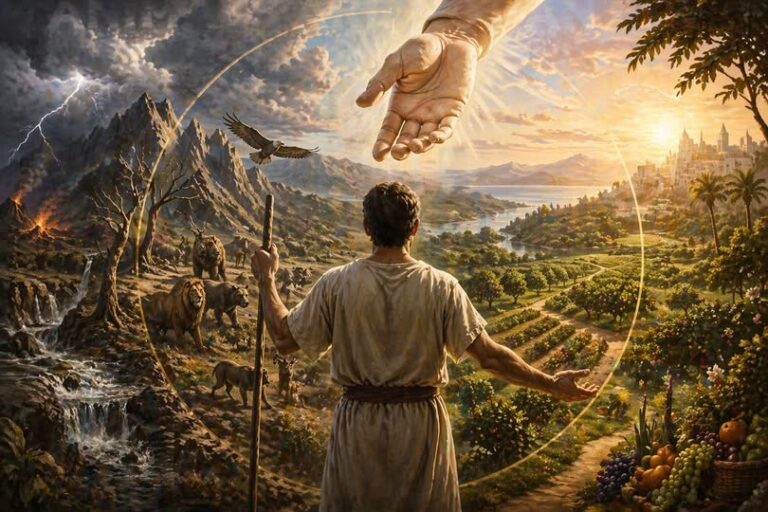
Biblically, this imagery is most clearly seen in Eden. Eden is portrayed as a garden set on a mountain, watered by rivers, and functioning as a meeting place between God and humanity. It is the original sacred space, not simply because of its beauty, but because it is ordered and sustained by God’s presence.
The Hanging Gardens mirror this imagery while stripping it of covenantal meaning. They present life and abundance as products of royal authority and divine patronage disconnected from obedience to Yahweh. What Eden represents by gift, Babylon claims by construction.
Kingship, Authority, and the Gods of the Nations
Ancient empires understood kingship as divinely sanctioned. Kings ruled on behalf of the gods, maintaining order and prosperity in exchange for loyalty and ritual devotion. The biblical texts acknowledge this worldview while also exposing its failure. The rulers behind the nations were meant to govern justly, but instead promoted violence, pride, and exploitation.
The Hanging Gardens functioned as a visual endorsement of this system. They proclaimed that Babylon’s gods had succeeded where others failed, producing peace, fertility, and harmony. Yet this abundance existed alongside forced labor, conquest, and exile. The garden becomes a mask. It displays order while concealing injustice.
This tension is central to the biblical critique of empire. Beauty and prosperity are not signs of righteousness when they are built on oppression and rebellion against God’s authority.
Babylon as a Rival Center of Order
From the tower of Babel onward, Babylon repeatedly positions itself as a place where heaven and earth meet on human terms. The Hanging Gardens reinforce this identity. Elevated above the city and sustained through human ingenuity, they transform Babylon into a rival center of sacred order, one that claims the ability to provide life apart from Yahweh.
This explains why Babylon remains such a powerful symbol in Scripture. It is not condemned simply for its wealth, but for what that wealth claims. Babylon presents itself as a source of life, security, and meaning independent of the Creator.
In Revelation, Babylon is described as beautiful, wealthy, and intoxicating, yet destined for sudden destruction. The judgment is not arbitrary. It is the exposure of a false sacred order that could not endure.
The Collapse of the Counterfeit Garden
When Babylon falls, what collapses is not only an empire but a worldview. The structures that claimed permanence prove fragile. The abundance that appeared self-sustaining vanishes. The gods who promised life are revealed as powerless to save.
The Hanging Gardens, whether historical reality or preserved memory, belong to this system. They represent humanity’s attempt to reclaim Eden through power rather than obedience, through domination rather than faithfulness.
Eden Restored
The biblical story does not end with the loss of sacred space. It ends with its restoration. Revelation closes with a garden city where water flows freely, trees bear fruit for healing, and God dwells permanently with His people. This garden is not built upward in defiance. It is given, established by God, and shared with those who remain faithful. The contrast is intentional. Babylon offers a garden without God. Scripture ends with a garden where God is fully present.
Conclusion
The Hanging Gardens of Babylon serve as a powerful symbol of false sacred space. They reflect humanity’s recurring desire to manufacture life, order, and meaning apart from Yahweh, often under the authority of powers that promise blessing while delivering oppression.
By placing the gardens within the biblical story of Eden, empire, and judgment, their significance becomes clear. Every counterfeit garden eventually withers. Only the sacred space established by God endures.
Discussion Questions
- Why did ancient empires invest so much effort in gardens, temples, and monumental architecture rather than limiting themselves to purely functional structures? What did these spaces communicate about authority and power?
- How does the biblical description of Eden as sacred space shape the way we should understand later attempts to recreate garden imagery in imperial contexts like Babylon?
- In what ways can prosperity, beauty, and technological achievement mask injustice or moral failure, both in the ancient world and in modern societies?
- Why does Scripture consistently portray Babylon as more than a historical city, and how does this symbolic role help explain its prominence in later biblical texts such as Revelation?
- What does the contrast between Babylon’s garden and the restored garden at the end of Revelation reveal about the difference between human-made order and divine restoration?
Want to Know More
- Stephanie Dalley, The Mystery of the Hanging Garden of Babylon: An Elusive World Wonder Traced
Dalley’s work is the most serious scholarly treatment of the Hanging Gardens. She surveys the ancient sources, addresses the Babylon versus Nineveh debate, and places royal gardens firmly within Mesopotamian ideology of kingship, water control, and divine favor. - Joan Oates, Babylon
A foundational archaeological and historical study of Babylon that examines the city’s religious life, royal propaganda, architecture, and self-understanding as a center of order and power in the ancient world. - John H. Walton, Ancient Near Eastern Thought and the Old Testament
Walton provides essential background for understanding sacred space, cosmology, kingship, and how Israel’s theology both overlaps with and critiques ANE worldviews without collapsing into them. - G. K. Beale, The Temple and the Church’s Mission: A Biblical Theology of the Dwelling Place of God
This work traces Eden as sacred space, the temple as its continuation, and the biblical theme of false versus true dwelling places of God, making it particularly useful for contrasting Eden with imperial imitations like Babylon. - Thorkild Jacobsen, The Treasures of Darkness: A History of Mesopotamian Religion
A classic study of Mesopotamian religion that explores how gods, kingship, fertility, and order were understood, providing critical context for how gardens and abundance functioned as religious symbols rather than neutral luxuries.
About the Author