The Kurdish people are one of the oldest surviving populations of the Ancient Near East. Today they number roughly 30 to 40 million and live primarily in the mountainous region where modern Turkey, Iraq, Iran, and Syria meet. This region is commonly called Kurdistan, though it has never been recognized internationally as an independent state.
Their homeland sits along the northern arc of Mesopotamia and the Zagros Mountains, the same highland belt that formed the natural boundary between the great empires of the ancient world. Assyria, Babylon, and Persia controlled the fertile river valleys, but the mountains were far more difficult to dominate. Tribal cultures endured there for centuries, protected by geography and organized around strong clan and kinship structures.
Ancient sources describe these mountain societies as fiercely independent. Greek historian Xenophon encountered such a people during his retreat through the region in the fourth century BC. In his account, Anabasis, he describes tribes called the Carduchi who repeatedly attacked his army as it attempted to cross their territory. Many historians see these Carduchi as likely ancestors of the Kurdish people.
The Kurdish homeland also overlaps with regions historically associated with the Medes, an Iranian people who helped destroy the Assyrian Empire in the seventh century BC. Kurdish identity did not arise from a single tribe but developed over centuries from multiple highland populations. Even so, their culture reflects the continuation of ancient mountain societies that existed alongside the great empires of Mesopotamia.
Kurdish Religion and Ancient Spiritual Layers
Most Kurds today are Sunni Muslims, but their religious landscape is far more complex than that simple description suggests. Islam spread into the Kurdish highlands over time, yet older cultural and spiritual traditions continued to shape religious life in the region.
One of the most distinctive Kurdish religious traditions is Yazidism.
The Yazidis are an ethnoreligious community whose beliefs combine elements of ancient Mesopotamian religion, Iranian traditions, and later regional influences. Their theology centers on a single supreme God who governs the world through seven angelic beings. The most prominent of these figures is Melek Taus, known as the Peacock Angel.
Misunderstanding of Yazidi theology led many Muslim communities to falsely accuse them of devil worship. That accusation fueled centuries of persecution against Yazidis despite the fact that their religion reflects a complex monotheistic framework that includes divine intermediaries and heavenly administrators. In some respects, their beliefs preserve echoes of older Near Eastern cosmologies.
Another Kurdish religious tradition is the Yarsani faith, also known as Ahl-e Haqq. This belief system blends elements of Islamic mysticism with older Iranian religious concepts and places strong emphasis on divine manifestation through historical figures. The Yarsani tradition also preserves sacred poetry and oral teachings that stretch back centuries.
These religious communities demonstrate that the Kurdish region has preserved layers of spiritual traditions that reach back into the religious world of the Ancient Near East.
A Nation Without a State
Despite their deep historical roots in the region, the Kurds never received an independent nation after the collapse of the Ottoman Empire. When European powers redrew the map of the Middle East following World War I, Kurdish lands were divided among several newly formed states.
Instead of gaining independence, Kurdish populations were placed under the authority of Turkey, Iraq, Syria, and Iran. Each of these governments pursued policies aimed at suppressing Kurdish identity, language, and political autonomy.
This division fractured Kurdish political organization. Rather than developing a single national leadership, Kurdish political movements emerged separately within each of the countries where Kurdish populations lived.
Kurdish Political Movements
In Iraq the most influential Kurdish political groups are the Kurdistan Democratic Party and the Patriotic Union of Kurdistan. These organizations dominate the Kurdish autonomous region in northern Iraq, which maintains its own parliament and military forces known as the Peshmerga. This region represents the closest thing the Kurds have achieved to self-government.
In Turkey, the most prominent Kurdish militant organization has been the Kurdistan Workers’ Party. This group originally emerged as a Marxist revolutionary movement seeking Kurdish independence and has fought a decades-long conflict with the Turkish government. Because of its tactics, it has been designated a terrorist organization by Turkey, the United States, and the European Union.
In Syria, Kurdish forces organized primarily under the Syrian Democratic Forces and related militias during the Syrian civil war. These groups became widely known for their role in defeating ISIS in northern Syria, though they remain politically controversial due to their connections with Kurdish movements in Turkey.
In Iran, Kurdish political groups exist as well, though they operate under strict limitations imposed by the Iranian government. The result is a fragmented political landscape in which Kurdish movements pursue different goals and strategies depending on the country in which they operate.
In recent decades Kurdish forces have also become some of the most important allies of Western nations in the fight against Islamist extremism. Kurdish fighters in Iraq and Syria played a major role in defeating ISIS on the ground, often serving as the primary force retaking territory while Western nations provided air support. Kurdish Peshmerga forces helped stabilize northern Iraq after the fall of Saddam Hussein, and Kurdish led militias in Syria were instrumental in capturing ISIS strongholds such as Raqqa.
Thousands of Kurdish fighters were killed in these campaigns. Despite their role in defeating one of the most brutal Islamist movements in modern history, Kurdish communities today remain vulnerable to attack from neighboring states and militias.
The Ongoing Genocide of the Kurdish People
The Kurdish people have endured repeated campaigns of repression and violence throughout the modern era, but those attacks are not confined to the past. Large-scale efforts to destroy Kurdish autonomy and identity are still taking place today.
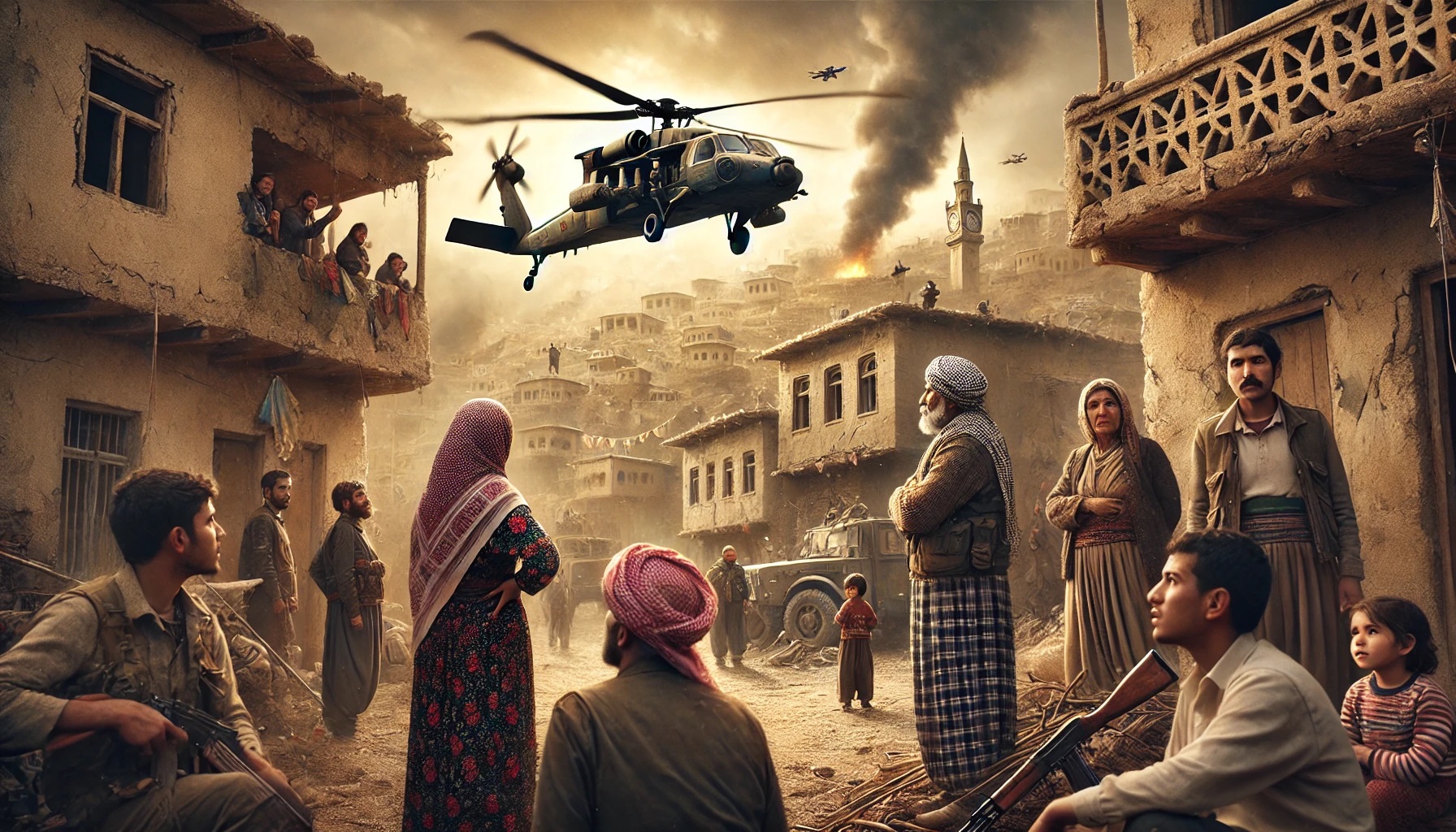
Turkey has conducted sustained military campaigns against Kurdish regions for decades. Entire villages have been destroyed, Kurdish political leaders have been imprisoned, and Kurdish cultural expression has often been criminalized. Turkish military operations in southeastern Turkey and northern Syria have displaced hundreds of thousands of Kurdish civilians. These campaigns are frequently framed as counterterrorism operations, but in practice, they have repeatedly devastated Kurdish population centers.
In northern Syria, Kurdish regions that played a major role in defeating ISIS have been repeatedly attacked by Turkish forces and allied militias. These operations have resulted in widespread displacement of Kurdish populations and the destruction of Kurdish self-governing institutions that had emerged during the Syrian civil war.
Human rights organizations have documented forced population transfers, demographic engineering, and systematic targeting of Kurdish communities in areas captured by Turkish-backed forces. These policies aim to permanently alter the ethnic composition of historically Kurdish regions.
The Yazidi population has also faced genocidal violence in recent years. In 2014, ISIS targeted the Yazidis of Sinjar with mass executions, enslavement of women and children, and the destruction of entire communities. Thousands remain missing today. Although ISIS was eventually defeated, Yazidi communities remain extremely vulnerable.
The Kurdish people, therefore, continue to face not only repression but active attempts to dismantle their communities, eliminate their autonomy, and erase their cultural presence from regions they have inhabited for millennia.
Why Christians Should Care
The Kurdish crisis is not simply a geopolitical issue. Scripture consistently teaches that God’s people must care about injustice and the suffering of the vulnerable.
Deuteronomy teaches that God “executes justice for the fatherless and the widow, and loves the sojourner, giving him food and clothing.” God then commands His people to show that same concern for those who are displaced and vulnerable. The Kurds today include millions who have been driven from their homes by war and political repression, making this command particularly relevant.
Proverbs gives an even more direct warning. “Rescue those who are being taken away to death; hold back those who are stumbling to the slaughter.” The passage continues by warning that claiming ignorance does not excuse silence in the face of injustice. When atrocities occur, and the world looks away, Scripture makes clear that indifference is not righteousness.
Jesus reinforced this principle in the parable of the Good Samaritan. The Samaritan belonged to a religious community whose theology differed sharply from Judaism, yet he was the one who showed mercy to the wounded man. The lesson is unmistakable. Our neighbor is the one who needs mercy, not the one who shares our doctrine.
Most Kurds are not Christians. Many are Sunni Muslims, while others follow Yazidi or Yarsani religious traditions. Those belief systems differ significantly from Christianity, but that difference does not remove the biblical command to care about injustice and suffering.
In fact, moments like this create opportunities for the Gospel. When Christians defend the oppressed, help refugees, and speak against genocide, they demonstrate the character of Christ in a way that words alone cannot accomplish. Compassion often opens doors for the message of the Gospel in places where it has rarely been heard.
Conclusion
The Kurdish people stand as a living link to the ancient world of the Near East. Their homeland lies in the same mountain regions that once sheltered tribal societies resisting imperial domination, and their culture preserves traditions that stretch back into the deep history of the region.
Yet the modern era has divided them across several states and subjected them to repeated repression, displacement, and genocide. The campaigns now taking place against Kurdish populations in Turkey and Syria demonstrate that this struggle is not merely historical. It is ongoing.
Understanding the Kurds helps illuminate both the ancient landscape of the Near East and one of the most overlooked humanitarian crises unfolding in the modern Middle East. It also reminds Christians that defending the oppressed is not only an act of justice but an opportunity to reflect the mercy and truth of Christ in a broken world.
Discussion Questions
- The Kurdish homeland lies in the same mountainous regions that ancient empires struggled to control. How does Kurdish history illustrate the long-term survival of highland cultures from the Ancient Near East into the modern world?
- Kurdish society includes several religious traditions, including Sunni Islam, Yazidism, and the Yarsani faith. What does this religious diversity reveal about how ancient spiritual traditions can survive and adapt over time?
- After World War I, Kurdish lands were divided between Turkey, Iraq, Syria, and Iran. How did these political borders contribute to the ongoing instability and fragmentation of Kurdish political movements?
- Military operations by Turkey and conflicts in Syria have displaced large numbers of Kurdish civilians. What are the long-term consequences of demographic engineering and forced displacement for a people without their own state?
- Scripture calls believers to defend the vulnerable and rescue those facing injustice. How should Christians balance standing against oppression while also using moments of compassion as opportunities to share the Gospel?
Want to Know More
- David McDowall, A Modern History of the Kurds
This is widely considered the standard scholarly history of the Kurdish people. McDowall traces Kurdish origins, their role within the Ottoman and Persian empires, the division of Kurdish lands after World War I, and the modern political struggles facing Kurdish communities across Turkey, Iraq, Iran, and Syria. - Michael M. Gunter, The Kurds: A Modern History
Gunter provides a clear overview of Kurdish political movements and the complex relationships between Kurdish factions operating in different countries. The book helps explain why Kurdish political unity has been difficult to achieve and how regional politics shape Kurdish struggles for autonomy. - Ofra Bengio, The Kurds of Iraq: Building a State Within a State
Bengio examines the development of the Kurdish autonomous region in northern Iraq and the emergence of Kurdish self-rule following the fall of Saddam Hussein. The book provides insight into Kurdish governance, internal political divisions, and the role of the Peshmerga. - Christine Allison, The Yezidi Oral Tradition in Iraqi Kurdistan
This study documents the oral religious traditions of the Yazidi people and provides a detailed look at one of the most distinctive religious communities within Kurdish society. The work helps illuminate how ancient regional beliefs and traditions have been preserved into the modern era. - Xenophon, Anabasis
This classical Greek account from the fourth century BC describes the Carduchi, a fierce mountain people living in the same region that is now Kurdish territory. Many historians view this description as one of the earliest historical references to the ancestors of the Kurdish people.
About the Author