Few passages in the New Testament have caused more confusion than 1 Peter 3:18-22. Peter says that Christ was put to death in the flesh, made alive in the Spirit, and that in this state He went and proclaimed to the “spirits in prison,” specifically those who had been disobedient in the days of Noah. Read in isolation, the passage can sound mysterious enough that people begin importing later traditions into it, especially the idea that Jesus was offering salvation to dead human beings. But Peter is not being vague or speculative. He is drawing from a shared theological framework that his audience already understood, and once that framework is restored, the passage becomes direct and coherent.
The “spirits in prison” are best understood not as deceased humans, but as rebellious supernatural beings tied to the events of Genesis 6. These are the Watchers who crossed a God-ordained boundary, corrupted humanity, and contributed to the conditions that brought about the flood. Peter connects them explicitly to the days of Noah, and that connection is reinforced by 2 Peter and Jude, both of which describe sinful angels being confined in chains of darkness until judgment. When Peter uses language associated with Tartarus, he is not speaking about human dead at all, but about cosmic offenders who have already been judged and imprisoned.
The Genesis 6 Background Peter Assumes
Peter writes as though his readers already know the story behind his words, and in the Second Temple Jewish world, they would have. Genesis 6:1-4 was widely understood as describing a supernatural rebellion in which the “sons of God” took human women and produced the Nephilim. This event was not treated as a minor detail. It was seen as a catastrophic violation of God’s created order, one that accelerated the corruption of the earth and helped bring about the flood.
That understanding is reflected in Jewish literature like 1 Enoch, which expands on the actions of the Watchers, describing their descent, their corruption of humanity, and their eventual imprisonment in darkness until the final judgment. The New Testament echoes this framework rather than replacing it. Jude describes angels who abandoned their proper domain and are now kept in eternal chains under darkness. Second Peter says that God cast sinful angels into Tartarus and committed them to chains of gloomy darkness until judgment. These passages align naturally with the Watcher interpretation of Genesis 6 and make far better sense of Peter’s language than attempts to reinterpret the “spirits” as human beings.
What Christ Was Doing When He Went to Them
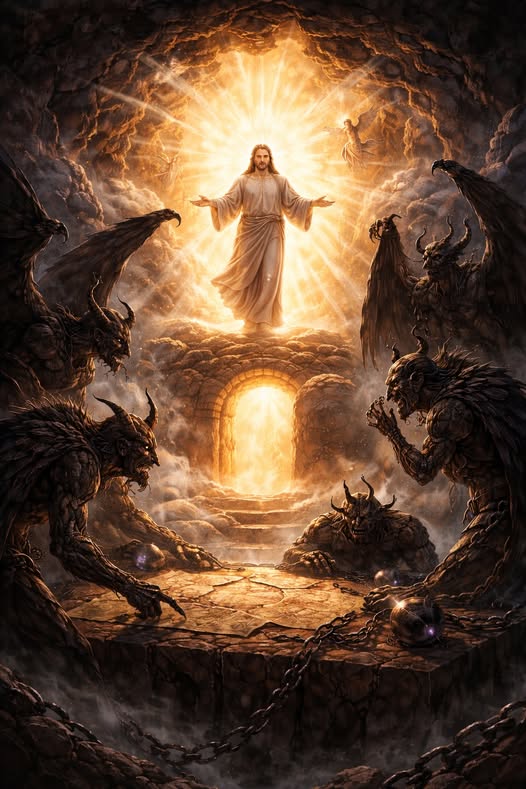
The key to understanding 1 Peter 3:19 is the word “proclaimed.” Christ did not go to these imprisoned spirits to offer them repentance or extend salvation. Scripture consistently presents fallen angels as reserved for judgment, not redemption. Peter’s focus is not on mercy toward these beings, but on Christ’s victory over them. The immediate context confirms this, because Peter moves directly from this proclamation to Christ’s exaltation at the right hand of God, with all spiritual powers subjected to Him.
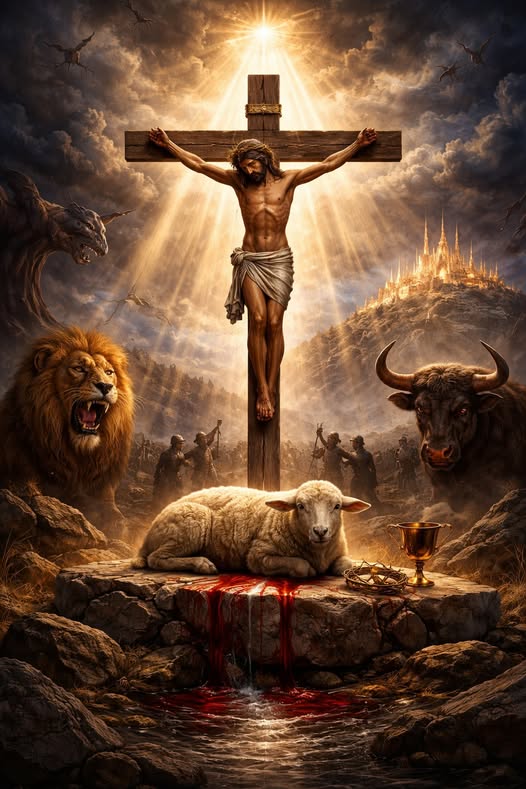
This means Christ’s descent to the spirits in prison is best understood as a declaration of triumph. The cross was not a defeat at the hands of hostile powers. It was the moment their failure was sealed. The resurrection vindicated Christ publicly, and the ascension established His authority over every competing power. The rebellion of the Watchers in the days of Noah represented a profound attempt to corrupt God’s purposes for humanity, but it ultimately failed, and those responsible were imprisoned. When Christ proclaims to them, He is not negotiating. He is announcing that their rebellion has been judged and that His reign is now established.
Tartarus in 2 Peter and Why That Matters
Second Peter provides a crucial interpretive key by explicitly stating that the angels who sinned were cast into Tartarus. In Greek thought, Tartarus was the deepest region of the underworld, the place where divine enemies were imprisoned after rebellion. Peter uses this term intentionally, not because he is adopting pagan mythology, but because he is using a familiar concept to describe a real supernatural prison. His audience would immediately understand that he was referring to the place of confinement for cosmic rebels.
This helps clarify 1 Peter 3. The “spirits in prison” are not an undefined group of the dead. They are the same category of beings described in 2 Peter and Jude, supernatural offenders who are already confined and awaiting final judgment. Once that connection is made, Peter’s statement stops sounding obscure and instead fits cleanly within a consistent biblical pattern.
The Nations, the Rebel Elohim, and the Wider Cosmic Rebellion
The story does not end with the flood. After that judgment, humanity rebels again at Babel, and this time the response is different. God divides the nations and allots them to other elohim, while keeping Israel as His own portion. This was not a neutral arrangement. It was an act of judgment in which the nations were disinherited and placed under lesser spiritual powers. But those powers did not remain faithful. Psalm 82 presents them as corrupt rulers who judge unjustly and are themselves condemned by the Most High.
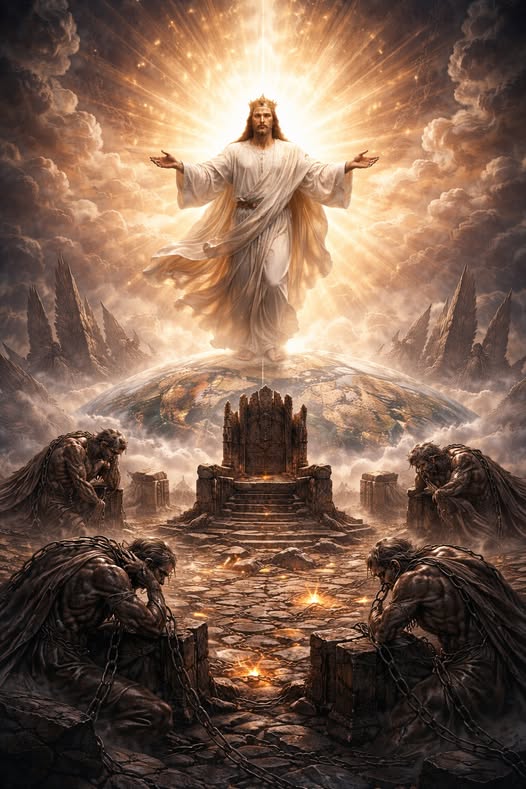
This means the biblical narrative includes multiple layers of supernatural rebellion. The Watchers transgressed before the flood and were imprisoned. The elohim over the nations later became corrupt and came under judgment. When Christ proclaims victory to the spirits in prison, He is acting within this larger context. He is not only declaring the defeat of one group of rebels. He is advancing the overthrow of the entire rebellious order that has influenced and corrupted the nations. His ascension marks the beginning of the reclamation of that authority, as He takes His place above all powers and sends the gospel out to the nations that had once been handed over.
The Titans and the Distorted Memory of the Nations
This is where the connection to Greek mythology becomes especially revealing. In Greek tradition, divine or semi divine beings rebel, are defeated, and are cast into Tartarus. That pattern closely mirrors the structure found in Scripture, but in distorted form. The existence of these parallels does not suggest that the Bible borrowed from Greek mythology. It suggests that the nations preserved fragmented memories of real events and reshaped them within corrupted religious systems. The truth remains, but the details are altered.
The distortion becomes clear when we examine who is placed at the center of the story. In Greek mythology, Zeus, the chief storm god, is the one who defeats the rebels and casts them into Tartarus. In the biblical account, that authority belongs to Yahweh alone. The Most High is the true Judge, and all rebellious beings are subject to Him. The pagan version preserves the event but replaces the true Judge with a false one.
This inversion is not merely literary. Revelation identifies the great Zeus complex at Pergamum as Satan’s throne, directly linking Zeus worship with satanic dominion. That connection makes the distortion even more pronounced. The pattern of rebellion and imprisonment is remembered, but the figure placed on the throne is not the true God. It is a counterfeit aligned with the adversary.
There is also a deeper layer to consider. If the Nahash stood behind the broader supernatural rebellion and helped draw other divine beings into defiance of Yahweh, then in an indirect sense he contributed to the very judgment that later fell on them. Their imprisonment was still the act of the Most High, but their fall into that judgment was bound up with the serpent’s corruption. In that light, a pagan tradition that places one dominant divine figure at the center of both the rebellion and its aftermath may preserve a confused memory of a real pattern. Scripture clarifies what the myths distort by maintaining the distinctions. Yahweh is the Judge, the Nahash is the corrupter, and the Watchers are among the rebels who fall under divine sentence.
What emerges is a consistent picture. The nations remembered enough to preserve the outlines of rebellion, judgment, and imprisonment, but not enough to preserve the truth about who was who. The result is mythology that reflects reality in structure while distorting it in identity. Scripture restores the proper roles and reveals the true King.
Why Peter Brings This Up
Peter is not trying to satisfy curiosity about the unseen realm. He is strengthening believers who are facing suffering and opposition. His argument is that Christ has already passed through suffering into victory, and the most dangerous rebel powers in existence are already defeated and restrained. The spirits most associated with ancient corruption and defiance are not roaming free. They are imprisoned, and Christ has proclaimed His victory over them.
This gives the passage its pastoral weight. The cross was not defeat. The resurrection was not merely personal vindication. Together with the ascension, they mark the public overthrow of the rebel powers. The Watchers are chained. The corrupt elohim are under judgment. The authority they misused has been reclaimed. For believers, that means suffering is not a sign that evil is winning. It is a temporary reality in a world where the decisive victory has already been secured.
Conclusion
The “spirits in prison” are not dead humans awaiting a second chance. They are the imprisoned Watchers, the supernatural rebels from the days of Noah who violated God’s order, corrupted the world, and were cast into the abyss to await final judgment. Peter’s language, when read alongside Jude and 2 Peter, makes that identification clear. Christ did not descend to offer them salvation. He descended to proclaim their defeat.
But that moment belongs to a larger story. After Babel, the nations were placed under other elohim, and those powers also became corrupt and came under condemnation. Christ’s victory over the imprisoned Watchers is part of His broader work of reclaiming the nations and overthrowing the entire rebellious order. The myths of the nations preserve fragments of this reality, but they distort the identities involved, placing false gods in the role that belongs to Yahweh alone.
Scripture restores the truth. The rebellion was real. The judgment was real. The imprisonment was real. And Christ’s victory over those powers is final. He did not descend in defeat. He descended as the victorious King, and now reigns above every authority in heaven and on earth. The cosmic rebellion has been broken, and the King has taken His throne.
Discussion Questions
- How does identifying the “spirits in prison” as the Watchers from Genesis 6 change the meaning of 1 Peter 3:19–20?
- Why does Peter specifically connect these spirits to the days of Noah, and what does that tell us about their identity?
- How do 2 Peter 2:4 and Jude 6 help clarify who these imprisoned spirits are?
- In what ways do Greek myths about the Titans and Tartarus reflect a distorted memory of real events described in Scripture?
- How does Christ’s victory over the imprisoned Watchers connect to the broader theme of reclaiming the nations from corrupt elohim?
Want to Know More
- Michael S. Heiser, The Unseen Realm: Recovering the Supernatural Worldview of the Bible
This is one of the clearest modern explanations of the Divine Council worldview, including Genesis 6, the Watchers, and the role of rebellious spiritual beings in biblical theology. Heiser directly addresses passages like 1 Peter 3 and connects them to the broader supernatural framework of Scripture. - Michael S. Heiser, A Companion to the Book of Enoch: A Reader’s Commentary, Vol. 1: The Book of the Watchers (1 Enoch 1–36)
This work walks through the Watchers tradition in detail and shows how Second Temple Jewish thought understood Genesis 6. It provides essential background for understanding how Peter and Jude use this material. - Richard Bauckham, Jude, 2 Peter (Word Biblical Commentary, Vol. 50)
Bauckham’s commentary is one of the most respected scholarly treatments of Jude and 2 Peter, especially on the θέμα of imprisoned angels, Tartarus, and Second Temple traditions. It provides strong historical and textual grounding for identifying the “spirits in prison.” - Amar Annus, “On the Origin of Watchers: A Comparative Study of the Antediluvian Wisdom in Mesopotamian and Jewish Traditions” (in Journal for the Study of the Pseudepigrapha)
This scholarly study explores how the Watchers tradition relates to older Ancient Near Eastern material. It helps explain how biblical events were remembered and distorted across cultures, which is directly relevant to the Titans comparison. - Hesiod, Theogony
This primary Greek source contains the account of the Titans, their rebellion, and their imprisonment in Tartarus. Reading it alongside Scripture highlights the structural similarities and the theological distortions preserved in Greek mythology.
About the Author