The Shroud of Turin remains one of the most studied and controversial artifacts in the world. This ancient linen cloth bears the image of a crucified man, and for centuries, many Christians have believed it to be the burial shroud of Jesus Christ. For a long time, skeptics treated that claim as effectively settled against authenticity. The 1988 carbon dating result seemed to place the cloth in the medieval period, and for many people, that ended the discussion before it really began. Since then, however, the evidence has shifted in ways that are no longer easy to dismiss. Developments in chemistry, forensic science, textile analysis, and imaging have steadily weakened the old dismissal and strengthened the case that the Shroud is far older than its critics once claimed.
What makes the Shroud so difficult to explain away is not merely that it is old or mysterious. It is that several different lines of evidence point in the same direction. The image itself behaves in ways that do not fit a medieval forgery. The blood and wound patterns match crucifixion with disturbing precision. The much-cited carbon dating result now appears to have been based on a compromised sample rather than the original cloth. Pollen and plant evidence connect the Shroud to the Near East. Historical traces suggest the cloth, or at least a cloth like it, was known long before its public appearance in medieval France. None of this means every question has been resolved, but it does mean the old habit of waving the Shroud away as a pious fake no longer works.
The Image That Should Not Exist
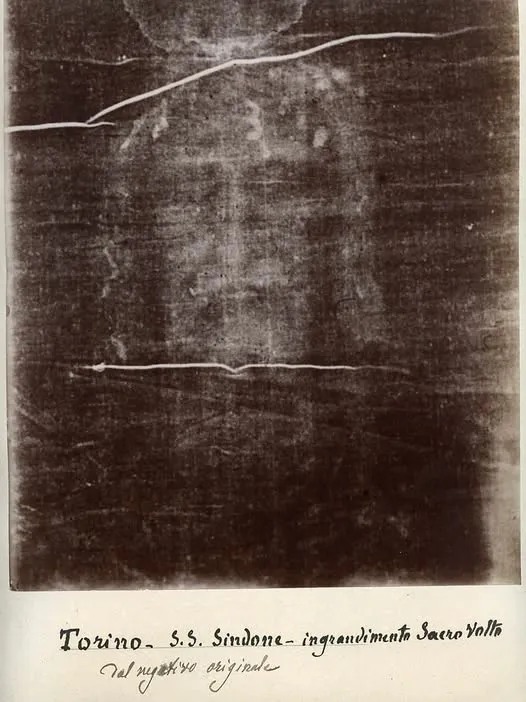
One of the most astonishing features of the Shroud is the image itself. In 1898, Secondo Pia took the first photographs of the cloth, and when he developed the negatives, the faint image on the linen suddenly appeared as a far more detailed and lifelike face. That moment transformed the discussion. The Shroud’s image functions as a photographic negative. In other words, the cloth itself contains reversed light and dark information so that the photographic negative produces a clearer and more natural-looking image than the original. That is a remarkable property for any ancient object, let alone one that predates photography by many centuries.
That alone would be difficult enough to explain, but the mystery deepens when the image is examined at the fiber level. The image is not the result of paint, dye, or pigment. It does not soak into the threads the way an artistic medium would. Instead, the discoloration exists only on the outermost surface of the linen fibers, at an almost microscopic depth. The image is so superficial that it affects only a tiny fraction of each fiber. This is one of the reasons the Shroud continues to frustrate attempts to explain it as ordinary art. Medieval artists knew how to paint cloth. They did not know how to create a full-body image with no brushstrokes, no directional application, no pigment load, and no deep penetration into the fibers.
Why the Carbon Dating No Longer Settles the Matter
For years, the main response to all of that was simple. None of it mattered, because the carbon dating had already settled the issue. In 1988, a sample taken from the Shroud was tested and dated to between AD 1260 and 1390. That result was widely reported as definitive proof that the cloth was medieval. The problem is that the sample used for the test appears not to have come from an untouched section of the original fabric. It was taken from a corner of the Shroud that had long been suspected of being part of a repaired area, especially after damage caused by the 1532 fire. If that section had been rewoven or contaminated by newer material, then the date returned by the test would tell us the age of the repair, not the age of the Shroud itself.
That is where Raymond Rogers became so important to the discussion. His analysis of fibers from the tested corner found evidence of cotton and dye not present in the main body of the cloth. In other words, the area used for the carbon dating was materially different from the rest of the Shroud. In his 2005 study, Rogers argued that the sample was taken from a rewoven section and therefore could not be trusted to represent the age of the entire cloth. That finding did not automatically prove the Shroud dated to the first century, but it did destroy the confidence with which the 1988 result had been used. The test that supposedly ended the debate was likely performed on the wrong part of the cloth.
New Dating Methods Point Much Earlier
Once that happened, the question of the Shroud’s age had to be reopened. More recent analysis has moved beyond radiocarbon dating and looked instead at the aging of the linen itself. In 2022, researchers used Wide-Angle X-ray Scattering to study the cellulose structure of the fibers. This approach measures the natural degradation of linen over time under certain conditions. Their conclusion was that the fabric was consistent with an age of roughly 2,000 years, which places it in the first-century range. That does not mean every scientist now agrees on the date, but it does mean there is now a serious scientific argument that the cloth fits the era of Jesus rather than the Middle Ages.
This matters because the older skeptical case depended heavily on one supposedly decisive test. Once that test was shown to be compromised, the discussion had to broaden. Now the conversation includes independent methods of analysis, and those methods are not pointing toward a medieval origin. They are pointing much further back.
The Forensic Evidence Fits Crucifixion
The forensic evidence is equally compelling. The stains on the Shroud have long been identified as real human blood, commonly reported as type AB, and they show chemical signs associated with severe trauma. Elevated bilirubin levels are especially significant because they are consistent with intense physical abuse. The body image also displays wounds that align closely with Roman crucifixion. There are extensive scourge marks across the back and legs. The head bears puncture wounds consistent with a crown of thorns. The nail wounds are located in the wrists rather than the palms, which fits Roman practice much better than the artistic traditions that often show nails through the hands. There is also a major wound in the side, and that wound may be one of the most important details on the entire cloth.
The significance of these injuries is not merely that they resemble Christian art. In several places, they actually cut against the assumptions of later artistic tradition. The wrist wounds are the clearest example. A forger working from conventional religious imagery would have been more likely to place the nails through the palms, because that is how crucifixion was often depicted. Instead, the Shroud preserves details that better fit Roman execution than medieval imagination.
The Side Wound Shows the Man Was Dead
The blood pattern at the side wound shows a separation between blood and a lighter fluid, often described as serum, creating a halo effect around the stain. This kind of separation is consistent with blood that has already begun to settle after death. That means the man wrapped in the Shroud was not merely wounded. He was dead when the side wound was inflicted. This detail matters because it matches the Gospel description in John 19:34, where blood and water flow from Jesus’s side after His death. It also strikes directly at theories that Jesus survived the crucifixion. The Shroud does not present the image of a man who fainted and later recovered. It presents the body of someone who suffered extreme trauma and had already died.
This is one of the reasons the Shroud matters beyond curiosity. It does not merely present a generic victim of execution. It preserves a pattern of suffering and death that aligns in striking ways with the Gospel accounts. The closer the wounds are studied, the less they look like symbolic embellishment and the more they look like the record of an actual crucified corpse.
The Pollen and Plant Evidence Points East
Another important part of the authenticity case is the botanical evidence. Pollen and plant traces found on the Shroud have been cited as evidence that the cloth spent time in the Near East rather than originating in medieval Europe. Max Frei identified pollen from species associated with the Middle East, and later work by Avinoam Danin argued that some of the floral evidence pointed specifically toward the Jerusalem area. Some of the plants identified are associated with springtime, which is noteworthy given the timing of Passover. A medieval forger in France should not have been able to place a believable Near Eastern botanical signature onto a cloth in a way that would survive scrutiny centuries later. This evidence fits naturally with the idea that the Shroud has a history rooted in the land where Jesus was crucified and buried.
This point matters because it adds another layer to the cumulative case. The Shroud does not simply look ancient. It carries signs of having been in the very part of the world where the burial of Jesus would have taken place. That does not stand alone as the only argument, but it certainly does not belong off to the side as an afterthought either.
The Historical Trail Did Not Begin in Medieval France
The historical record also becomes more interesting the closer one looks. The Shroud did not simply appear from nowhere in the fourteenth century, despite how it is often presented. Byzantine references to a cloth bearing the image of a man, especially the Image of Edessa, have led many researchers to argue that the Shroud was known earlier under another form or name. Some suggest it may have been folded in such a way that only the face was visible. That possibility would help explain why older records sometimes emphasize an image of the face without describing the full body.
On top of that, depictions of Christ in Byzantine art begin to show facial features strikingly similar to those seen on the Shroud, including elongated proportions, distinctive asymmetry, and other unusual details. That kind of continuity makes more sense if artists were working from a known image tradition rather than inventing it from scratch. The point is not that every icon proves the Shroud was there. The point is that the image tradition surrounding Christ begins to show markers that fit much better with borrowing from an existing object than with independent invention.
The Case Has Become Cumulative
Taken together, these points form a cumulative case that has become difficult to dismiss. The image remains unexplained by known medieval methods. The carbon dating once used to close the case appears to have relied on a repaired section rather than the original linen. Newer dating methods point back toward the first century. The forensic evidence matches the death of a scourged and crucified man with remarkable precision. The pollen and plant traces point eastward, not toward a medieval European workshop. The historical and artistic trail suggests the cloth, or at least knowledge of it, reaches back much earlier than skeptics once claimed.
Any one of these arguments might be challenged in isolation, but that is not how the evidence should be handled. The force of the case lies in the way these lines of evidence reinforce one another. The Shroud is difficult to dismiss not because of one dramatic fact, but because too many different facts converge in the same direction.
Conclusion
For that reason, the Shroud of Turin can no longer be honestly dismissed as a simple medieval forgery. That position depends on ignoring too much data and placing too much weight on a radiocarbon test that appears to have sampled the wrong material. Absolute proof may still remain out of reach, and caution is always appropriate when dealing with artifacts of this kind, but the overall evidence has become far more convincing than many critics are willing to admit. At this point, authenticity is not a fringe conclusion clung to by the overly devout. It is a serious and defensible reading of the evidence.
At minimum, the Shroud deserves to be treated as an ancient artifact with features that remain scientifically and historically extraordinary. At maximum, it may be the single most significant physical object associated with the crucifixion and burial of Jesus Christ ever preserved. Either way, it is no longer the easy target it once was.
Discussion Questions
- If the Shroud of Turin cannot be explained by known medieval methods, what does that imply about its origin, and why do you think that implication is resisted?
- How does the combination of forensic evidence, image properties, and historical data create a cumulative case that is stronger than any single piece of evidence on its own?
- Why is the flaw in the 1988 carbon dating so significant to the overall debate, and what does it reveal about how easily a single study can shape public perception?
- In what ways do the wound patterns and blood evidence on the Shroud align with the Gospel accounts, and why is that alignment difficult to attribute to coincidence or artistic interpretation?
- How does the possibility that the Shroud is authentic affect the way we think about the physical reality of the crucifixion and burial of Jesus, rather than treating them as purely theological claims?
Want to Know More?
- Ian Wilson, The Blood and the Shroud: New Evidence That the World’s Most Sacred Relic Is Real
Wilson is one of the best-known Shroud researchers, and this book is a major pro-authenticity work. It is especially useful for the historical trail of the Shroud, the questions surrounding the 1988 carbon dating, and the broader cumulative case for authenticity. - Kenneth E. Stevenson and Gary R. Habermas, Verdict on the Shroud: Evidence for the Death and Resurrection of Jesus Christ
This is a strong entry point for readers who want a readable but serious treatment of the forensic and apologetic significance of the Shroud. It is especially helpful for connecting the wound patterns, blood evidence, and burial details to the Gospel accounts. - Janice Bennett, Sacred Blood, Sacred Image: The Sudarium of Oviedo: New Evidence for the Authenticity of the Shroud of Turin
This book focuses on the Sudarium of Oviedo, the face cloth often discussed alongside the Shroud. It is valuable because it explores how the blood patterns and historical traditions connected to the Sudarium may reinforce the case that the Shroud preserves genuine burial evidence from the crucifixion. - Thomas de Wesselow, The Sign: The Shroud of Turin and the Secret of the Resurrection
This is a more provocative and interpretive work, but it is still an important book in the wider Shroud conversation. It is especially useful for thinking about the historical and theological impact of the artifact, not just the scientific debates surrounding it. - Fr. Robert Spitzer, Christ, Science, and Reason: What We Can Know about Jesus, Mary, and Miracles
This is broader than the Shroud alone, but it includes substantial discussion of scientific evidence connected to the Passion and Resurrection of Jesus, including the Shroud of Turin. It works well for readers who want the Shroud placed inside a larger apologetic framework rather than treated as an isolated relic question.
About the Author