Few phrases have been repeated more often in modern preaching than the claim that the Father turned away from Jesus on the cross. Many Christians treat it as if Scripture says it plainly. It is often used to stress the horror of sin and the cost of atonement. The problem is that the Bible never directly says this. Nowhere does the text state that the Father turned His face away from the Son. What Scripture actually gives us is something deeper, richer, and far more careful than the slogan that so often gets repeated.
This matters because the cross is not the place where the Trinity falls apart. It is the place where the triune God accomplishes redemption. If we speak carelessly here, we are not merely making a small interpretive mistake. We are risking language about the Father and the Son that Scripture itself does not use, and that should make us stop and slow down before we repeat what sounds familiar.
Where the Idea Comes From
The idea usually comes from an attempt to explain Jesus’ cry from the cross in Matthew 27:46 and Mark 15:34: “My God, my God, why have you forsaken me?” Many believers hear those words and immediately conclude that the Father must have literally abandoned the Son. That interpretation is then reinforced by another common statement, that God is too holy to look upon sin, so when Jesus bore the sins of the world, the Father turned away from Him.
At first glance, that may sound reverent. It seems to honor God’s holiness and the seriousness of Christ’s sacrifice. But something can sound spiritual and still go beyond the text. Scripture does not tell us that the Father stopped looking at the Son. Scripture does not tell us that fellowship within the Godhead was broken. Scripture does not say that the Father ceased to be with Christ. Those are conclusions people import into the passage, not conclusions the passage itself states. That is a major difference, especially in a doctrine as central as the cross.
A First-Century Teaching Method We Miss
One major reason this misunderstanding persists is that modern readers often miss how Scripture was commonly used in the first century. Rabbis did not always quote an entire passage word for word. It was a known and recognized practice to quote a line from a well-known text in order to draw listeners to the larger context. A single line could function as a doorway into the whole passage, because the audience knew the Scriptures well enough to follow where the speaker was taking them.
We see Jesus use this method elsewhere. In John 10:34, He quotes a single line from Psalm 82, “I said, you are gods,” and then builds His argument from the broader context of that Psalm. He does not pause to recite the whole thing. He assumes His audience knows the text and can track the point He is making. The same pattern matters at the cross. When Jesus cries, “My God, my God, why have you forsaken me,” He is not throwing out an isolated statement detached from its source. He is invoking Psalm 22.
That means the original audience would not have heard only one sentence. Their minds would have been drawn to the whole Psalm. Modern readers often do the exact opposite. We isolate the opening line, stop there, and build a doctrine on that fragment. But Jesus’ use of Scripture points us in the other direction. He is not inviting us to stop at the first verse. He is inviting us to read the whole Psalm in light of what is happening before their eyes.
Jesus Was Quoting Psalm 22
Psalm 22 is not only a lament. It is a prophetic pattern that finds its fullest expression in the crucifixion. The parallels are too strong to dismiss as accidental. The Psalm describes mockery, public humiliation, intense physical suffering, the stretching and wasting of the body, the dividing of garments, and the casting of lots. The Gospel writers clearly present Jesus’ crucifixion as the fullest realization of that pattern. This is not a case of Christians forcing a random Psalm onto the cross. The Psalm itself reaches beyond David’s immediate experience and finds its true climax in the greater Son of David.
That matters because when Jesus quotes the opening line, He is identifying Himself as the righteous sufferer of Psalm 22. He is not merely expressing pain in a vacuum. He is locating His suffering within the scriptural pattern that Psalm 22 establishes. The cry is real, the agony is real, and the suffering is real, but the quote is also interpretive. It tells the audience what kind of moment this is. Jesus is not just suffering. He is fulfilling Scripture.
Once that is clear, the popular interpretation begins to unravel. If Jesus is invoking Psalm 22 as a whole, then we do not have the right to seize on its first line while ignoring where the Psalm goes. The opening cry matters, but the rest of the Psalm matters too, and the rest of the Psalm prevents us from flattening Jesus’ words into the simplistic claim that the Father literally turned away from Him.
Psalm 22 and the Surrounding Powers
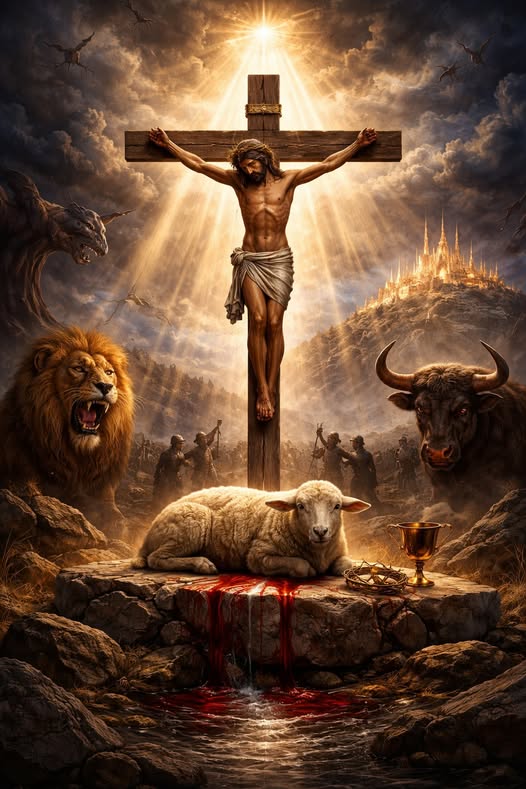
Psalm 22 also reveals that the cross is not merely an execution at the hands of human authorities. The enemies surrounding the righteous sufferer are described through vivid imagery: bulls of Bashan, roaring lions, and dogs encircle him. This is not random poetic decoration thrown in for color. In the biblical world, these images carry associations of chaos, predation, death, and hostile rule. They portray the sufferer as hemmed in by violent, beast-like opposition.
Bashan in particular is significant. Within a Divine Council Worldview, Bashan is not just a place-name with no theological weight. It carries deep supernatural associations. It is connected to the realm of the dead, to giant clans, and to territory marked by rebellion against Yahweh. So when Psalm 22 says that strong bulls of Bashan surround the sufferer, the image does more than describe a crowd of angry men. It evokes the righteous one being hemmed in by forces aligned with chaos and rebellion.
That fits the crucifixion far better than a purely flattened reading ever could. Jesus is not only being executed by Rome and handed over by corrupt human leadership. He is also confronting the deeper rebel order standing behind human rebellion. The earthly rulers are acting, but they are not acting alone. This is why Paul can say in 1 Corinthians 2:8 that the rulers of this age crucified the Lord of glory. The cross is a human event, but it is not merely human. It is also cosmic. The powers close in, thinking they are winning, when in reality they are participating in the very act that seals their defeat.
The Cry of Dereliction Was Real
None of this softens the suffering of Christ. Jesus was not quoting Psalm 22 as a detached lecturer giving a Bible study from the cross. He was living it. He experienced the horror of bearing sin, the shame of public humiliation, the curse of death, and the extremity of human suffering. Any interpretation that reduces His cry to a cold literary reference misses the depth of what He endured.
At the same time, Scripture’s own categories matter. The language of “why have you forsaken me” belongs to the language of lament. The Psalms repeatedly give voice to the experience of distance, abandonment, silence, and desperation. The righteous sufferer cries out from within real agony. That does not mean God has literally ceased to be present every time such language is used. It means that Scripture gives the faithful a way to speak honestly from the depths of affliction. Jesus, as the true righteous sufferer, speaks in that language from within the full weight of the cross.
What must be resisted is the leap from real anguish to metaphysical separation within the Trinity. Feeling forsaken and being ontologically cut off are not the same thing. Jesus is expressing the depth of His suffering, not announcing that the eternal union of Father and Son has collapsed. That distinction is not small. It is the difference between reading the cry as biblical lament and turning it into a theory that Scripture itself never states.
The Psalm Itself Rejects the Popular Claim
If Jesus is invoking Psalm 22, then Psalm 22 must be allowed to interpret His words. And when we let the Psalm speak for itself, it creates a serious problem for the common slogan. Psalm 22:24 says that God “has not despised or abhorred the affliction of the afflicted, and he has not hidden his face from him, but has heard, when he cried to him.” That is not a minor detail tucked away in the Psalm. It is one of the Psalm’s central interpretive statements.
That means the very passage Jesus invokes explicitly says that God has not hidden His face from the afflicted one. So whatever Jesus’ cry means, it cannot be flattened into the claim that the Father literally turned His face away from the Son. The Psalm itself blocks that conclusion. It gives us the language of true agony, but it also gives us the assurance that God has not abandoned the righteous sufferer.
This is exactly why the first-century teaching method matters. Jesus gives the opening line to draw His hearers into the whole Psalm. The Psalm then interprets the moment properly. If we quote the first line and ignore the rest, we end up saying the opposite of what the Psalm itself says. That is not honoring Jesus’ use of Scripture. That is overriding it.
The Father and the Son Were Not Divided
There is also a theological line we cannot afford to cross. The Father, Son, and Holy Spirit are perfectly united. The cross does not introduce a rupture within the Godhead. It reveals the unified work of God in redemption. If we say the Father literally abandoned the Son in the sense many people mean, then we are no longer talking about the Son bearing wrath within the saving plan of God. We are talking about some kind of fracture within the Trinity itself.
Scripture does not give us that picture. In John 16:32, Jesus says that His disciples will scatter and leave Him alone, yet He is not alone, because the Father is with Him. The disciples abandon Him, but the Father does not. Nothing in the crucifixion narratives requires us to reverse that statement and imagine that at the crucial moment the Father also departs. Second Corinthians 5:19 moves in the same direction when Paul says that God was in Christ reconciling the world to Himself. That is not the language of divine absence. It is the language of divine action, divine presence, and divine purpose.
So the cross is not the place where the Father ceases to love the Son or where the unity of the Trinity collapses. It is the place where the Father sends, the Son obeys, and redemption is accomplished in perfect harmony with the will of God. The suffering is real, the judgment is real, and the sacrifice is real, but divine disunity is not part of the biblical picture.
Bearing Sin Without Becoming Sinful
Some of the confusion here comes from the biblical language that Christ became sin for us and became a curse for us. Those are strong statements, and they should be. But they are judicial and representative statements, not statements that Jesus became morally corrupt or personally hateful to the Father. He bore guilt as the sin bearer. He carried judgment as the covenant representative of His people. He stood in the place of sinners, but He did not become a sinner in His character.
That distinction matters because popular preaching often drifts into language that suggests the Father looked at the Son and saw something morally repulsive. Scripture never speaks that way. The Son remained the spotless Lamb, the obedient Son, the faithful Messiah. The cross is not the moment when Jesus becomes unworthy of the Father’s presence. It is the moment when the Son’s obedience reaches its fullest expression as He carries out the Father’s saving mission to the uttermost.
This is why passages such as Philippians 2 are important. Christ became obedient unto death, even death on a cross. That obedience was not met with the Father’s disgust toward His person. It was the path through which redemption was accomplished. The Son is not rejected as personally defiled. He is offering Himself in obedient, sacrificial love.
The Victory Hidden in the Psalm
Psalm 22 does not end in despair. It ends in vindication, worship, and the restoration of the nations. The afflicted one is heard. Deliverance comes. Then the ends of the earth remember and turn to Yahweh, and the families of the nations worship before Him. That movement is crucial, because it shows that the Psalm is not merely about private pain. It is about suffering that leads to worldwide proclamation and divine kingship over the nations.
That fits the cross perfectly. What looks like defeat is actually the turning point of history. The rebel powers close in on the righteous one, but their apparent victory becomes the means of their downfall. The suffering of the Messiah opens the way not only for individual forgiveness, but for the reclamation of the nations. Within a Divine Council framework, that matters enormously. The nations long associated with corrupt rule and spiritual rebellion are being brought back under Yahweh’s kingship through the obedient suffering of His Messiah.
So Psalm 22 is not only crucifixion-shaped. It is kingdom-shaped. It moves from agony to vindication, from encirclement by hostile powers to worldwide acknowledgment of Yahweh’s rule. That is why Jesus’ use of the Psalm is so important. He is not merely saying that He feels abandoned. He is identifying the cross as the moment when the righteous sufferer endures the assault of the rebel order and emerges as the one through whom the nations will be restored.
Why This Matters
This is not a minor wording issue. The way we speak about the cross shapes the way people imagine God. If we say the Father turned away from Jesus, many believers will picture the Son becoming unlovable, the Father withdrawing in revulsion, and the Trinity somehow fracturing at Calvary. That is not the picture Scripture gives. It may be emotionally dramatic, but it is not biblically careful.
But if we let Psalm 22, the teaching methods of Jesus’ day, and the theology of the Trinity guide us, the scene becomes much clearer. The righteous sufferer is surrounded by hostile human and spiritual powers. He cries out in real anguish from the depths of covenantal suffering. Yet God has not abandoned Him. The Father remains with the Son. The cross is not divine fracture, but divine victory. It is the place where God in Christ confronts sin, bears judgment, defeats the rebel powers, and begins the restoration of the nations.
That is not a weaker view of the cross. It is a fuller one, a more scriptural one, and a more glorious one. It preserves the horror of the moment without forcing onto the text an idea the text itself does not teach.
Conclusion
The claim that the Father turned away from Jesus goes beyond what Scripture actually says. Jesus’ words from the cross are not an isolated statement meant to stand by themselves. They are a deliberate quotation meant to draw His hearers into Psalm 22 as a whole, much like His use of a single line from Psalm 82 draws His audience into the larger context of that passage. Once Psalm 22 is allowed to interpret the moment, the popular slogan begins to fall apart.
Psalm 22 prophetically frames the crucifixion, describes the righteous sufferer surrounded by hostile powers, and explicitly says that God did not hide His face from the afflicted one. At the cross, Jesus bears sin, endures judgment, and experiences real anguish, yet the Father does not abandon Him and the unity of the Trinity is not broken. The cross is not the moment when God turns away from the Son. It is the moment when God, in Christ, confronts sin, defeats the rebel powers, and begins the restoration of the nations.
Discussion Questions
- When Jesus quotes “My God, my God, why have you forsaken me,” how does understanding the first-century practice of quoting a single line to reference an entire passage change how we interpret His words?
- Psalm 22:24 says that God did not hide His face from the afflicted one. How does that verse challenge the common teaching that the Father turned away from Jesus on the cross?
- What is the difference between Jesus feeling forsaken in His suffering and the idea that the Father actually abandoned Him? Why does that distinction matter theologically?
- How does the imagery of the bulls of Bashan, lions, and dogs in Psalm 22 deepen our understanding of what was happening at the cross beyond just a human execution?
- If the cross is not a moment of division within the Trinity but a unified act of redemption, how should that reshape the way we talk about and teach the crucifixion?
Want to Know More?
- Michael S. Heiser, The Unseen Realm: Recovering the Supernatural Worldview of the Bible
Heiser lays out the Divine Council Worldview in a clear and accessible way, explaining how spiritual powers, geography like Bashan, and the rebellion of the nations shape the biblical story. This is especially helpful for understanding how Psalm 22 can operate on both human and cosmic levels at the same time. - John Goldingay, Psalms, Volume 1: Psalms 1–41 (Baker Commentary on the Old Testament Wisdom and Psalms)
Goldingay provides a careful and text-driven treatment of Psalm 22, walking through its structure, original context, and theological meaning. This helps ground the discussion in what the Psalm actually says instead of relying on popular assumptions about it. - Richard Bauckham, Jesus and the Eyewitnesses, 2nd ed.: The Gospels as Eyewitness Testimony
Bauckham strengthens confidence in the Gospel accounts as rooted in eyewitness memory. This is important for showing that the crucifixion details that align with Psalm 22 are not forced connections, but historically grounded events preserved by those who were there. - N. T. Wright, The Day the Revolution Began: Reconsidering the Meaning of Jesus’s Crucifixion
Wright explores the cross within the larger biblical story of covenant and kingdom. While readers may not agree with every conclusion, the book is valuable for seeing the crucifixion as a cosmic and redemptive event, not just an isolated moment of suffering. - Jeremy R. Treat, The Crucified King: Atonement and Kingdom in Biblical and Systematic Theology
Treat connects atonement and kingdom themes, showing how the cross is both the means of forgiveness and the moment where God’s reign breaks into the world. This aligns well with the lesson’s emphasis on the cross as victory over the rebel powers and the beginning of the restoration of the nations.
About the Author