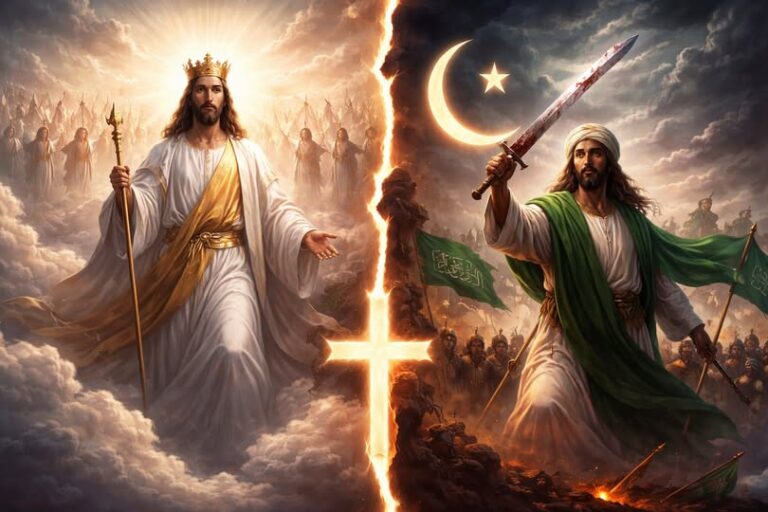
Many religious systems claim divine origin, but Scripture does not treat all such claims as equal. The Bible establishes clear patterns for how God gives law, how revelation functions, and how divine authority is expressed through covenant, worship, and holiness. When those patterns are absent or reshaped, the issue is not merely theological disagreement but legitimacy. The question is not whether a system claims to come from God, but whether it bears the marks of divine revelation as God has actually revealed it.
In the biblical worldview, divine law is never experimental, provisional, or gradually enforced. When Yahweh gives law, it is immediately binding, covenantal in nature, and aimed at guarding allegiance to Him against rival spiritual powers. These patterns form the standard by which later claims of divine instruction must be evaluated, not according to usefulness or sincerity, but according to coherence with what Scripture itself presents as divine action.
Kosher Law as Genuine Divine Legislation
Kosher law is covenantal legislation given directly by Yahweh to Israel as part of the Mosaic covenant. The dietary laws of Leviticus and Deuteronomy are inseparable from the Temple, priesthood, sacrificial worship, and ritual purity system that governed Israel’s relationship with God. These laws were not designed to improve health or regulate behavior in isolation. They existed to enforce holiness and to prevent Israel from participating in pagan religious systems.
In the Ancient Near East, food was never neutral. Eating was covenantal and often sacrificial. To share a meal was to share allegiance, and many animals prohibited under kosher law were associated with foreign cults, funerary rites, or chaos symbolism. By regulating Israel’s diet, Yahweh was regulating Israel’s worship. Kosher law functioned as a daily rejection of idolatry and a constant reinforcement of loyalty to Yahweh. It is immediately binding, theologically grounded, and stable within its covenantal framework, which is precisely how divine law functions in Scripture.
Halal as Selective Inheritance and Reduction
Islam does not present halal dietary rules as a new covenantal system. Instead, it frames them as a continuation or restoration of earlier revelation given to the People of the Book, placing halal downstream from kosher law rather than alongside it as an independent act of revelation. This framing matters because it already concedes dependence rather than originality.
Halal mirrors kosher boundaries at key points. Pork and blood are forbidden, and ritual slaughter is required, but these are inherited prohibitions rather than original theological categories. Where halal differs, it does so through simplification. Entire classifications of clean and unclean animals disappear, and there is no Temple, no priesthood, no sacrificial system in operation, and no theology of ritual purity comparable to Leviticus. What remains is a reduced rule set detached from the covenantal framework that originally gave those boundaries meaning.
As a result, halal regulates permissibility rather than holiness and functions primarily as an identity marker for the ummah. Its theological target is no longer paganism but Christianity, which explains why the law retains biblical language while abandoning biblical structure. The form is borrowed, but the function is changed.
Islam and the Repurposing of Biblical Figures
This pattern extends beyond dietary law into theology. Islam repeatedly affirms biblical figures while redefining them in ways that directly negate Christian doctrine. Abraham is reframed primarily as a proto-Muslim rather than as the covenant bearer through whom the messianic promise would come. Moses is affirmed as a lawgiver, but his law is reduced and reinterpreted. Jesus is acknowledged as a prophet but stripped of divinity, crucifixion, resurrection, and authority.
The method is consistent. The figure is retained to borrow legitimacy, but the meaning is altered to deny the fulfillment of revelation in Christ. This is not continuity with biblical theology but theological counter-programming that preserves familiarity while redirecting allegiance.
Within a biblical Divine Council worldview, this pattern is expected. Rebellious spiritual powers do not create truth independently. They reuse and distort what Yahweh has already revealed, redirecting worship while maintaining recognizable forms.
The Words of Wisdom in Historical Context
The Words of Wisdom did not emerge in a theological vacuum. It arose in early nineteenth-century America during a period saturated with health reform, temperance activism, and moral hygiene movements. These movements promoted abstinence from alcohol, tobacco, coffee, and tea, often framing them as substances that weakened moral character, clouded judgment, or undermined social order. Such ideas were widely circulated through pamphlets, lectures, and reform societies well before the founding of the LDS movement.
Within this cultural environment, the Words of Wisdom appear not as a confrontation with idolatry or pagan worship, but as an adoption of prevailing reformist concerns. Its list of prohibited substances closely mirrors those targeted by contemporary temperance advocates rather than categories derived from Scripture. Notably, it does not prohibit practices the Bible consistently associates with moral failure, such as gluttony, exploitation, or feasting tied to idolatrous rites. The focus is selective, culturally specific, and disconnected from biblical holiness categories.
The text itself reinforces this framing by explicitly introducing its guidance as not given by commandment or constraint, describing it as counsel adapted to human weakness rather than binding divine law. In Scripture, divine law is never introduced this way. When Yahweh gives law, it is grounded in covenant, holiness, and worship from the outset, not offered as optional advice.
Over time, however, the function of the Words of Wisdom shifts dramatically. What begins as non-binding counsel becomes enforced as a requirement for temple access and a measure of personal worthiness. This evolution does not reflect biblical patterns of revelation, where clarification may occur, but categories do not change. God does not give advice that later becomes mandatory obedience through institutional policy. That trajectory reflects organizational development rather than divine command.
LDS Repurposing of Biblical Figures
The LDS movement follows the same repurposing pattern seen in Islam. Biblical figures are retained but redefined to support a new theological system. Adam becomes a cosmic priest figure within an expanded cosmology. Abraham is reframed primarily as a model for exaltation rather than as the bearer of the messianic promise. Moses becomes a precursor to modern prophets rather than a unique covenant mediator.
Most significantly, Jesus is affirmed in name while His finished work is functionally denied. His atonement is redefined as incomplete without ongoing ordinances, temple rituals, and obedience to LDS authority structures. Biblical language is preserved, but biblical meaning is altered, allowing familiarity to mask theological departure.
Divine Law vs. Imitation Systems
Kosher law stands alone as genuine divine legislation because it is covenantal, immediately binding, theologically grounded, and aimed at preventing pagan worship and enforcing holiness. Halal and the Words of Wisdom both claim divine origin but fail the same tests. Both borrow from existing biblical structures, remove the covenantal theology that gives those structures meaning, and repurpose boundaries as identity markers or institutional controls.
Both Islam and the LDS movement retain biblical figures while redefining them to counter Christian claims. This pattern is not accidental. It reflects a consistent strategy of imitation that preserves form while altering substance, allowing counterfeit systems to appear continuous while denying fulfillment.
Conclusion
Scripture shows us how God gives law and how He reveals Himself, and those patterns are neither vague nor flexible. Kosher law fits those patterns precisely because it is rooted in covenant, directed toward holiness, and designed to prevent assimilation into rival systems of worship. Halal and the Words of Wisdom, by contrast, reproduce selected elements of biblical structure while discarding the theological engine that made those elements necessary in the first place. In both cases, the result is not restoration but reduction, where boundaries remain but purpose is lost.
Likewise, the repurposing of biblical figures in Islam and LDS theology follows the same trajectory. Familiar names are retained, but their roles are redefined to deny the culmination of revelation in Christ. When measured against the biblical standard, this is not how divine revelation develops. It is how imitation functions. The distinction between divine law and counterfeit authority is therefore not a matter of tone or polemic, but of coherence with Scripture itself, which provides the criteria by which all claims of revelation must be judged.
Discussion Questions
- What specific features distinguish divine law in Scripture from later systems that merely claim divine origin, and why do those features matter for evaluating legitimacy rather than sincerity?
- How does kosher law’s direct confrontation with pagan worship help explain why biblical dietary laws are covenantal and theological rather than health-based or cultural?
- In what ways do halal dietary rules demonstrate dependence on kosher law, and how does the removal of covenantal context change the function of those rules within Islam?
- How does the repurposing of biblical figures in both Islam and LDS theology follow the same counterfeit pattern, and why is redefining meaning more effective than outright rejection?
- Why does Scripture portray rebellious spiritual powers as imitators rather than creators, and how does that framework help explain the similarities between counterfeit religious systems and biblical revelation?
Want to Know More
- Jacob Milgrom, Leviticus 1–16
Milgrom’s commentary is foundational for understanding Levitical law as covenantal theology rather than hygiene or symbolism. He demonstrates how dietary restrictions, purity laws, and sacrificial regulations function together to enforce holiness and to prevent Israel from participating in pagan worship practices common throughout the Ancient Near East. - Joel Richardson, When a Jew Rules the World
Richardson documents how Islam appropriates biblical figures, laws, and expectations while redefining them in ways that directly counter Christian doctrine, particularly regarding Jesus, authority, and eschatology. This work supports the lesson’s analysis of imitation and counterfeiting rather than independent revelation. - Gabriel Said Reynolds, The Qur’an and the Bible
Reynolds offers a rigorous academic analysis of how the Qur’an reuses, reshapes, and reinterprets biblical figures, narratives, and laws. This work is essential for documenting Islam’s dependence on earlier Jewish and Christian material and for understanding how biblical figures are repurposed to negate Christian theology while maintaining the appearance of continuity. - Michael S. Heiser, The Unseen Realm
Heiser’s Divine Council framework explains why Scripture portrays rebellious spiritual powers as counterfeiters rather than creators. This theological lens helps explain why later religious systems reuse biblical laws and figures while stripping them of covenantal meaning and redirecting allegiance. - Grant H. Palmer, An Insider’s View of Mormon Origins
Palmer provides a historically grounded analysis of early LDS doctrinal development, including the evolution of the Words of Wisdom and the repurposing of biblical figures. His work documents how institutional enforcement replaced revelation over time, reinforcing the distinction between divine law and human construction.
About the Author