Some Latter-day Saint discussions of eternal progression appeal to early Christian language about deification to suggest continuity with ancient Christianity. The claim is not usually that LDS exaltation is identical to historic theosis, but that Christianity once held a more expansive view of human glorification that was later diminished or obscured, and that Joseph Smith restored it. That appeal makes the King Follett Discourse a critical point of evaluation, because it is one of the clearest moments where Smith articulates his understanding of God, humanity, and exaltation in explicit metaphysical terms. If continuity exists, it must survive comparison at that level rather than at the level of shared vocabulary.
Christianity has always taught glorification. The disagreement is not over whether humanity is destined for glory, but over what kind of glory Scripture actually describes and whether that destiny preserves the Creator–creature distinction that historic theosis consistently maintains.
What Biblical Theosis Is and Is Not
Biblical theosis is not the absorption of humanity into God or the elevation of humans into deity. It is participation in God’s life by grace while remaining eternally a creature. The New Testament speaks freely of union, transformation, and inheritance, yet it never treats these realities as a collapse of being. God remains uncreated, self-existent, and sovereign, while redeemed humanity remains created, dependent, and upheld by God’s will.
When Peter speaks of believers becoming partakers of the divine nature, he does so in the context of moral transformation and escape from corruption through God’s promises, not the acquisition of deity. Paul frames glorification as adoption and inheritance received through Christ, not promotion into divine status. Jesus prays for a real and intimate unity between God and His people, but that unity is modeled on obedience, love, and shared holiness rather than ontological leveling. Even Revelation, which presents the saints reigning with Christ, preserves Christ as the unique Lord who is enthroned, worshiped, and unrivaled.
Historic Christian theology, including the strongest Eastern formulations of theosis, preserves this boundary with care. Union does not erase distinction. Participation does not become identity. Theosis magnifies God precisely because it preserves worship, grounding intimacy in grace rather than metaphysical equality.
What the King Follett Discourse Actually Claims
The King Follett Discourse moves in a different direction. In that sermon, Joseph Smith teaches that God the Father was once as humans are and progressed to godhood, and he presents human exaltation as the possibility of becoming as God is. This is not merely an affirmation that humans will be glorified, made holy, or brought into communion with God. It is a claim about God’s own past and about the attainability of godhood itself. God is no longer described as eternally uncreated, but as a being who advanced within an existing order of reality.
The discourse also asserts that the human soul or intelligence cannot be destroyed. This is not framed simply as a statement about God’s mercy or moral restraint, but as a claim about the nature of the soul itself. The implication is that even God does not possess the authority to annihilate it. At that point, the biblical framework of contingency begins to unravel. If the soul is metaphysically indestructible, then created existence is no longer entirely dependent on God’s sustaining will, and a form of inherent permanence is placed within the creature that is not presented as a gift granted by God.
Indestructibility and the Loss of Creaturely Dependence
Scripture consistently presents a different account of reality. God alone has life in Himself. All other life is derived, sustained, and upheld by Him. Immortality is something humans seek and receive through Christ, not something they possess by nature. Resurrection is an act of God, not the inevitable continuation of an indestructible soul. When everlasting life is promised, it is promised as a gift, grounded in union with Christ, not as a metaphysical guarantee independent of God’s will.
Once the soul is treated as indestructible by nature, exaltation inevitably shifts from grace to progression. Glorification ceases to be God’s act toward dependent creatures and becomes advancement within a system where beings already possess eternal status in some form. Theosis speaks the language of gift, communion, and transformation. Eternal progression, as articulated in the King Follett Discourse, speaks the language of ascent, development, and attainment.
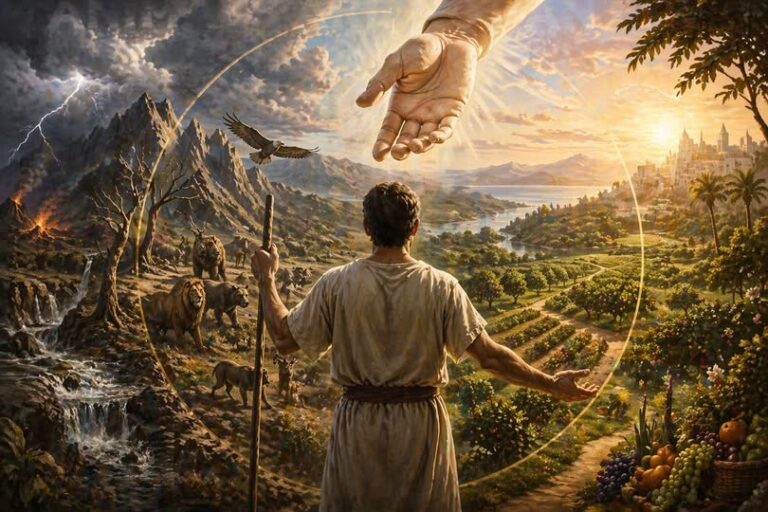
Eden Revisited
Genesis 3 is not simply about forbidden knowledge. It is about unauthorized ascent and the rejection of dependence. The serpent promises godlikeness without obedience, knowledge without submission, and life without the finality of death. “You will be like God” and “you will not die” are not incidental phrases. They define the temptation.
When godhood is presented as attainable within the same category as God’s own status, and when death is reframed so that the creature’s existence is never truly at stake, the structure of that temptation returns, even if the vocabulary is theological rather than mythic. The King Follett Discourse does not quote the serpent, but it echoes the same logic.
Christ as the Counter-Pattern
The New Testament presents a radically different pattern in Christ Himself. Jesus is not a man who ascends into godhood. He is the eternal Son who descends into humility, obedience, and suffering. He does not grasp authority. He empties Himself. He submits to the Father’s will and is exalted by the Father precisely because He does not seize.
Christian glorification follows that arc. Believers are united with Christ in His death and resurrection, transformed by grace, and raised to share in His reign as redeemed creatures, not as gods who replicate divine authority. The path to glory runs through dependence, obedience, and resurrection, not metaphysical promotion.
Conclusion
Christian theosis has always insisted that the line between Creator and creature is not an obstacle to intimacy with God but the very condition that makes grace possible. God remains God, and humanity is glorified precisely because it does not become God. Worship remains meaningful because divine life is shared by grace rather than duplicated by nature.
The King Follett Discourse crosses that line. By portraying God as a being who once progressed to godhood and by treating the human soul as metaphysically indestructible, it reframes exaltation as advancement within an eternal system rather than communion with the uncreated God. Immortality becomes inherent rather than bestowed, and godhood becomes the end of human destiny rather than union with God through Christ.
That shift does not restore an ancient Christian doctrine. It replaces it. In doing so, it returns to the oldest temptation humanity ever faced, godlikeness without dependence, glory without gift, and life without submission. Christianity rejects that promise not because it limits human destiny, but because it guards the truth that makes genuine communion with God possible at all.
Discussion Questions
- How does historic Christian theosis maintain the Creator–creature distinction while still affirming genuine participation in God’s life, and why is that distinction essential for preserving worship and grace?
- In what ways does the King Follett Discourse redefine the nature of God and the human soul, and how do those redefinitions reshape the meaning of exaltation and salvation?
- Why does treating the human soul as metaphysically indestructible change the biblical understanding of dependence on God, and how does this shift affect the concept of immortality as a gift rather than an inherent possession?
- How does the serpent’s promise in Genesis 3 function as a pattern for later theological systems, and where do you see structural similarities between that temptation and the logic of eternal progression as articulated in the King Follett Discourse?
- How does Christ’s pattern of descent, obedience, and exaltation in Philippians 2 challenge theological models that frame human destiny primarily in terms of ascent, progression, or attainment?
Want to Know More
- Norman Russell, The Doctrine of Deification in the Greek Patristic Tradition
This is one of the most authoritative academic treatments of theosis in the early Church. Russell carefully traces how deification language developed in Greek Christianity while preserving the Creator–creature distinction, making it especially useful for contrasting historic theosis with later systems that collapse that boundary. - Vladimir Lossky, The Mystical Theology of the Eastern Church
Lossky provides a classic Eastern Orthodox articulation of theosis that emphasizes participation by grace without ontological confusion. His work is essential for understanding how strong deification language functions within a rigorously maintained doctrine of God. - Michael J. Christensen and Jeffery A. Wittung (eds.), Partakers of the Divine Nature: The History and Development of Deification in the Christian Traditions
This edited volume surveys deification across Eastern and Western Christianity, showing both continuity and limits within historic theology. It is particularly helpful for demonstrating that Christian traditions can speak boldly about participation without ever teaching godhood. - Joseph Smith, Teachings of the Prophet Joseph Smith, compiled by Joseph Fielding Smith
This is a primary LDS source that preserves the King Follett Discourse and related teachings. Using this volume avoids caricature and allows Joseph Smith’s own words to define LDS claims about God, the soul, and exaltation. - Terryl L. Givens, Wrestling the Angel: The Foundations of Mormon Thought—Cosmos, God, Humanity
Givens offers a sophisticated LDS theological presentation that situates the King Follett ideas within a broader cosmology. While sympathetic to Mormon theology, the book clearly articulates the metaphysical commitments that distinguish eternal progression from historic Christian theosis, making it valuable even for critical comparison.
About the Author