The idea of intelligent life beyond Earth has long stirred imaginations. From ancient myths to modern science fiction, humanity has wondered whether we are alone in the cosmos. In recent years, as scientific exploration of the universe has expanded, some have begun asking whether the discovery of extraterrestrial life, particularly intelligent life, would undermine the Christian faith. But a careful look at Scripture reveals that the existence of aliens, should they be discovered, would pose no theological threat to the Bible’s message or its view of humanity’s place in creation.
The Bible Is Not Earth-Centric, But God-Centric
One of the most common objections raised is that the Bible appears to be focused exclusively on Earth, implying that nothing else matters. But this misunderstands the nature of Scripture. The Bible is not a comprehensive account of everything God created; it is a covenantal history focused on humanity’s relationship with God. It tells the story of redemption, not cosmological trivia.
Genesis 1:1 begins, “In the beginning, God created the heavens and the earth.” This phrase includes all of reality—everything in the skies, space, and the earth beneath. The Bible affirms God as the Creator of all things, not just our planet. Psalm 8 marvels at the moon and stars, recognizing them as works of God’s hands. Colossians 1:16 says that “by Him all things were created, in heaven and on earth, visible and invisible.” If life exists elsewhere in the universe, it is because God created it.
Humanity’s Unique Role: Imagers of God in Material Creation
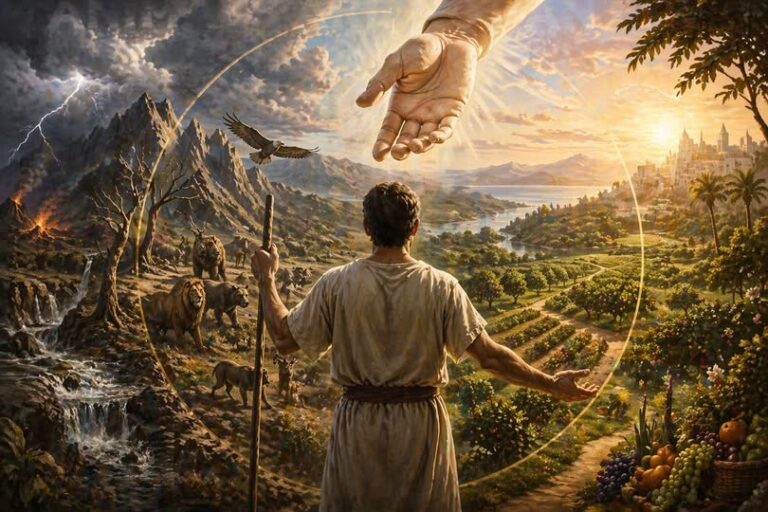
While the Bible allows for a broad and awe-inspiring creation, Earth does hold a unique distinction. It is where Yahweh chose to make His imagers in the material realm.
Genesis 1:26–27 declares that mankind was made “in the image of God.” This is not simply about intelligence, emotion, or creativity. It is about vocation. Humans were appointed as God’s representatives to steward and govern physical creation. Earth is the stage on which this divine image-bearing role unfolds.
No other creature, on this planet or potentially others, is ever described in Scripture as bearing this specific status. That doesn’t mean others don’t exist, or even that they aren’t intelligent or moral. But it does mean that the biblical narrative centers on humanity because of this appointed role. Psalm 115:16 says, “The heavens are the Lord’s heavens, but the earth He has given to the children of man.” The Earth is humanity’s realm, assigned by God as a sacred responsibility.
This doesn’t diminish God’s sovereignty over the cosmos, nor does it exclude the existence of other beings. It simply establishes Earth as the unique stage of human image-bearing and redemption.
The Divine Council and the Idea of Non-Human Intelligences
Long before discussions of aliens, the Bible already affirmed the existence of intelligent non-human beings: angels, seraphim, cherubim, the “host of heaven,” and the divine council (Psalm 82, Job 1–2, 1 Kings 22). These are not metaphors but actual entities who serve roles in the cosmic order.
If God created a vast array of spiritual intelligences, it is not a stretch to imagine He could also create other physical intelligences. In fact, the concept of other beings with roles, purposes, and relationships to God is already embedded in the biblical worldview. They are not all saved, nor are they all fallen. This opens the door to imagining how other alien species, if they exist, might fit within a similar moral and relational framework with their Creator.
Adam’s Race and the Scope of Redemption
Some worry that the Bible’s doctrine of salvation, centered on Jesus as the incarnate Son of God, would be undermined if there were intelligent alien species. But Scripture never claims that Jesus’s work applies universally to all created beings in the exact same way. Hebrews 2:16 states that Christ came to help “the offspring of Abraham,” not angels or other beings. Romans 8:20–22 says all creation groans under corruption, but that does not necessarily mean every creature in the universe shares Adam’s fallen nature.
It is entirely possible, Biblically, that other intelligent races exist without being part of Adam’s story. They may be unfallen. They may have their own redemptive narratives. Or they may exist simply to glorify God in their own way. Scripture is silent on this issue, not because it denies the possibility, but because it is not relevant to our covenantal history.
God’s Sovereignty Over All Creation
Psalm 24:1 declares, “The earth is the Lord’s and the fullness thereof, the world and those who dwell therein.” But this is not a limitation. It is a statement of divine ownership. Psalm 103:19 further says, “The Lord has established His throne in the heavens, and His kingdom rules over all.” God’s reign is not confined to human affairs. He is the King of the cosmos.
If alien civilizations exist, they too are under His sovereignty. Their presence would simply expand our understanding of the breadth of God’s creativity and kingship. It would not diminish our value or story but would highlight the grandeur of His works.
Theological Humility and Cosmic Awe
Finally, the possibility of intelligent extraterrestrial life should lead to wonder, not fear. Theologians like C.S. Lewis explored this idea with reverence. In his Space Trilogy, Lewis imagined other unfallen worlds and suggested that Earth might be the exception, a rebel planet in need of rescue.
Far from contradicting the Bible, such ideas invite humility. Just as Job was humbled by God’s interrogation about the cosmos (Job 38–41), so too should we respond to discoveries with awe and reverence. We may not be the center of the universe, but we are deeply loved by the One who made it all.
Conclusion
The Bible does not need to be rewritten if aliens are discovered. It already allows for a complex universe full of unseen realities and non-human intelligences. What matters most is not whether we are alone, but that we are known, deeply and redemptively, by our Creator.
Earth is unique because it was chosen as the realm of God’s imagers, but that uniqueness does not exclude the existence of others. It simply magnifies the mystery and majesty of the One who made us all.
Discussion Questions
- Why do some Christians fear the possibility of alien life, and what biblical assumptions underlie that fear?
- How does the existence of non-human spiritual beings in the Bible prepare us to consider the possibility of intelligent aliens?
- Would alien life need redemption in the same way humans do? Why or why not?
- What does it mean for humans to be imagers of God in material creation, and how might that differ from other intelligent life?
- How does the vastness of the universe reflect the glory of God and challenge human-centered pride?
Want to Know More?
- Michael S. Heiser, The Unseen Realm: Recovering the Supernatural Worldview of the Bible
A foundational work on the biblical concept of the divine council and non-human intelligences, framing a cosmic context that accommodates spiritual and possibly extraterrestrial beings. - C. S. Lewis, Out of the Silent Planet
The first book in Lewis’s Space Trilogy, this fictional work explores a universe where some intelligent worlds remain unfallen, offering theological reflection through narrative. - Paul Thigpen, Extraterrestrial Intelligence and the Catholic Faith: Are We Alone in the Universe with God and the Angels?
A thoughtful Catholic examination of how intelligent alien life could fit within Christian theology without undermining core doctrines. - David Wilkinson, Science, Religion, and the Search for Extraterrestrial Intelligence
A physicist and theologian addresses the relationship between scientific pursuit of alien life and the religious implications, with a special focus on Christian thought. - Jeff Zweerink, Is There Life Out There?
Written by an astrophysicist with Reasons to Believe, this book explores how a Christian worldview can thoughtfully engage with the possibility of extraterrestrial life.
About the Author